
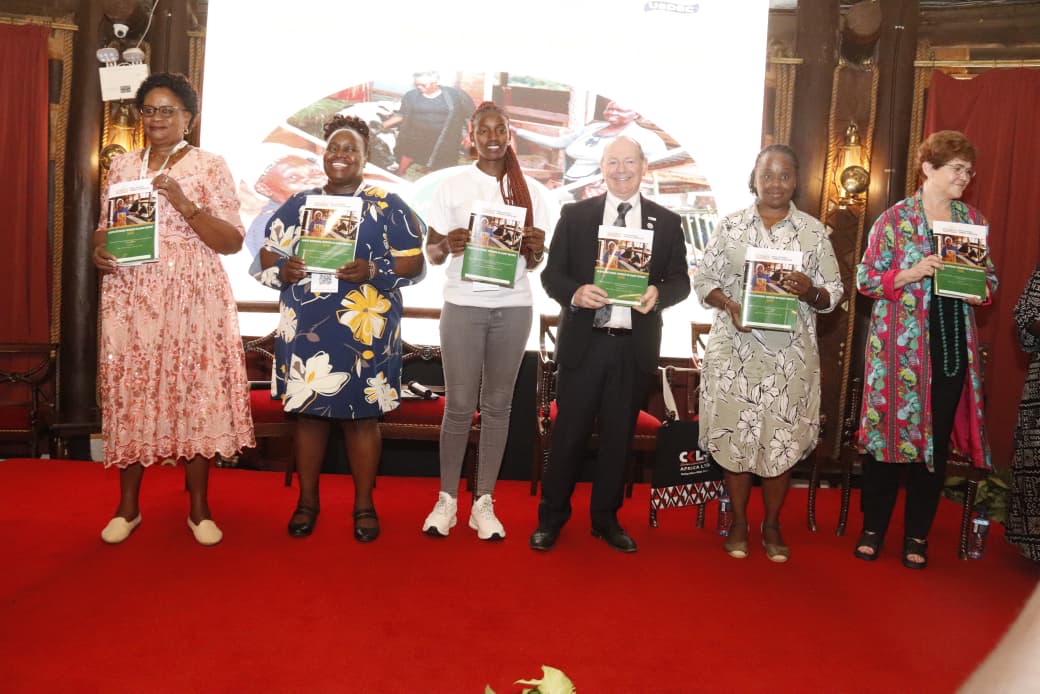
KENAFF Launches Women in Dairy Report as Study Exposes Leadership and Land Gaps in Sector
By Peace Muthoka
NAIROBI, June 10, 2026 — The Kenya National Farmers Federation (KENAFF), in partnership with the United States Dairy Export Council (USDEC), has launched the Women in Dairy Report 2026, unveiling both the growing influence of women in Kenya’s dairy sector and the deep-rooted barriers still limiting their full participation.
The report, launched on Wednesday as part of efforts to mark 2026 as the Year of the Woman Farmer, highlights women as the backbone of dairy farming in Kenya while raising concern over low leadership representation, limited land ownership and barriers to accessing finance.
Although women account for the majority of labour and cooperative membership in dairy farming, the findings reveal that many still struggle to fully benefit from the sector they help sustain.
Speaking during the launch, lead researcher Nancy Rapando of the Africa Centre for Climate, Food and Nature said the study was commissioned by KENAFF to profile the role of women as key players in Kenya’s dairy value chain and to understand the opportunities and challenges shaping their participation.
Rapando said the research focused on five key milk-producing counties — Kiambu, Meru, Uasin Gishu, Nakuru and Nyandarua — selected because of their strong dairy potential. However, the study concentrated on high-potential dairy regions and excluded pastoral areas.
She noted that while Kenya has established policies supporting gender empowerment, the findings revealed a disconnect between policy and reality, particularly in leadership and ownership spaces.
According to the report, women make up nearly 86 percent of membership in dairy cooperatives, underscoring their critical role in production and milk marketing. Despite this dominance, however, only about 30 percent occupy leadership positions within cooperatives.
Rapando said the imbalance means many women remain heavily involved in production but have little say in decisions affecting the sector.
“Women are participating significantly, but their leadership representation remains low,” she said, adding that stronger inclusion in leadership structures would help women influence decisions on financing, markets and development programmes.
At the same time, the report found that women’s financial independence in dairy farming remains complicated despite signs of progress.
While many women reported having greater control over dairy income, researchers discovered that payments are often processed through mobile money accounts registered under husbands or male family members. As a result, the report raises questions about whether women have complete financial autonomy over earnings generated from dairy farming.
Rapando explained that although the sector is witnessing positive changes, existing household systems still appear to shape how income is managed.
The study further identified land ownership as one of the biggest barriers to women’s advancement in dairy farming.
Only 23 percent of women interviewed reported owning title deeds in their names, limiting their ability to make long-term investments or secure financing. Others depended on jointly owned land or had no ownership rights at all.
Researchers noted a strong connection between land ownership and women’s empowerment, particularly in Nakuru County, which recorded higher levels of women holding land titles.
According to Rapando, Nakuru’s progress can largely be linked to supportive county policies that intentionally promote women’s economic empowerment.
She pointed to gender-responsive procurement systems, targeted financing programmes and deliberate support for women groups as some of the measures encouraging greater participation.
Additionally, some financial institutions have introduced dairy financing packages designed specifically to support women farmers, making it easier for them to invest in dairy enterprises.
“When support systems exist, women are empowered to invest more confidently in assets such as land and dairy production,” Rapando said.
The report drew insights from nearly 200 women affiliated with KENAFF-supported cooperatives. Researchers clarified that the exercise was not a national census but a representative study aimed at understanding women’s participation and experiences in selected dairy-producing regions.
Even so, the findings are expected to shape conversations around agricultural reforms and gender inclusion within the dairy value chain.
Access to credit also emerged as a major challenge for women farmers.
Rapando noted that many financial institutions continue to rely heavily on land title deeds as collateral, automatically disadvantaging women who often lack ownership documents.
To bridge the financing gap, the report recommends more flexible lending approaches tailored to the realities of women farmers.
Among the proposals is allowing livestock registered in a woman’s name, dairy insurance records and cooperative milk supply histories to serve as alternative proof of financial reliability.
“Milk records can help lenders understand a farmer’s consistency and repayment potential,” Rapando said. “If women are supplying milk regularly, such records should build confidence among financial institutions.”
She added that while joint land ownership remains an important long-term goal, immediate interventions are necessary to ensure women are not left behind in accessing credit.
Despite the barriers, the report also paints an optimistic picture of the future.
In counties such as Meru, researchers observed a growing number of young women joining dairy farming, signalling renewed interest in a sector that has traditionally been dominated by older generations.
Rapando said the trend demonstrates that dairy farming is increasingly becoming attractive to younger women, offering hope for the future of the industry.
“The data shows promise,” she said. “More women are joining cooperatives, selling milk and becoming active participants in the dairy value chain.”
However, the report cautions that persistent barriers — including poor land access, long distances to milk collection centres and weak representation in cooperative leadership — continue to prevent many women from fully thriving.
Researchers believe strengthening women’s voice in leadership positions will help address many of these long-standing challenges while improving access to opportunities.
Reacting to the findings, KENAFF Women and Youth Lead Valery Otieno described the report as a major milestone in recognizing women’s contribution to Kenya’s dairy sector.
“For us, this report is a stepping stone,” she said. “Women have always played a significant role in dairy farming, but their contribution has often been overlooked.”
Otieno said the findings not only celebrate women’s achievements but also reveal areas that require urgent action to create a more inclusive and supportive dairy sector.
Moving forward, she said KENAFF intends to shift from recognition to action by pushing for practical interventions that will strengthen women’s involvement and success in dairy farming.
She noted that the report could be among the first in Kenya dedicated specifically to women in dairy farming, attracting interest from stakeholders including the State Department for Cooperatives.
Otieno maintained that women remain at the centre of dairy production in the country, estimating that nearly 80 percent of labour in the sector is carried out by women.
Their increasing participation in dairy cooperatives, she added, reflects a growing momentum that stakeholders must now support through policy, financing and leadership opportunities.
“Women are truly at the heart of the dairy sector,” Otieno said. “The next step is ensuring they also have equal opportunities to lead, own resources and benefit fully from the value they create.”
As Kenya seeks to modernise agriculture and strengthen food systems, stakeholders say the Women in Dairy Report 2026 offers an important roadmap for addressing inequalities and unlocking the full potential of women farmers who continue to sustain one of the country’s most vital agricultural sectors.