
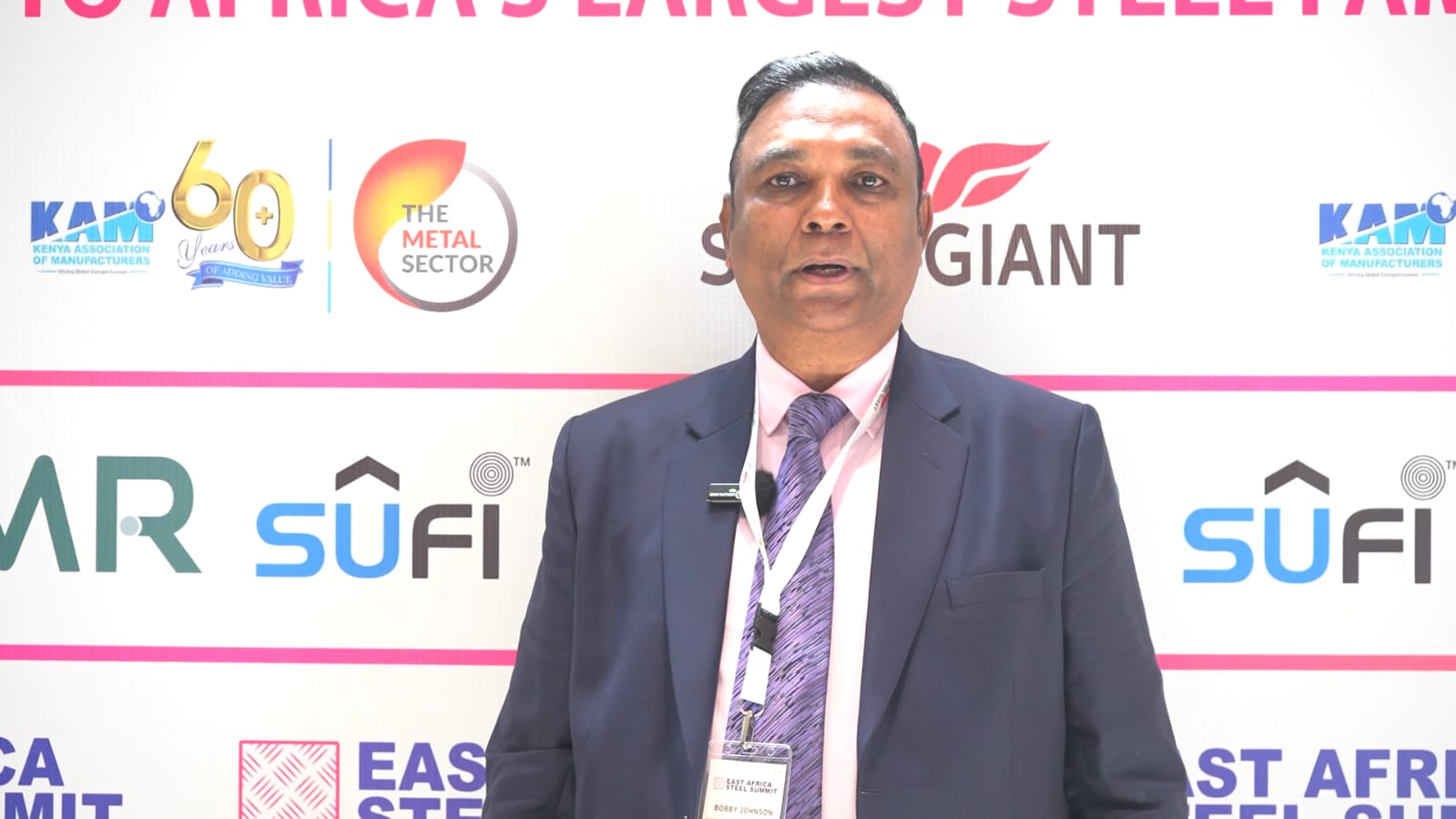
KAM Metal and Allied Sector Chairman Bobby Johnson
By Editorial Team
NAIROBI, July 6, 2026 — The Kenya Association of Manufacturers (KAM) has urged the government to lower production costs, eliminate substandard imports and create a predictable business environment to help the country’s steel industry operate at full capacity and compete more effectively in regional and global markets.
The call came during the opening of the two-day East African Steel Summit at the Sarit Centre in Nairobi, where manufacturers said Kenya has the capacity to produce far more steel than it currently does but continues to depend heavily on imports.
Speaking at the summit, KAM Chief Executive Tobias Alando said Kenya’s steel industry has transformed significantly since it began with nail production in 1948. Today, the sector manufactures hot and cold rolled products, tubes and pipes, wire products, fabricated steel and aluminium products, making it one of the country’s key manufacturing industries.
He said the industry contributes about 13 per cent of Kenya’s manufacturing output and pays nearly KSh34 billion in taxes every year. Even so, most of its production capacity remains unused.
Alando noted that Kenya has an installed steel production capacity of 4.2 million tonnes but currently operates at only 36 per cent. In contrast, the country imported about 1.66 million tonnes of iron and steel products in 2025 while exporting only 197,000 tonnes.
He blamed the low production levels on high raw material and energy costs, declining exports of finished steel products, cheap imports and unpredictable tax policies.
“Despite the capacity we have built over the years, Kenya continues to import substantial volumes of steel products. This presents an opportunity to expand local production, deepen value addition, strengthen local supply chains and reduce our dependence on imports,” Alando said.
He added that increasing local steel production would strengthen Kenya’s industrialisation agenda by supporting critical sectors such as construction, transport, energy and manufacturing.
At the same time, Alando said demand for steel is set to rise as the government rolls out affordable housing, roads, railways, ports, industrial parks and energy projects. He noted that manufacturers also have access to larger export markets through the African Continental Free Trade Area (AfCFTA), the Common Market for Eastern and Southern Africa (COMESA) and the Kenya-European Union Economic Partnership Agreement.
However, he cautioned that local manufacturers cannot fully benefit from these opportunities unless the country tackles the industry’s long-standing competitiveness challenges.
He identified high electricity costs, the influx of substandard and illicit products, limited access to affordable financing and an unpredictable regulatory environment as the biggest obstacles to growth.
To reverse the trend, Alando called for stronger collaboration between the government, manufacturers, financial institutions and development partners to create an environment that encourages investment and expands local production.
KAM Metal and Allied Sector Chairman Bobby Johnson said the steel industry’s growth goes hand in hand with East Africa’s infrastructure and industrial development.
“Every home, every kilometre of road and rail, every hospital and school being built today depends on the work of this industry,” Johnson said. “As investment in affordable housing, transport, energy and other infrastructure grows, our manufacturers are ready to meet this demand and realise the full potential of the steel sector.”
He also urged East African Community partner states to strengthen enforcement of quality standards and work together to stop substandard steel products from entering regional markets.
According to Johnson, harmonised standards that are consistently enforced will protect consumers, support compliant manufacturers and strengthen the competitiveness of the regional steel industry.
KAM is hosting the East African Steel Summit in partnership with Steel Giant. The forum has attracted more than 400 delegates and exhibitors, including manufacturers, processors, traders, policymakers, financiers and technology providers, who are discussing the future of steel production, investment, trade, innovation and sustainability across East Africa.