
InSupply Health Pushes Pharmacies to Expand Family Planning Services Across Kenya
By Peace Muthoka
NAIROBI, Kenya, September 3, 2026 — Community pharmacies could take on a bigger role in Kenya’s primary healthcare system as InSupply Health pushes to expand access to family planning services beyond traditional health facilities.
The organisation says five years of testing have shown that pharmacies can provide quality family planning services while remaining viable businesses, creating an opportunity to reach more women with convenient and affordable reproductive healthcare.
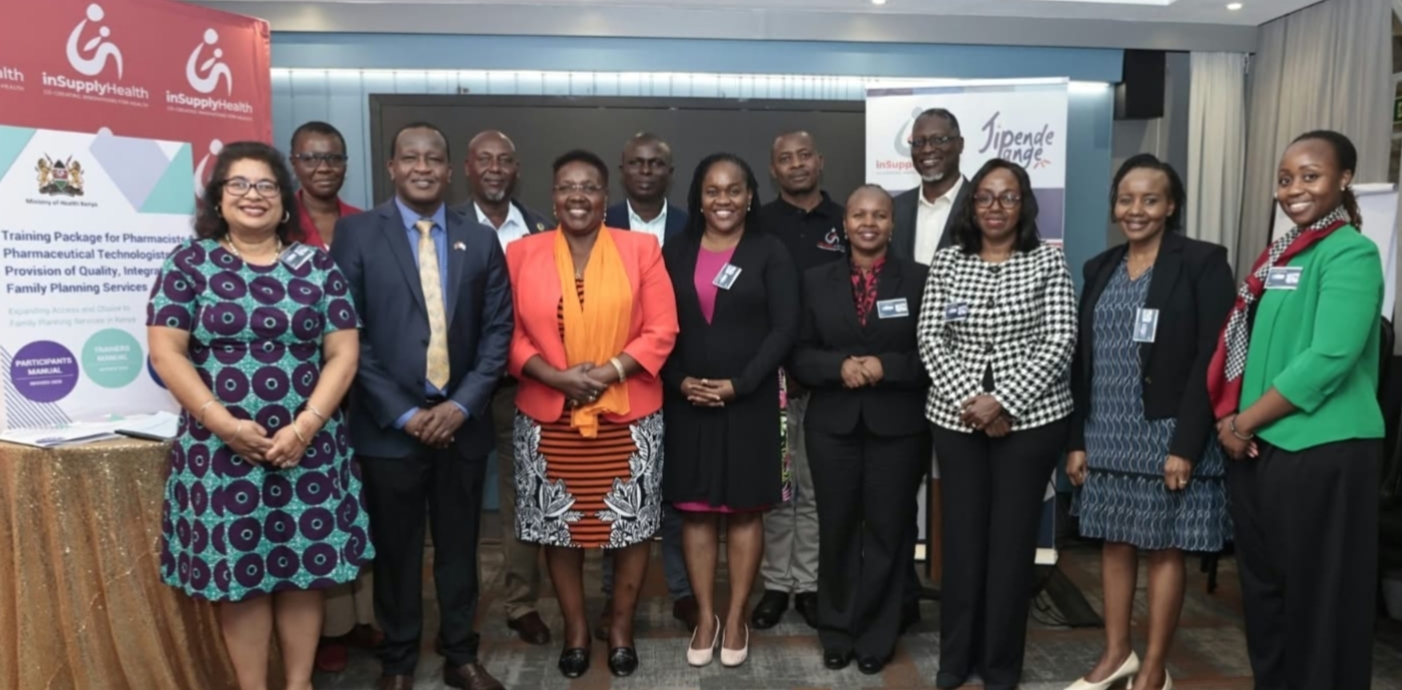
The proposal was discussed on Thursday during the Strengthening Pharmacy Provision of Contraceptives in Kenya Project Learning and Exit Summit, which brought together the Ministry of Health, InSupply Health, Phillips Therapeutics Ltd, pharmacy professionals and other partners to examine the future of pharmacy-based healthcare.
InSupply Health chief executive Yasmin Chandani said the organisation began the five-year Market Test Project by asking whether community pharmacies could provide quality family planning services while maintaining sustainable businesses.
The answer, she said, has been positive.
So far, the project has served more than 200,000 women through a network of up to 600 pharmacies in 10 counties, while also increasing access to a wider range of family planning methods.
However, Chandani said expanding the model nationally would require stakeholders to address challenges around reporting, commodities, financing, provider capacity and business incentives.
She also called for stronger referral links between pharmacies, public facilities and private clinics to ensure clients receive appropriate care when they require services beyond what pharmacies can provide.
The experience, she added, has shown that trust is central to uptake.
Pharmacies that understand their communities, listen to clients and focus on service rather than treating every visit as a transaction have recorded stronger demand, Chandani said.
This is partly because pharmacies are often closer to where people live and operate for longer hours, giving women an alternative to facilities where they may face long queues or limited opening times.
Quality remains a priority
While stakeholders want pharmacies to provide more services, the Ministry of Health says expansion must go hand in hand with quality and accountability.
Albert Ndwiga, Programme Manager in the Ministry’s Division of Reproductive and Maternal Health, said integration into the wider health system should not compromise standards of care.
For the model to work, pharmacies need licensed providers with appropriate competencies, clear service packages, referral pathways, certification and accountability mechanisms.
The approach also reflects the Ministry’s broader recognition that Kenyan women seek healthcare through both public and private channels and that the two systems need to work together.
Sustainability beyond donor funding
Phillips Therapeutics Ltd chief executive Newton Siele said sustainability would also depend on whether pharmacy owners see the model as beneficial to their businesses.
He identified business skills, understanding clients, effective use of data, communication and owner involvement as important factors in determining whether pharmacies will take ownership of the services.
With more than 7,500 registered pharmacies in Kenya, the sector offers a potentially extensive network for expanding family planning, reproductive health and selected primary healthcare services. InSupply Health currently works with about 600 pharmacies.
To strengthen the sector, InSupply Health has also launched a hybrid Pharmacy Family Planning training curriculum for pharmacists and pharmaceutical technologists.
The programme combines three to four weeks of self-paced online learning with a two-day practical session, replacing the previous five-day, fully in-person training model.
According to Chandani, more than 700 providers have so far undergone training.
The new approach aims to make training easier and cheaper for pharmacy providers, who no longer have to leave their businesses for several days to attend sessions in Nairobi.
InSupply Health now hopes to take the model to all 47 counties.
Chandani said the next phase would focus on building a market-driven model that can survive beyond donor support. The organisation is working with professional associations to explore self-funded training, allowing pharmacies to invest in their own capacity.
Ultimately, the summit pointed to a changing role for pharmacies in Kenya’s health system.
Rather than serving only as places where people buy medicines, stakeholders envision pharmacies becoming trusted community health points where people can access information, family planning, screening, self-care services and referrals.
For InSupply Health and its partners, the challenge now is to turn the lessons of five years into a sustainable model that can bring quality reproductive healthcare closer to women across the country.