
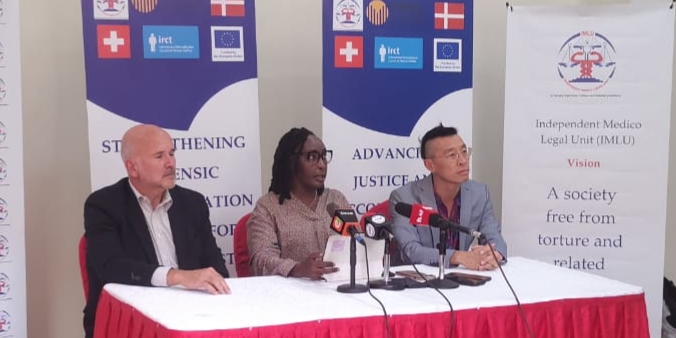
Forensic Experts Join Hands with IMLU to Strengthen Accountability in Custodial Death Investigations.
By Peace Muthoka.
Nairobi, Kenya, November 6, 2025 — Kenya is grappling with a disturbing rise in deaths occurring in police custody, exposing deep cracks in the country’s justice and accountability systems. Between 2024 and 2025, the Independent Medico-Legal Unit (IMLU) documented 17 such cases in police stations, remand facilities, and prisons across at least ten counties, including Nairobi, Nakuru, Murang’a, Siaya, Mombasa, Kakamega, and Busia.
As the country continues to face incidents of police brutality and deaths during protests, IMLU’s forensic experts have conducted 80 autopsies, documenting 59 protest-related deaths in 2025 alone. Postmortem examinations revealed shocking evidence of physical assault, asphyxiation, and blunt-force trauma—pointing to systemic failures in upholding human rights and the rule of law.
To address these gaps, IMLU, with support from the International Rehabilitation Council for Torture Victims (IRCT), convened a three-day forensic training workshop for pathologists and lawyers drawn from its national network. The session, held in Nairobi, was led by Professor Dr. Djordje Alempijevic, a member of the UN Subcommittee on Prevention of Torture and former Head of Forensic Medicine at Belgrade University, alongside James Lin, the Istanbul Protocol Programme Coordinator at IRCT.
The training aimed to strengthen the capacity of Kenyan forensic experts in documenting, investigating, and reporting cases of torture and deaths in custody in line with international standards.
“This is really about transparency in determining the causes of death, whether in custody or during protests,” said James Lin. “The only way to ensure accountability for families and society is by applying the most comprehensive, science-based approaches to investigation. That’s what we’re trying to promote here.”
Professor Alempijevic emphasized that forensic science is key to uncovering truth and ensuring justice.
“Truth is essential for reconciliation and closure,” he said. “Forensic evidence offers reproducible facts what one expert documents should be verifiable by another. However, in Kenya, documentation levels remain below international standards, which is why we are here to help raise the bar.”
He added that better documentation would ensure that even in cases where deaths in custody were due to natural causes, the findings would be supported by credible evidence, while unlawful killings or torture would be clearly documented to allow swift delivery of justice.
The workshop focused on applying globally recognized frameworks such as the Istanbul Protocol, which guides the documentation of torture, and the Minnesota Protocol, which governs investigations into unlawful deaths.
Despite the enactment of the National Coroner Service Act (2017) which provides for independent investigations into reportable deaths—implementation has stalled due to administrative hurdles, including the absence of a Cabinet Secretary for Justice. This delay has left investigations under the control of police and state pathologists, raising concerns about impartiality and the persistence of impunity.
IMLU and its partners, including the Police Reforms Working Group–Kenya (PRWG-K) and the Department of Justice, continue to push for the Act’s full operationalization. They argue that an independent coroner system would ensure transparent investigations, timely communication with families, and accountability for those responsible.
IMLU Executive Director Peter Kiama reiterated the organization’s commitment to advancing justice through science-based investigations.
“Forensic documentation turns pain into proof and evidence into justice,” he said. “Every life lost in state custody must be investigated not as a statistic, but as a call to action for reform.”
As Kenya continues to confront deaths in custody and violence during protests, initiatives like these offer hope that justice will no longer depend on testimonies alone but on the power of evidence, truth, and accountability.