
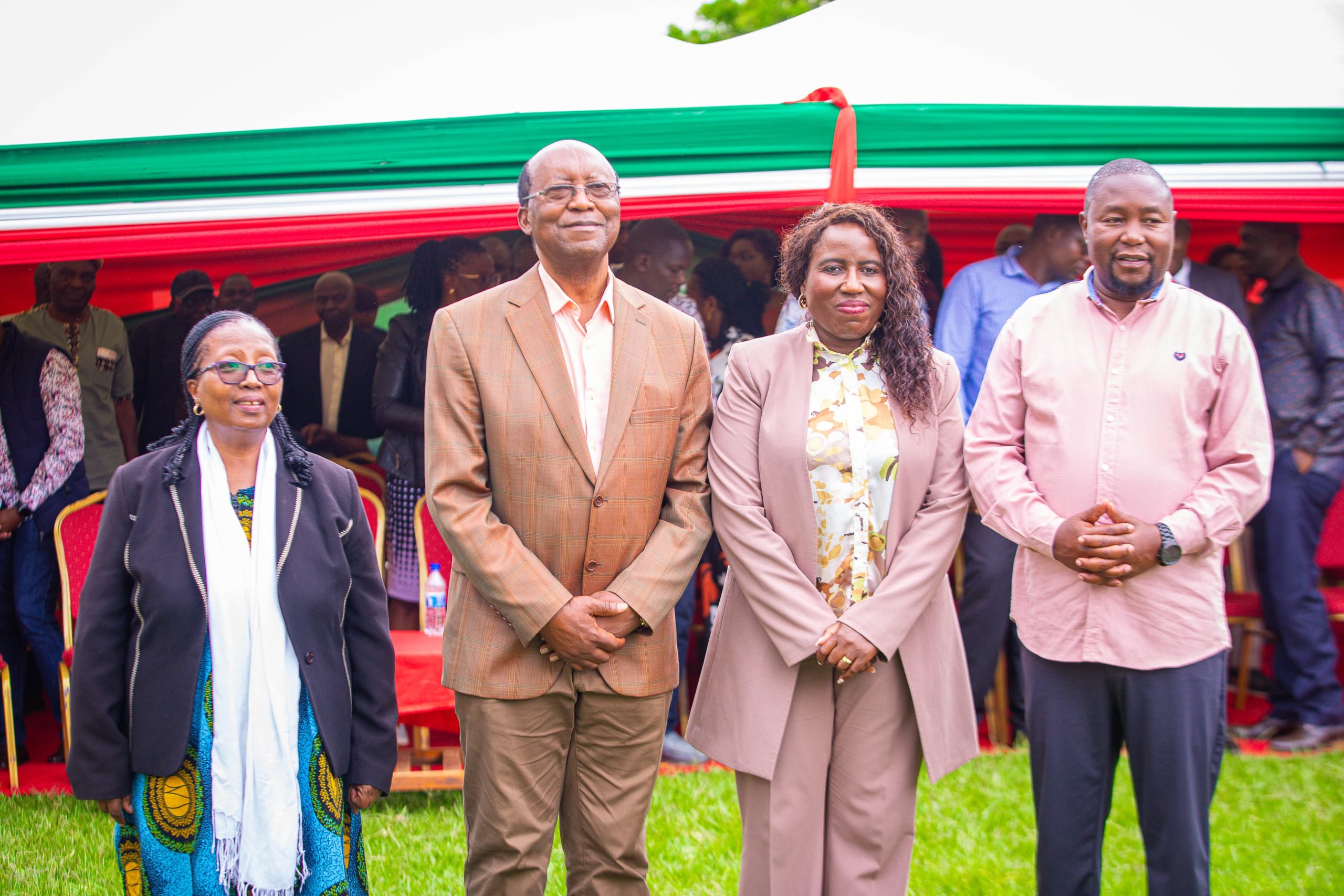
JKUAT Vice Chancellor Prof Victoria Ngumi (left) , PS Higher Education, Dr. Beatrice Inyangala ( 2nd right) , JKUAT Council Chair, Dr. James Onsando (2nd left) and Hon. Innocent Mugabe at the Wafula Wabuke JKUAT TVET Institute grounds.
By Peace Muthoka
NAIROBI, Kenya — Jomo Kenyatta University of Agriculture and Technology (JKUAT) has broken ground for the construction of the Wafula Wabuge JKUAT TVET Institute in Likuyani Constituency, Kakamega County, in a move aimed at expanding access to technical and vocational training.
The ceremony, held on Tuesday, October 13, 2026, brought together government officials, university leaders, local representatives and community stakeholders, with the new institution expected to offer certificate and diploma programmes in engineering, agriculture and information and communication technology (ICT).
The institute is designed to equip young people with practical, industry-aligned skills, promote innovation and create pathways to employment and entrepreneurship. It is also expected to help address the technical skills gap in the region and beyond.
Principal Secretary for Higher Education and Research Dr Beatrice Inyangala, who presided over the groundbreaking, said the project reflects the government’s commitment to expanding access to quality technical education in line with national development priorities, including the Bottom-Up Economic Transformation Agenda (BETA) and Kenya Vision 2030.
“The establishment of Wafula Wabuge JKUAT TVET Institute represents a transformative step in our effort to democratise higher education and technical skills training in Kenya,” Dr Inyangala said.
She added that bringing engineering, agriculture and ICT training under one roof would help prepare young people for the demands of industry while supporting sustainable economic growth.
The area Member of Parliament, Mugabe Innocent Maino, welcomed the project, saying it would bring technical training closer to residents and reduce the need for learners to travel long distances to access such opportunities.
“This groundbreaking ceremony is a monumental victory for our constituency and the surrounding communities. The Institute will serve as a beacon of opportunity for thousands of young people, providing them with direct access to world-class training in critical fields without having to travel far from home,” Maino said.
He pledged support for the development and growth of the institute, describing it as an opportunity for young people in Likuyani and neighbouring communities to acquire skills that could improve their livelihoods.
JKUAT Vice-Chancellor Prof. Victoria Wambui Ngumi said the institution would build on the university’s experience in science, technology and agriculture by extending its expertise to technical and vocational trainees.
“Establishing this dedicated TVET institute allows us to extend our specialized expertise directly to technical and vocational trainees,” Prof. Ngumi said.
She said practical training in ICT, modern agricultural practices and engineering would prepare learners to address real-world challenges while creating opportunities for innovation and entrepreneurship.
Prof. Ngumi reaffirmed JKUAT’s commitment to implementing the project and acknowledged the contribution of the late Wafula Wabuge, whose family donated 50 acres of land to the university for training and research activities.
JKUAT Council Chairman Dr Micah Onsando said the institute would provide more than technical training, noting that entrepreneurial skills would be important in helping learners turn their knowledge into sustainable livelihoods.
“JKUAT is a leader on commercialization, value addition and knowledge economy. That is what the university is bringing on the ground, here in Likuyani,” Dr Onsando said.
He reaffirmed the university council’s commitment to expanding infrastructure and improving operational efficiency to support its training and research mandate.
The new institute will also build on JKUAT’s existing engagement with communities in Likuyani through technology transfer initiatives focused on modern dairy farming, crop husbandry and agribusiness.
Through its lab-to-land approach, the university has been transferring technologies and practical knowledge to local residents, particularly in agriculture and related enterprises.
The Wafula Wabuge JKUAT TVET Institute is expected to strengthen this link between training, research and community development by providing young people with technical skills that respond to local and national economic needs.