

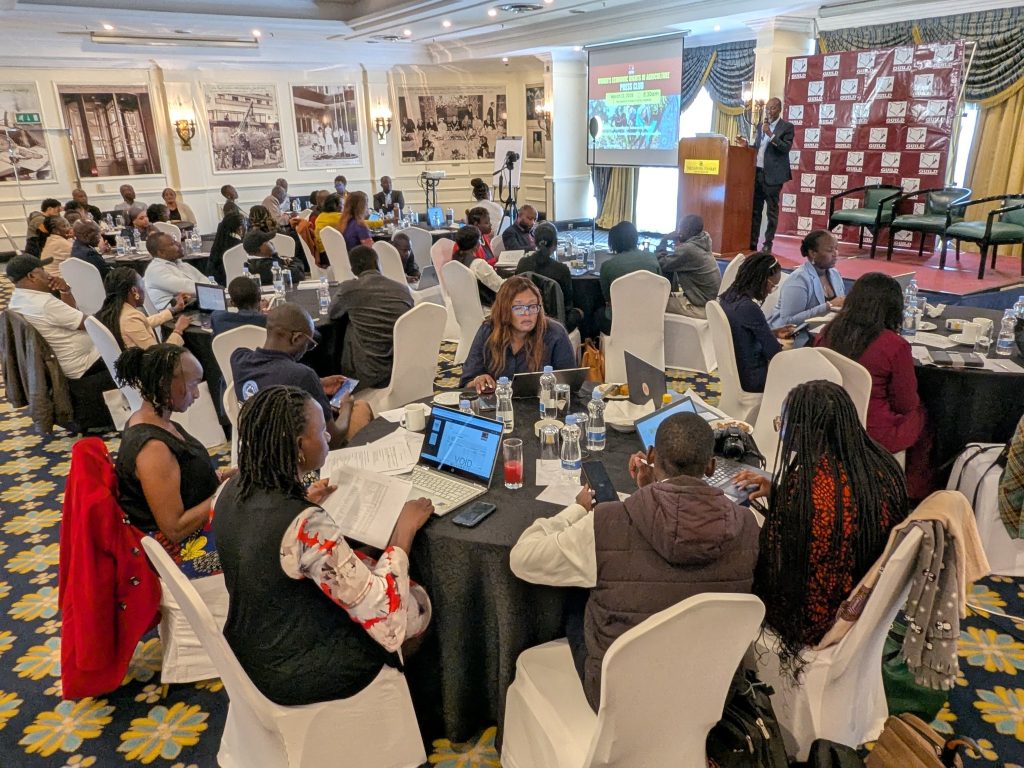
Participants pose for a group photo during a forum on women’s empowerment in agriculture held in Nairobi during International Women’s Week. The meeting brought together experts, researchers, media professionals, and development partners to discuss ways of strengthening support for women farmers and agripreneurs across the country.
By Peace Muthoka
Nairobi, March 12, 2026 – Women farmers remain the backbone of Kenya’s food system, yet their contribution continues to receive limited recognition in policy, financing, and national economic planning.
This was the central message during a high-level forum held in Nairobi that brought together experts from academia, media, civil society, and development organizations to discuss how women farmers and agripreneurs can be better supported to unlock their full economic potential.
The meeting, held during International Women’s Week under the theme “Women Cultivating Opportunity,” focused on advancing rights, justice, and practical action for women farmers across the country. Participants explored how stronger policies, improved access to finance, and increased visibility in national conversations can help women thrive within the agricultural sector.
Speakers at the event said women are not only feeding families but also sustaining local markets, strengthening rural economies, and supporting entire agricultural value chains across the country.
Opening the forum, Zubeida Kananu, President of the Kenya Editors Guild, said creating opportunities for women farmers benefits not just individuals but entire communities and national economies.
“When we create opportunities, share resources, and open doors, the benefits extend far beyond individuals,” Kananu said. “Families thrive, communities grow stronger, and entire economies flourish.”
She noted that the impact of women’s work in agriculture is often underestimated despite their central role in food production and rural livelihoods.
According to Kananu, women farmers cultivate the land, feed families, sustain local markets, and support value chains that keep the country’s food system functioning.
“They are not only providing food,” she said. “They are creating opportunities, supporting livelihoods, and strengthening communities.”
Kananu said the conversation about women in agriculture ultimately comes down to rights, justice, and meaningful action.
“This is about ensuring women farmers and agripreneurs receive the recognition, support, and opportunities they deserve,” she said.
Her remarks also included a personal reflection about the influence of her late mother, whose small food business supported both the family and the surrounding community.

Kananu recalled how her mother’s dedication ensured food was always available at home while her small enterprise helped educate her children and support local farmers.
“My late mother loved feeding people. Through her small kibanda she supported farmers, educated her children, and nourished a community,” she said.
“She reminds us that behind every thriving food system are women quietly feeding a nation.”
Kananu also challenged journalists to increase coverage of women farmers and agripreneurs, noting that their stories remain largely underreported in mainstream media.
She said the media has an important role in strengthening evidence-based, gender-responsive journalism that highlights both the challenges women face and the innovative solutions they are developing across the agricultural sector.
“We must ensure the stories of women cultivating opportunity in farms, markets, cooperatives, and agritech spaces are told with the depth, accuracy, and visibility they deserve,” she said.
“As we discuss rights, justice, and action for women farmers, we must remember the thousands of women like my mother whose daily sacrifices feed families and sustain communities across this country.”
Many of these women, she noted, may never stand on a public podium, yet their labor continues to feed the nation.
“If we truly want change, our conversations must translate into real opportunity, real support, and real action for women in agriculture,” she said.
Experts at the forum also highlighted the enormous economic contribution women make to Kenya’s agricultural sector.
Delivering a keynote presentation, Mary Mbithi, Team Leader at the Women’s Economic Empowerment Hub at the University of Nairobi and Professor of Economics at the university, said agriculture remains one of the most important pillars of Kenya’s economy.
She noted that the sector contributes between 22 and 25 percent of the country’s Gross Domestic Product and provides employment and income for millions of households.
Agriculture also accounts for about 60 percent of Kenya’s export earnings, making it a critical driver of economic growth and national stability.
Within this sector, Mbithi said women play an especially significant role.
Women make up between 70 and 80 percent of the agricultural labor force in Kenya and are responsible for producing roughly 60 to 80 percent of the country’s food.
“Women are central to Kenya’s agricultural economy,” Mbithi said. “If you find ten people working in agriculture, seven or eight of them will be women.”
Despite this major contribution, she said women continue to face structural barriers that limit their productivity and economic empowerment.
One of the biggest challenges is limited land ownership.
Although women perform most of the farming work, they own less than 10 percent of land titles in the country.
Land ownership, Mbithi explained, plays a critical role in determining who controls agricultural decisions and resources.
“When someone does not have a title deed, their decision-making power becomes limited,” she said.
Without ownership rights, many women farmers cannot decide what crops to grow, how much to produce, or how to invest in expanding their farms.
Land ownership also affects access to credit. Financial institutions often require land titles as collateral for loans. As a result, many women farmers cannot secure the financing needed to invest in modern technologies, irrigation systems, or improved seeds.
Women currently receive less than 10 percent of available agricultural credit in Kenya.
“Women need financing to invest in agriculture, but access to that finance remains limited,” Mbithi said.
She also noted that a large portion of women’s agricultural work takes place within the informal economy and is therefore not fully captured in national economic statistics.
Much of the produce grown by women is consumed within households rather than sold in formal markets. While this work is critical for food security, it is rarely reflected in official economic measurements such as Gross Domestic Product.
“This contribution may not appear in GDP calculations, but it feeds families and sustains communities,” Mbithi said.
Women in agriculture also shoulder a heavier workload compared to men.
Studies show that women farmers spend an average of nearly 13 hours each day on farming activities, household chores, and caregiving responsibilities, compared to about eight hours for men.
This combination of agricultural work and unpaid domestic labor limits the time women can dedicate to income-generating activities.
“The burden of unpaid work carried by women reduces the opportunities they have to participate fully in economic activities,” Mbithi said.
Experts at the forum said addressing these structural barriers is essential not only for gender equality but also for national economic development.
Closing the gender gap in agriculture, they said, could significantly increase productivity, improve household incomes, and strengthen food security across the country.
Research presented at the forum also highlighted the role of education and technology in empowering women farmers.
Lucy Wakiaga, Associate Research Scientist at the African Population and Health Research Center, said gender disparities in education, particularly in science and technology fields, limit women’s ability to adopt modern agricultural innovations.
“Educational inequality directly affects women’s productivity and leadership in agriculture,” she said.
Wakiaga explained that when women lack access to technical education and digital tools, they are often excluded from higher-value opportunities such as agritech, food processing, and export-oriented agriculture.
“If we want inclusive economic growth, we must invest in gender-responsive education systems and remove stereotypes that discourage girls from pursuing science and technology,” she said.
Participants at the forum also discussed the need for stronger partnerships to support women farmers across agricultural value chains.
They said governments, research institutions, development partners, and the private sector must work together to scale technologies and innovations that respond to the needs of women farmers.
Some of the innovative approaches discussed included youth- and women-led quality centers that connect farmers to markets, strengthen quality standards, and create opportunities across agricultural value chains.
The forum also highlighted the importance of involving men and young people in women’s empowerment initiatives to ensure sustainable progress within households and communities.
Participants further called for improved data collection to support evidence-based policymaking. Accurate data, they noted, is critical in identifying barriers facing women farmers and designing effective interventions to address them.
Stakeholders issued a strong call for action. They urged policymakers to strengthen women’s land and inheritance rights, expand access to affordable agricultural finance, and increase investment in women-led agribusiness enterprises.
Speakers agreed that empowering women farmers is one of the most powerful investments Kenya can make toward building resilient food systems and inclusive economic growth.
“Empowering women farmers is one of the most powerful investments we can make in Kenya’s future,” participants said.
They emphasized that building a stronger agricultural sector must begin with recognizing and supporting the millions of women who cultivate the nation’s opportunities every day.