
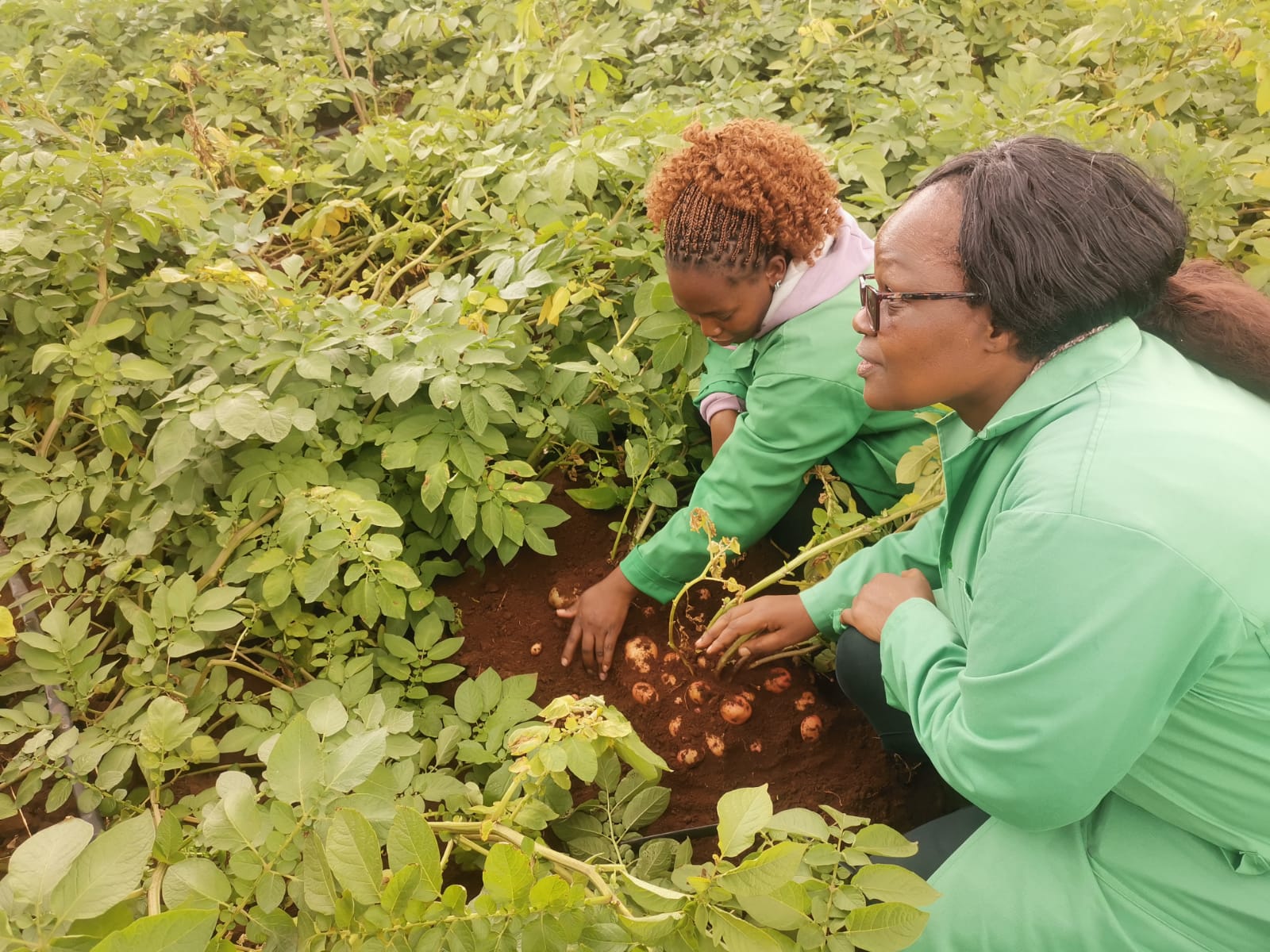
Dr. Miriam Mbiyu (Left), , a plant scientist at KALRO displays samples of genetically modified (GMO) potatoes during media study tour at confined field trials at Muguga.
Muguga, Kiambu – August 21, 2025 — Kenya’s agricultural sector is on the verge of a major breakthrough after scientists at the Kenya Agricultural and Livestock Research Organisation (KALRO) unveiled progress on a genetically modified (GMO) potato resistant to late blight disease.
The announcement came during a media study tour at KALRO Muguga, where journalists were given a firsthand look at confined field trials. The visit aimed to equip reporters with accurate information on biotechnology and its potential to transform Kenya’s food systems.
Late blight, a fungal disease that devastates potato harvests, is responsible for yield losses of up to 30 percent if unmanaged. Farmers often resort to spraying fungicides more than a dozen times per season an expensive and labor-intensive practice that poses health and environmental risks.
Dr. Moses Nyongesa, a lead scientist at KALRO, said the GMO potato could change that equation.
“Farmers growing this variety will no longer need to spray fungicides against late blight,” he explained. “This will drastically reduce production costs, safeguard the environment, and boost yields by up to 30 percent. Currently, Kenya produces around three million metric tonnes of potatoes, but this new variety could raise that significantly.”
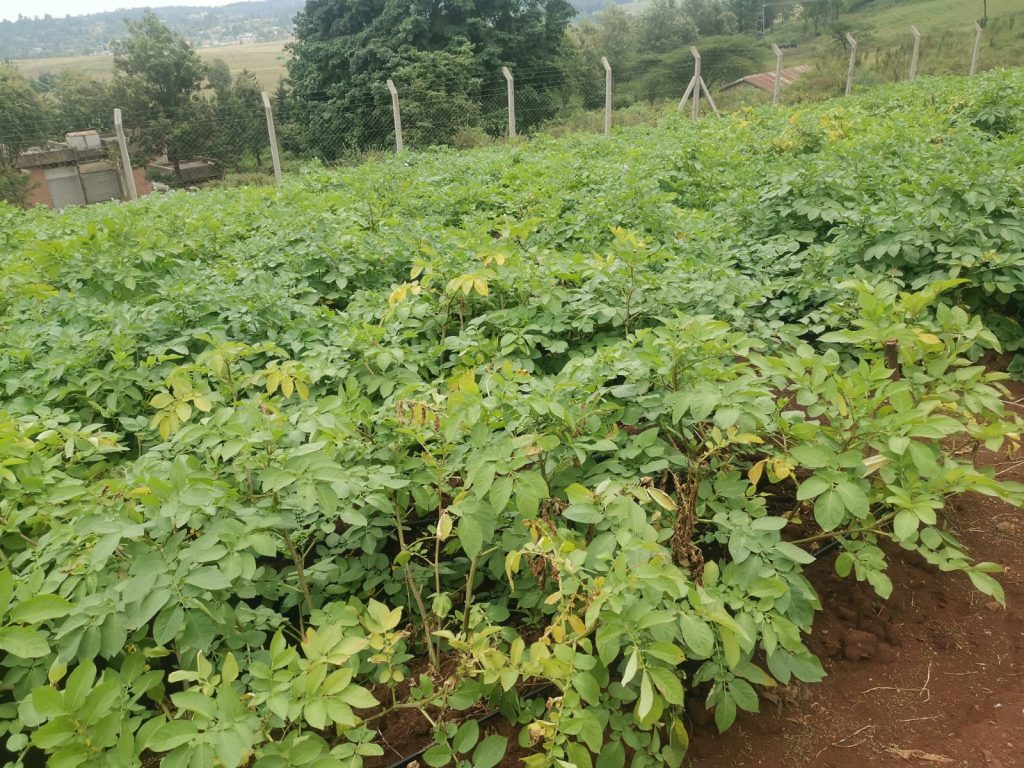
Genetically modified (GMO) potato varieties under confined field trials at KALRO Muguga.
Dr. Nyongesa noted that the potato carries three stacked resistance genes, making it highly durable against disease. He added that trials in laboratories ,greenhouses, and confined fields have confirmed its effectiveness, and the crop is now awaiting approval from the National Biosafety Authority (NBA). If approved, the next stage will be National Performance Trials in six potato-growing counties, paving the way for release as early as 2026.
Dr. Miriam Mbiyu, a plant scientist at KALRO, emphasized that apart from its resistance, the GMO potato is indistinguishable from conventional varieties in taste, nutrition, and appearance.
“We analyzed proteins, carbohydrates, and other nutritional compounds, and found no differences between the GMO and non-GMO potatoes,” she said. “The varieties Shangi, Asante, and Tigoni already popular with farmers now simply carry the added benefit of disease resistance.”
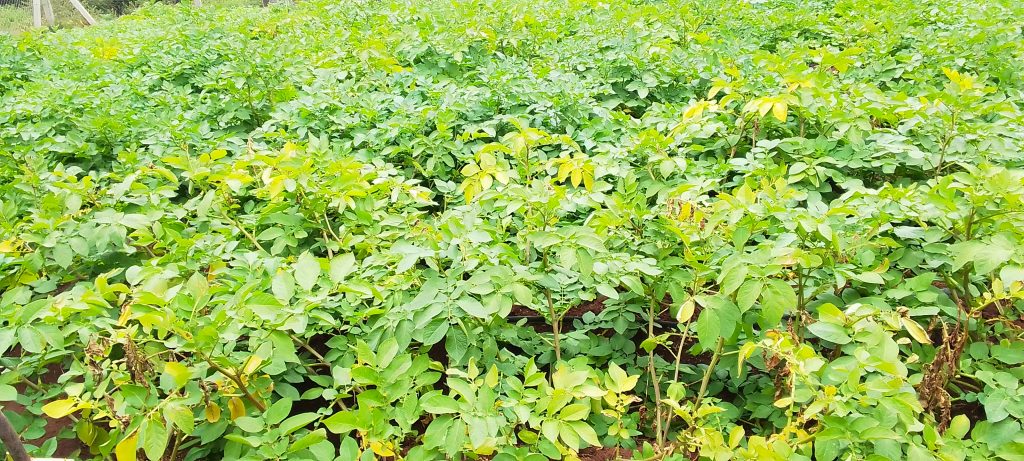
She explained that while conventional breeding can take up to 15 years to develop resistance, biotechnology enabled KALRO to achieve results within a few years. “We are currently bulking seed for national trials, and if all goes well, by October next year Kenya could have its first approved GMO potato,” Dr. Mbiyu added.
Beyond yields and costs, experts say the GMO potato could ease farmers’ burden. Dr. Paul Chege, from ISAAA Africenter, which works on communicating biotechnology, highlighted the human impact:
“Potato farmers spray up to 13 times a season. That is back-breaking labor and harmful to health. With this potato, they won’t need to spray for late blight. The yield that would have been lost to disease will now be harvested.”
Dr. Chege also pointed out that globally, 29 countries already cultivate GM crops on more than 200 million hectares. “Kenya has already adopted cotton, while South Africa, Nigeria, and Ethiopia grow biotech maize and soybeans. This potato places Kenya at the forefront of adopting solutions for local food security challenges,” he said.
KALRO stressed that the GMO potato is publicly bred and will be licensed to seed companies on a non-exclusive basis, ensuring accessibility for both small-scale and large-scale farmers.
“We are not replacing conventional breeding but adding to farmers’ choices,” Dr. Nyongesa concluded. “The GMO potato is about food security, lower costs, and better livelihoods for Kenyan farmers.”
If approvals proceed smoothly, Kenya could soon join the ranks of nations using biotechnology to tackle hunger and the humble potato may become the crop that changes the country’s farming future.