
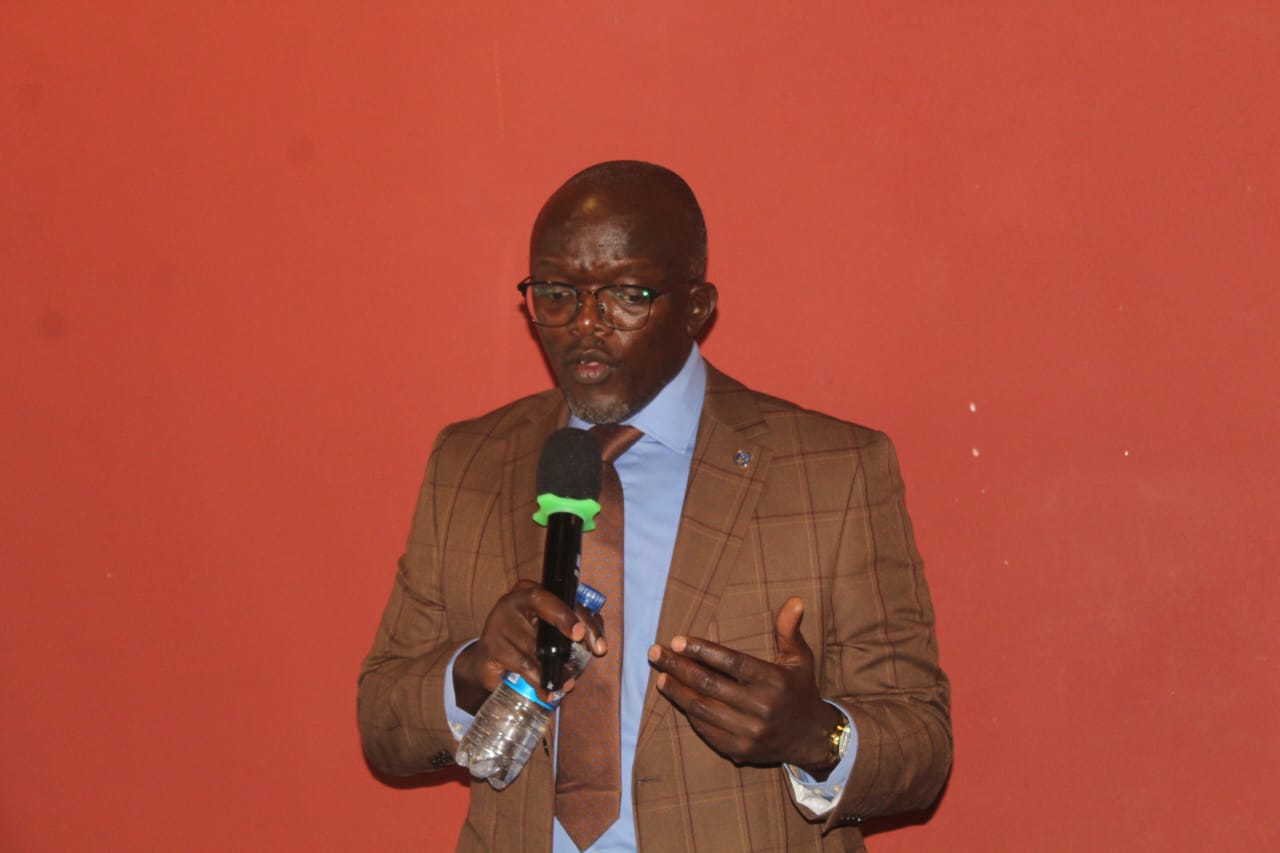
Evans Ogada, Advocate and Chair of the Rule of Law Committee at the East Africa Law Society,speaking during a National Symposium on Human Rights and the Ballot on Africa: Challenges and Opportunities held on 16 December 2025.
By Peace Muthoka.
Nairobi, December 16, 2025 — Kenya must protect human rights long before election day if the 2027 General Election is to remain credible, peaceful, and legitimate. This warning dominated discussions today as leaders, experts, and activists gathered in Nairobi for a national dialogue on human rights and electoral integrity.
The National Symposium on Human Rights and the Ballot in Africa was held at Ole Sereni Hotel and brought together a wide mix of participants, both in person and online. Human rights defenders, election experts, civil society leaders, media practitioners, constitutional bodies, academics, and international partners attended the day-long forum.
Organised by Chapter Four Programs and Projects Ltd with support from the Friedrich Naumann Foundation for Freedom East Africa, the symposium focused on the growing link between pre-election human rights violations and disputed elections across Africa. Speakers agreed that elections rarely collapse at the ballot. Instead, they fail much earlier, through fear, repression, and weakened institutions.
From the opening session, the tone was clear. Kenya cannot afford to treat elections as a single-day event. According to participants, the real danger lies in what happens before campaigns begin, before candidates are cleared, and before voters feel safe enough to participate.
Former Independent Electoral and Boundaries Commission chairperson Dr Isaac Ahmed Hassan urged Kenyans to take stock of the country’s electoral systems and institutions. He warned that violence, intimidation, and misconduct witnessed during recent by-elections were early signs of deeper problems.
He said if such actions occur on a national scale in 2027, Kenya risks holding chaotic and illegitimate elections. Voter apathy, he noted, already signals fear and declining public confidence. Many citizens, he said, choose to stay away from polling stations when violence and political intimidation go unchecked.
Dr Hassan stressed that the country does not lack laws or security capacity. What remains missing, he argued, is impartial enforcement. He called for the arrest and prosecution of all perpetrators of electoral violence, regardless of political affiliation.
He also issued a firm reminder to election officials. Commissioners and election managers, he said, take personal oaths to defend the Constitution. They cannot later hide behind instructions from powerful actors. He warned that history would judge those who compromise elections and that accountability does not expire with age or time.
As the discussion broadened, attention turned to lessons from the wider region. Chapter Four Executive Director Njeri Kabeberi drew sharp comparisons from Cameroon, Uganda, and Tanzania. She described elections marked by violence, prolonged rule, and systematic repression of opposition voices.
She said the erosion of human rights in Tanzania shocked many in the region, given its long-standing reputation for peace and stability. Uganda’s continued detention of opposition leaders, she added, remains a painful embarrassment for East Africa.
For Kenya, Kabeberi warned, the signs are already visible. She pointed to the Gen Z protests of 2024 and 2025, which saw killings, abductions, and arrests despite constitutional guarantees of free expression, movement, and assembly.
She argued that when a country violates its Constitution during peacetime, the situation often worsens as elections approach. Silence from authorities, she said, only deepens the crisis. In such moments, citizens must speak out.
According to Kabeberi, Kenya’s strongest defence has always been an active civil society and a vocal human rights movement. She urged defenders, activists, and ordinary citizens to remain vigilant, warning that Kenya’s collapse would destabilise the entire region.
She reminded participants of Kenya’s historic role as a regional anchor, hosting peace processes and transitional governments. That legacy, she said, must not be lost to political recklessness.
Calls for reform featured strongly throughout the day. East Africa Law Society Rule of Law Committee Chair Evans Ogadu emphasised the need for stronger legal safeguards to stop pre-election abuses. He warned against the misuse of police and security agencies for intimidation, abductions, and enforced disappearances.
Ogadu stressed that the independence of both security institutions and electoral bodies must remain protected from executive interference. Without this, he said, public trust would continue to erode.
Other voices reinforced the message. Cyprian Nyamwamu identified shrinking civic space, repression of opposition figures, and intimidation of independent actors as key drivers of electoral failure. He said strategic litigation, civic education, institutional independence, and citizen mobilisation must begin immediately if Kenya hopes to hold a credible election in 2027.
As the symposium closed, participants agreed on one point. Safeguarding human rights before the ballot is not optional. It is the backbone of democracy.
The forum aims to produce practical policy recommendations, a Nairobi Communiqué, and long-term collaboration to strengthen Kenya’s democratic resilience.
The message from Nairobi was unmistakable. When human rights collapse before elections, democracy becomes an empty ritual. For Kenya, the work of protecting the vote must start now, not on election day.