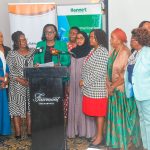
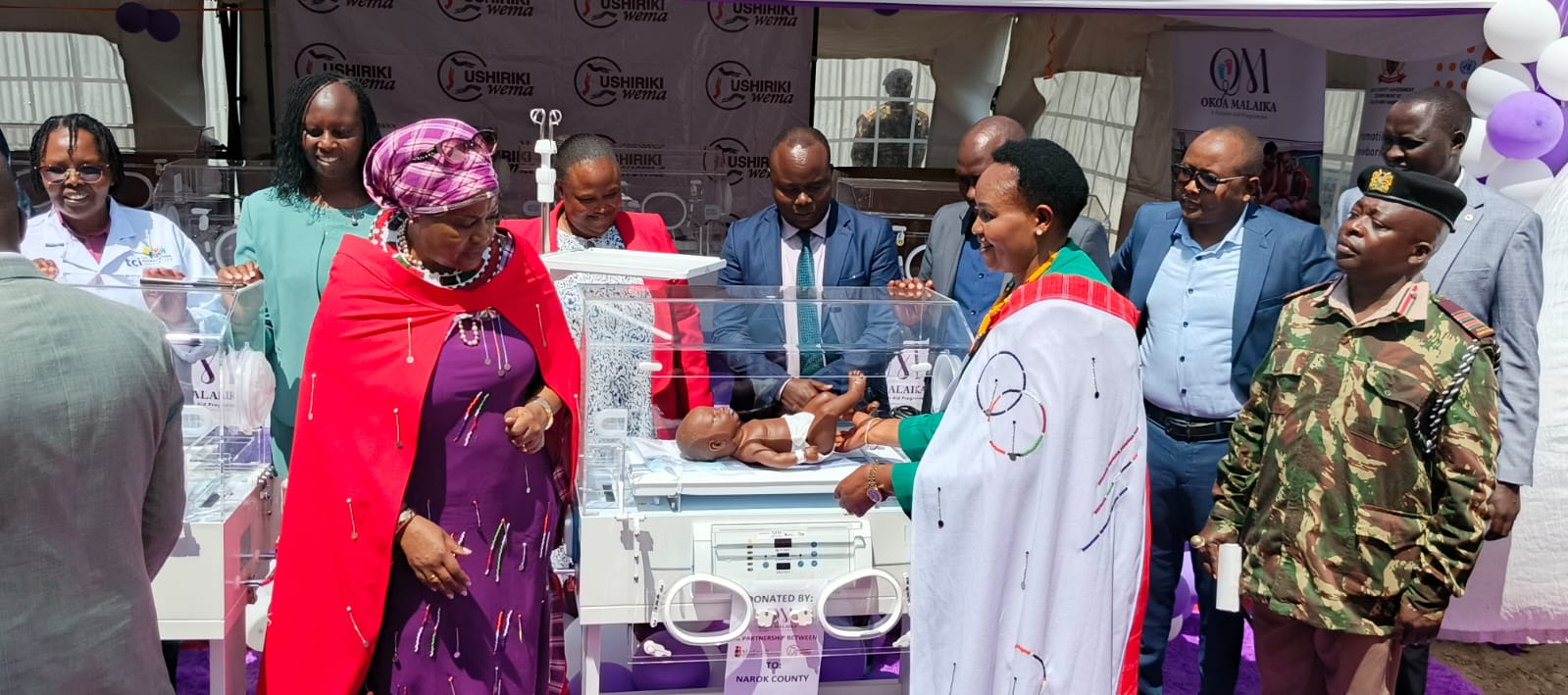
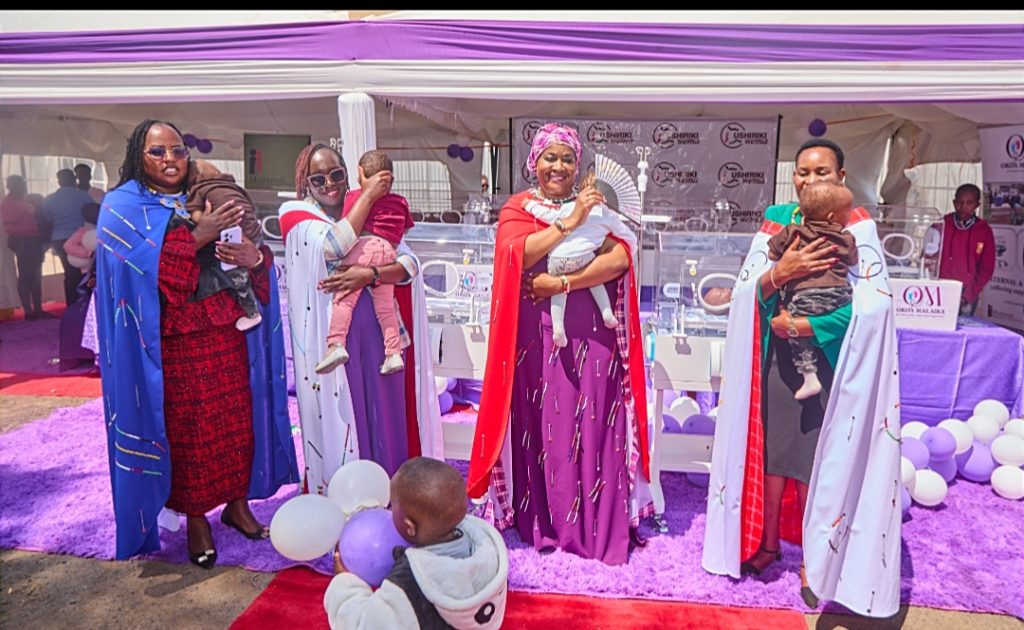
Ushiriki Wema Foundation Patron Tessie Musalia (left), officially hands over the Okoa Malaika program state-of-the-art neonatal incubators to Narok First Lady Agnes Ntutu during the Okoa Malaika Program hand of the equipment to the 29th-32nd counties namely Narok, Kajiado, Kericho, and Bomet on Thursday 2nd July 2026 at Narok County Referral Hospital. .
By Peace Muthoka
NAROK, July 2, 2026 — The Ushiriki Wema Foundation has expanded its Okoa Malaika programme to four more counties, strengthening Kenya’s efforts to reduce deaths among premature babies through the donation of neonatal incubators to hospitals in Narok, Kericho, Kajiado and Bomet.
The latest rollout increases the programme’s reach to 32 public health facilities across the country, giving more vulnerable newborns access to specialised care. The expansion comes at a time when Kenya continues to grapple with high rates of premature births, with about 134,000 babies born too soon every year—nearly 12 per cent of all births. An estimated 42,000 of these infants die, while thousands more live with lifelong health complications.
Speaking during the handover ceremony in Narok, the Foundation’s Patron, Her Excellency Madam Tessie Musalia Mudavadi, described the figures as alarming and called for greater investment in maternal and newborn healthcare. She said every child deserves an equal chance at life regardless of where they are born.
“Preterm birth remains a crisis in Kenya. Approximately 134,000 babies are born too soon each year and, tragically, 42,000 of these infants do not survive. This is not encouraging at all,” said Madam Tessie.
She observed that many of the deaths are not caused by a lack of skilled healthcare workers but by the shortage of lifesaving equipment in hospitals, leaving medical personnel unable to provide the care premature babies urgently need.
“Behind many of these deaths is a gap. A gap in resources. A healthcare worker with the skills to save a life but without the tools to do so. Health facilities are doing their best with their least, and in that gap, we lose our children,” she said.
Even so, Madam Tessie said Kenya has made maternal and newborn health a national priority through stronger collaboration between the government and development partners. She pointed to the launch of the Kenya Every Woman Every Newborn Everywhere (EWENE) Acceleration Plan 2026–2028, where President William Ruto reaffirmed the government’s commitment to ending preventable maternal and newborn deaths under the Universal Health Coverage programme.
“The President reminded us that maternal and newborn deaths devastate not only families but communities and our nation. Protecting mothers and children is essential to building a stronger future for Kenya,” she said, adding that the government’s KSh4.5 billion investment in maternal and child healthcare demonstrates its determination to tackle the challenge.
Madam Tessie said the Ushiriki Wema Foundation is complementing the government’s efforts through the Okoa Malaika programme by equipping hospitals with neonatal incubators, strengthening the capacity of healthcare workers and improving access to quality newborn care across the country.
“Through our advocacy and strategic partnerships, we are equipping health facilities, empowering healthcare workers and giving more babies born too soon a fighting chance to survive and thrive,” she said.
She noted that the programme’s expansion to Narok, Kericho, Kajiado and Bomet marks another milestone in the Foundation’s mission to improve newborn survival and ensure every child receives quality healthcare from birth.
“Our vision is simple—a Kenya where every woman receives the care she deserves, every newborn is given the best possible start to a healthy life, every healthcare worker has the equipment needed to save lives and every hospital is ready to provide lifesaving care when it matters most,” Madam Tessie added.
Okoa Malaika Programme Brand Ambassador Njoki Mambo said the initiative continues to honour the promise it made on World Prematurity Day in 2023 to ensure that no family loses a baby because of premature birth. She said the programme has steadily expanded across the country and is already transforming neonatal care in public hospitals.
“That promise has walked us across this country, all the way to 32 facilities today. Every phase of this journey brings us one step closer to a future where no family suffers the heartbreak of losing a baby to prematurity,” she said.
Njoki described every incubator as a symbol of hope rather than just a piece of medical equipment, saying it gives premature babies the warmth, protection and time they need to survive during their most vulnerable moments.
“When we place an incubator in a hospital, we are giving a baby born too soon what the world outside the womb cannot yet offer—warmth, protection and time. Time to grow, time to breathe and time to be ready. Each incubator is a symbol of hope and a promise to every mother that her baby’s survival will never be left to chance,” she said.
Having visited several beneficiary hospitals, Njoki said she had witnessed firsthand how the equipment has transformed neonatal care by enabling healthcare workers to save more lives.
“I have seen the faces of nurses who finally have the tools to match their skill. I have seen what it means for a facility to be ready, and I can tell you it really matters,” she said.
She added that every incubator represents the determination of a newborn fighting to survive and the resilience of families refusing to lose hope.
“Behind every incubator is a baby fighting for life. Behind every baby is a mother who has refused to give up. Behind every mother is a family holding its breath, waiting to exhale,” Njoki said.
Narok County First Lady Agnes Ntutu welcomed the partnership, saying continued investment in maternal and newborn healthcare will strengthen county health systems, improve newborn survival and expand access to quality healthcare services.
The Ushiriki Wema Foundation said it will continue rolling out the Okoa Malaika programme to more public hospitals across the country, reinforcing its commitment to ensuring every newborn, regardless of where they are born, has an equal opportunity to survive and enjoy a healthy start to life.