
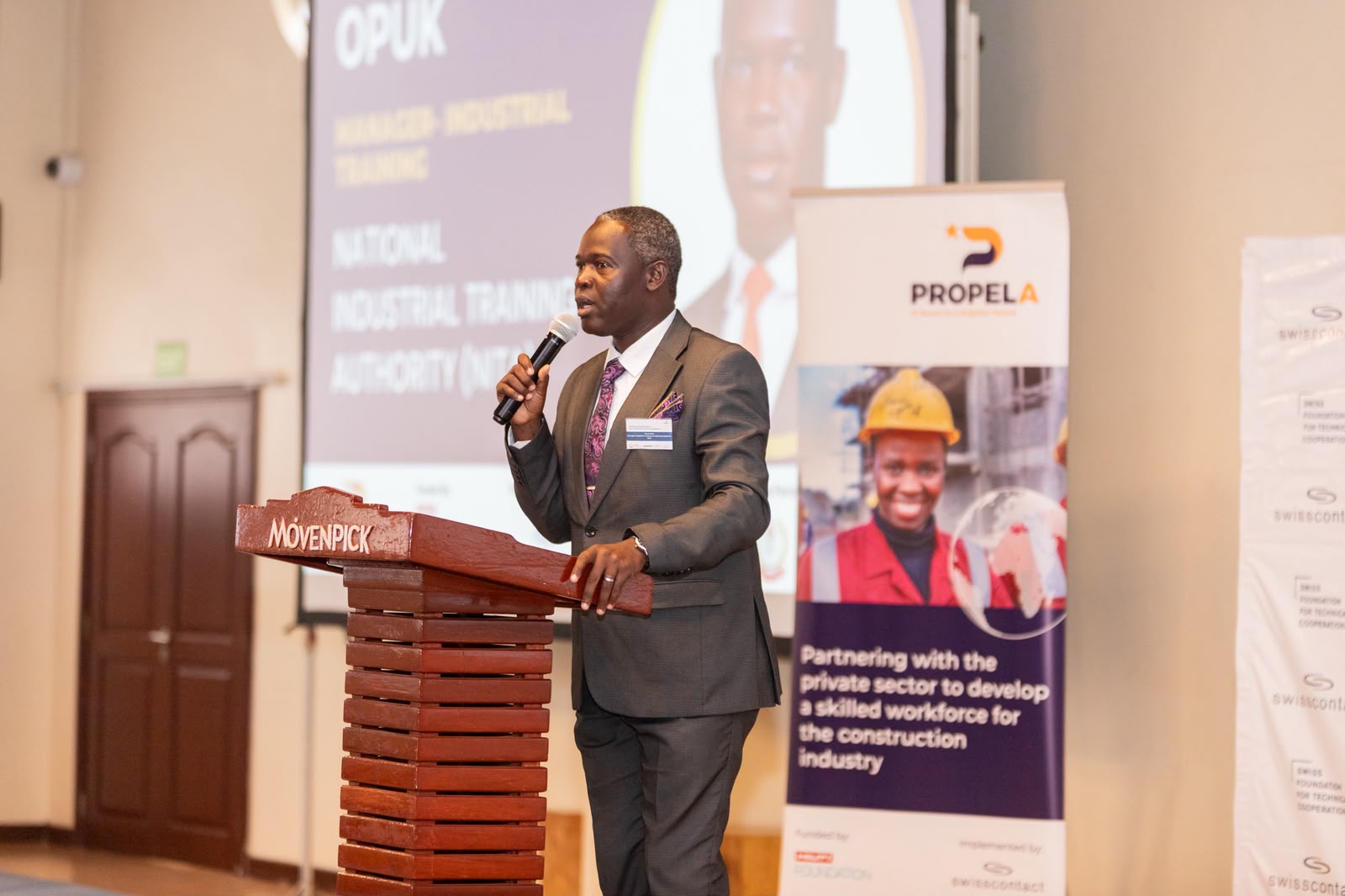
Representing the government, National Industrial Training Authority (NITA) official Musa Opuk , Industry Training , speaking during during the PropelA Business Impact and Investment Insights Breakfast hosted by Swisscontact
By Peace Muthoka
NAIROBI, Kenya — A new PropelA Return on Investment (ROI) Study has found that industry-led apprenticeship programmes are delivering significant financial returns for businesses while creating sustainable employment opportunities for young people, highlighting the value of workplace-based skills development in addressing Kenya’s skills gap.
The findings were unveiled during the PropelA Business Impact and Investment Insights Breakfast hosted by Swisscontact, which brought together government officials, private sector leaders, development partners and workforce development stakeholders to discuss the role of employer-led training in driving business growth and economic transformation.
Conducted by Orange & Teal on behalf of Swisscontact, the independent study found that companies participating in the PropelA Dual Apprenticeship Programme record an average 30 per cent Return on Training Investment (ROTI), generate approximately KES 2 million in net value per company and recover their investment within three years. The research also established that 87 per cent of the value created comes directly from apprentice productivity, demonstrating that investing in skills development translates into improved business performance.
Opening the forum, Swisscontact Kenya Country Director Sharon Mosin said the findings challenge the long-held perception that skills development is merely a social investment. Instead, she urged businesses to treat investment in people with the same priority as investments in machinery, technology and infrastructure.
She noted that a skilled and adaptable workforce remains one of the greatest competitive advantages for any business.
Mosin said poor hiring decisions often result in hidden costs such as lost productivity, increased recruitment expenses, production errors, additional supervision and missed business opportunities. However, she said structured apprenticeship programmes enable companies to develop competent employees while improving productivity, reducing staff turnover and strengthening overall financial performance.
“The question is no longer whether businesses can afford to invest in skills development. The real question is whether they can afford not to,” she said.
She added that PropelA adapts Switzerland’s long-established dual apprenticeship model to Kenya’s labour market by placing employers at the centre of workforce development, demonstrating that private sector investment in skills benefits businesses, young people and the broader economy.
The study comes as Kenya continues implementing the Bottom-Up Economic Transformation Agenda (BETA), which prioritises industrialisation, manufacturing and job creation. Despite growing demand for skilled workers, many employers continue to struggle to recruit industry-ready talent, while thousands of young people face challenges transitioning from education into meaningful employment.
Since its launch, the PropelA programme has partnered with more than 70 companies, trained over 400 apprentices and achieved an employment rate of more than 80 per cent, underscoring its success in bridging the gap between training and employment.
Providing the private sector perspective, Kenya Association of Manufacturers (KAM) Chief Executive Officer Tobias Alando said the programme has demonstrated the effectiveness of demand-driven skills development through stronger collaboration between industry and training institutions.
He revealed that more than 1,500 young people have been trained through industry-led initiatives, while over 1,260 graduates have secured employment. In addition, 710 youth have received entrepreneurship and financial literacy training, while eight industry-aligned curricula have been reviewed to ensure graduates acquire skills that meet employers’ expectations.
Alando further noted that a recent employment summit organised jointly with Swisscontact attracted 22 companies and more than 150 young people, highlighting the growing demand for dual apprenticeships, stronger TVET partnerships and sustainable talent development pipelines.
He also called for reforms to the National Industrial Training Authority (NITA) levy framework, saying improved policy incentives would encourage more employers to invest in workforce development.
Representing the government, National Industrial Training Authority (NITA) official Musa Opuk reaffirmed the government’s commitment to expanding quality work-based learning through apprenticeship programmes and supportive policy reforms.
Opuk said employers have consistently expressed concern that many graduates enter the labour market without sufficient practical experience, making workplace learning essential in preparing industry-ready professionals.
He noted that apprentices spend more than 70 per cent of their training in industry before earning nationally recognised qualifications. He added that employers participating in the programme have so far received KES 4.2 million in government reimbursements, demonstrating the state’s commitment to supporting apprenticeship training.
Opuk encouraged more employers to create apprenticeship opportunities, saying expanding workplace learning would strengthen business competitiveness while opening more employment pathways for young people.