
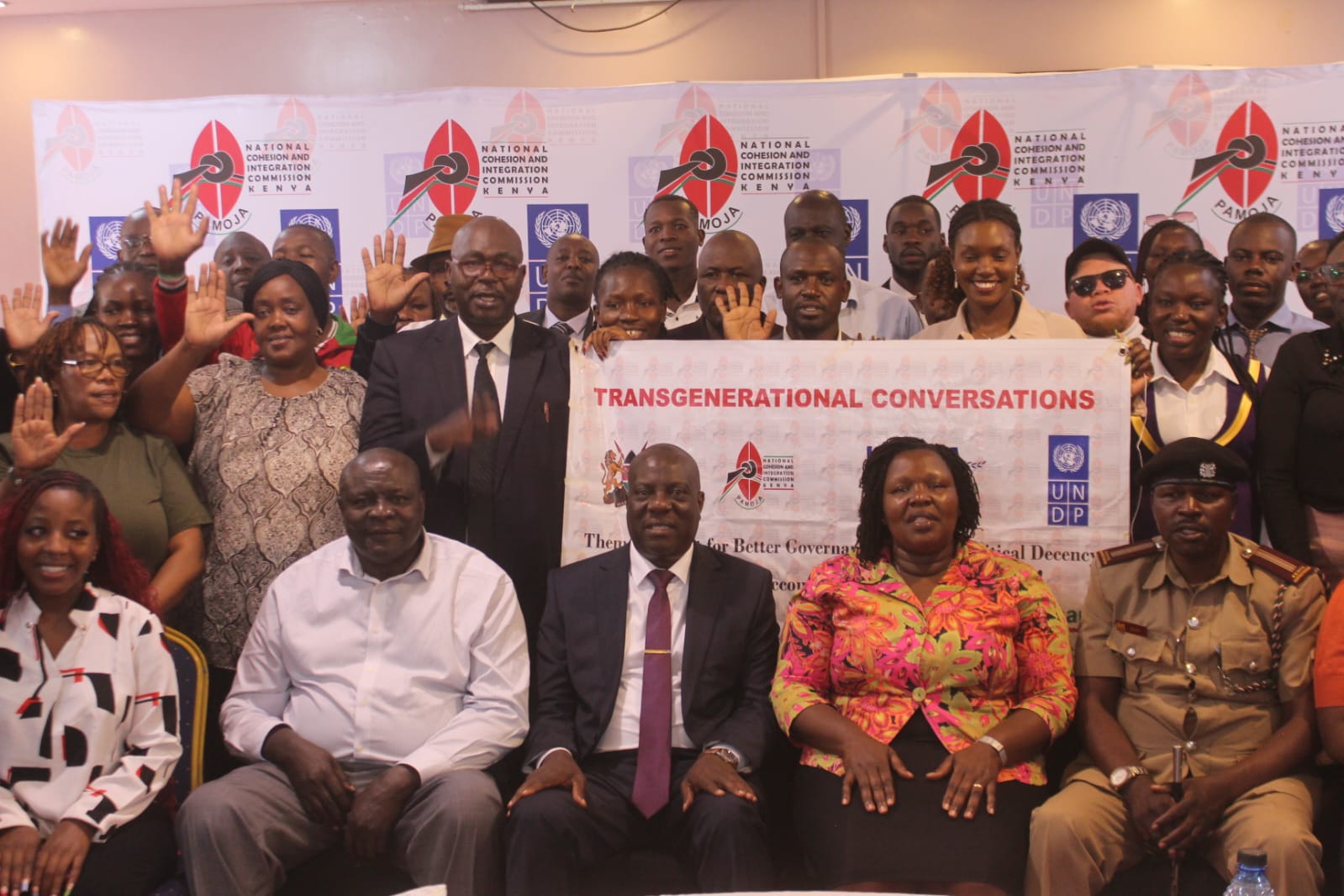
Government institutions, peace organisations, the media and communities pose for a group photo during the second day NCIC sensitisation forum in Nairobi on the Roadmap to a Peaceful 2027 General Election
By Peace Muthoka
NAIROBI, Kenya — The National Cohesion and Integration Commission (NCIC) has stepped up preparations for Kenya’s 2027 General Election, calling for stronger cooperation among government institutions, peace organisations, the media and communities to prevent hate speech, political intolerance and election-related violence.
The call came on Wednesday, October 7, 2026, during the second day of an NCIC sensitisation forum in Nairobi on the Roadmap to a Peaceful 2027 General Election. The two-day forum brought together development partners, government institutions, electoral stakeholders, peace actors and media practitioners to examine emerging risks and strengthen strategies for peaceful elections.
The forum, convened by NCIC in partnership with the United Nations Development Programme (UNDP) and the Korea International Cooperation Agency (KOICA), is being held under the “Uchaguzi Bila Noma” (Elections Without Trouble) campaign. The initiative seeks to take peacebuilding efforts to the county level, curb hate speech and political intolerance, and encourage issue-based political engagement ahead of the 2027 polls.
NCIC Commissioner Hon. Jackson Swadi Kedogo said safeguarding peace during the electoral period requires more than the efforts of one institution. He stressed the importance of collective action, dialogue and sustained collaboration among stakeholders to ensure that political competition does not degenerate into conflict.
Kedogo said the roadmap is intended to strengthen the country’s collective capacity to prevent, manage and resolve electoral-related conflict and violence. He also emphasised the need to deepen commitment to a peaceful 2027 General Election and promote national cohesion, tolerance and peaceful coexistence throughout the electoral cycle.
The second day of the forum focused on understanding what is happening at the community level and identifying potential areas of tension early enough for intervention. Stakeholders were encouraged to share their experiences openly so that emerging threats can be addressed before they develop into larger conflicts.
NCIC Director of Research and Knowledge Management Millicent Okatch said the views of stakeholders participating in the forum were critical to strengthening the commission’s preparedness for the 2027 elections. She urged participants to engage freely and without fear, particularly when discussing issues emerging in their respective areas.
“We want you to understand that you are very important, and the views that you are going to share with us are very critical for NCIC and other stakeholders to help us in our preparedness for the 2027 General Election,” Okatch said.
She said NCIC was particularly interested in understanding potential areas of danger, emerging issues and the actions that need to be taken immediately. The information, she added, would help strengthen early warning and early response mechanisms involving institutions and actors responsible for maintaining peace.
Okatch said the commission would continue engaging stakeholders across the country as part of preparations for the 2027 electoral cycle. She said the process was intended to ensure that concerns emerging at the local level inform national preparedness and response measures.
Presenting the Roadmap to a Peaceful 2027 General Election, NCIC Principal Officer Mohamed Dahiya said Kenya’s experience with multiparty elections demonstrated the need for deliberate efforts to strengthen electoral peace.
Dahiya noted that since the return of multiparty politics in 1992, several election cycles had been characterised by tension, uncertainty and, in some cases, violence. He said the 2002 and 2022 elections were relatively peaceful, but stressed that Kenya still needs sustained efforts to strengthen peaceful electoral processes.
He identified low public trust in institutions, political intolerance, early campaigns, hate speech, ethnic mobilisation, youth vulnerability and the negative use of social media as some of the major challenges that could affect the 2027 electoral period.
According to Dahiya, low public trust in electoral and other institutions remains a major concern, while declining trust between citizens and duty bearers can further create conditions for tension. He said rebuilding trust should therefore form part of the country’s peacebuilding efforts ahead of the elections.
Political intolerance was also identified as a major risk. Dahiya pointed to early campaigns, hate speech, ethnic mobilisation and political polarisation as issues that require attention from political leaders, institutions and citizens.
He said responsible political leadership and accountability would be critical in ensuring that political competition remains peaceful. Citizens, he added, also have a role to play by demanding responsible leadership and rejecting messages that could fuel division.
The role of young people featured prominently in the discussions. Dahiya said youth are central to Kenya’s political future but could be vulnerable to manipulation because of unemployment, frustration and political mobilisation.
He called for young people to be provided with positive spaces for participation and given meaningful leadership roles. Such opportunities, he said, would help them participate constructively in the political process rather than becoming vulnerable to manipulation.
The forum also examined the growing influence of digital platforms on elections. Dahiya warned that social media can be used to spread misinformation, hate speech and other harmful content, while emerging technologies such as artificial intelligence present new challenges that stakeholders must prepare for.
He called for greater digital responsibility, saying online platforms should become spaces for constructive civic engagement rather than tools for incitement and violence.
The roadmap also proposes creating spaces where citizens, particularly young people, can engage directly with duty bearers and institutions, including electoral and security agencies. Such engagement is intended to strengthen public confidence and reduce feelings of intimidation.
Dahiya further stressed the importance of effective early warning and response systems to help prevent conflicts from escalating. He said the responsibility for peaceful elections cannot be left to NCIC alone but must be shared across institutions and communities.
“Everyone has a role to play to ensure we have a violence-free General Election,” he said.
The roadmap therefore seeks to strengthen the country’s collective capacity to prevent, manage and resolve electoral-related conflict while building a multi-stakeholder commitment to a peaceful 2027 General Election.
Beyond preventing violence, NCIC said the process is also about building trust, responsibility and tolerance and ensuring that institutions work effectively from the community level to the national level.
As Kenya moves closer to the 2027 General Election, the Nairobi forum provides an opportunity for stakeholders to examine risks before they escalate and develop coordinated responses. The emphasis on early warning, dialogue and collaboration is intended to ensure that emerging concerns are addressed before they threaten peaceful coexistence.
Under the “Uchaguzi Bila Noma” campaign, NCIC and its partners are seeking to strengthen peace messaging across the country while encouraging Kenyans to engage in political competition without turning political differences into personal or communal conflict.
With the next General Election less than a year away, the commission is urging stakeholders to make peacebuilding a continuous process rather than an intervention reserved for the election period.