Greenpeace Africa Leads 60,000-Kenyan Petition to Halt Forest Destruction
By Peace Muthoka
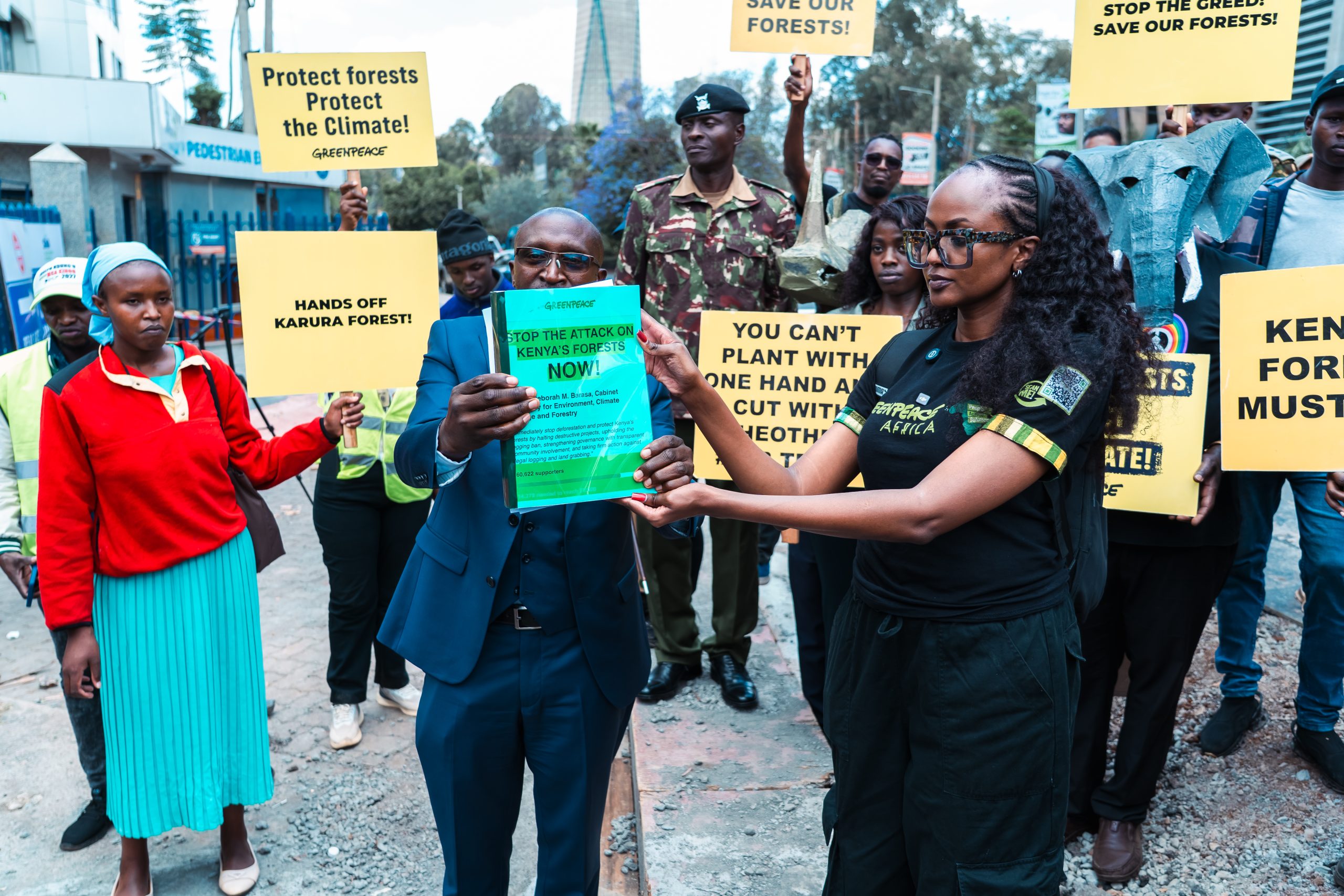
NAIROBI, Kenya, October 6, 2026 – Greenpeace Africa and a coalition of environmental organisations have petitioned the government to immediately halt activities they say are threatening Kenya’s protected forests, with more than 60,000 Kenyans signing a petition demanding stronger protection of the country’s natural forest cover.
In an open letter dated October 6, 2026, and addressed to Environment, Climate Change and Forestry Cabinet Secretary Dr Deborah Mlongo Barasa, the groups said the signatures represent growing public concern over the continued loss and degradation of forests. They want the government to take action against activities they say are putting protected forests at risk, including forest excisions, development projects, logging and land grabbing.
The petition comes as Kenya prepares to mark Mazingira Day on October 10, when national celebrations will culminate in a synchronised tree-planting exercise. However, the petitioners want this year’s celebrations to focus not only on the number of trees planted but also on protecting the forests that already exist. They argue that planting seedlings cannot replace mature indigenous forests that have taken decades or centuries to develop.
According to the petitioners, Kenya’s forests are important water towers that feed rivers supplying homes, farms and industries while supporting biodiversity and the livelihoods of millions of people. They also point to the role played by forest-adjacent communities, who they say have protected and conserved these landscapes for generations.
The groups have raised concerns over several forests and protected areas, including Imenti Forest, Nairobi National Park, Ngong Road Forest, Karura Forest, the Aberdare ecosystem, the Mau Forest Complex and Suam Forest. They say the cases are different in location but reflect a wider concern about development activities taking place in or near protected public forests.
At Imenti Forest, the petitioners are questioning the excision of 2.75 hectares following concurrence issued by the Principal Secretary for Forestry on May 6, 2026. They say the excision came amid reports of plans for an airstrip, golf course and State Lodge, and further allege that aerial footage showed work progressing at the airstrip site despite a court order blocking construction.
The groups argue that the situation at Imenti raises concerns beyond the forest itself, particularly over the enforcement of court orders issued to protect public land. They say failure to respect such orders could weaken efforts to protect other forests facing pressure from development projects.
In Nairobi National Park, the petitioners have raised concerns over the relocation of the Nairobi Animal Orphanage and a proposed 1,300-vehicle parking facility. They say court filings indicate that tree felling and clearing have taken place in an area designated as a Low Use Zone under the park’s management plan. The groups also say 4,642 Kenyans have gone to court over the matter and allege that petitioners were kept out of a court-ordered site inspection in July.
The petitioners have also turned their attention to Ngong Road Forest, which was gazetted in 1932 at about 2,850 hectares but has since been reduced to about 1,224 hectares through repeated excisions. They say heavy machinery entered the forest in July to clear a road linking Talanta Stadium to Bomas, while an eco-lodge was being built inside the Sanctuary Block.
The Environment and Land Court subsequently issued conservatory orders halting the two activities in a case brought by the Law Society of Kenya, the Green Belt Movement and JustAct. While acknowledging the need for infrastructure development in Nairobi, the petitioners argue that the city should not have to sacrifice its remaining forests in order to expand its road and other infrastructure networks.
Karura Forest is another area highlighted in the petition. The groups say trees were cleared around Rangers Village in February 2026 to accommodate National Youth Service personnel without consultation with Friends of Karura, which is the forest’s legal co-manager under a joint agreement running to 2041. Following a meeting with the Ministry in March, the government reportedly agreed to halt the project.
The petitioners are now asking CS Barasa to publicly confirm that commitment and restore the cleared area to indigenous forest in line with the Karura management plan. They argue that such action would demonstrate that government commitments to forest conservation extend beyond public statements to actual protection on the ground.
The Aberdare ecosystem has also been listed among the areas requiring greater protection because it serves as a catchment for the Sasumua and Ndakaini dams, which supply most of Nairobi’s water. The petitioners say the High Court cleared a 52-kilometre road through the Aberdare National Park and Forest in July, subject to the full implementation of environmental safeguards. They want the Ministry to publish how those safeguards will be enforced and monitored.
The Mau Forest Complex has similarly become a major concern for the petitioners. They describe the Mau as one of Kenya’s five main water towers and the largest indigenous montane forest in East Africa. According to the groups, the forest lost about a quarter of its cover between 1973 and 2013 through excisions, settlement, illegal logging and charcoal burning.
The petitioners have also questioned the lifting of the logging ban announced by President William Ruto on October 27, 2025, during the launch of a Mau conservation programme in Elburgon. They say there has been no public disclosure of the transparent framework that the Environment and Land Court required in 2023 before logging could resume.
In Trans Nzoia County, the groups are opposing plans to set aside 50 acres of Suam Forest for a border town and housing project linked to a one-stop border post with Uganda. They say the proposed development could put at risk years of reforestation and conservation work undertaken by the Green Belt Movement and other conservation actors.
The petitioners have particularly questioned the timing of the Suam Forest plans because this year’s national Mazingira Day celebrations will be held in Trans Nzoia. They argue that planting trees in a county where a public forest is facing development pressure would send a contradictory message unless the government also demonstrates its commitment to protecting existing forests.
At the centre of the petition is the argument that Kenya cannot rely on tree planting figures while natural forests continue to shrink. The government’s 15 billion tree programme, running from 2022 to 2032, aims to raise national tree cover to 30 per cent by 2032. The petitioners say they support the programme but insist that growing new trees must happen alongside the protection of mature natural forests.
They argue that a newly planted seedling cannot immediately perform the ecological functions of an indigenous forest that has developed over generations. Natural forests provide habitats for wildlife, protect water catchments and support ecosystems that cannot simply be replaced by planting an equivalent number of seedlings elsewhere.
“Growing tree cover while shrinking our forest cover is a contradiction,” the petitioners said, calling for a shift in the national environmental conversation from planting figures to forest protection and the survival of planted trees.
The groups also raised concerns over the Forest Conservation and Management (Amendment) Act, 2026, which took effect on June 16. They say the law allows the Kenya Forest Service to grant easements and wayleaves for roads and utilities across gazetted public forests. Combined with illegal logging and land grabbing, they argue, the provision could expose more public forests to pressure from development projects.
As a result, the petitioners want the Ministry to halt what they describe as destructive projects in Imenti Forest, Nairobi National Park, Ngong Road Forest, Karura Forest, Suam Forest and other protected forests. They are also calling for all court orders protecting forests to be respected and enforced.
The groups are further demanding that the government uphold the logging ban, including reinstating it in the Mau Forest Complex. They want greater transparency in forest governance through public disclosure of every excision, easement and licence affecting public forests, as well as meaningful participation by community forest associations and communities living adjacent to forests.
They have also called for firm action against illegal logging and land grabbing, including investigations and prosecution of those responsible and recovery of public forest land. The groups say communities and conservation organisations should have a meaningful role in decisions affecting forests because they are directly affected by the loss of these ecosystems.
The petitioners have asked CS Barasa to use Mazingira Day on October 10 to present the Ministry’s plan for protecting Kenya’s forests. They have also requested a written public response to each of the petition demands within 30 days, saying more than 60,000 signatories and others supporting the campaign will be watching the government’s response.
For Greenpeace Africa and its partners, the petition is ultimately about changing how Kenya measures progress in environmental conservation. They want the government to report not only how many trees have been planted but also how many have survived, how much natural forest has been protected, how much has been lost or degraded and what action has been taken against activities threatening public forests.
The groups said Kenyans have for years participated in efforts to defend forests, citing the role of citizens, community forest associations and conservation groups in protecting areas such as Karura and the Mau. With Mazingira Day approaching, they are now calling on the government to demonstrate that tree growing and forest protection will move forward together.