
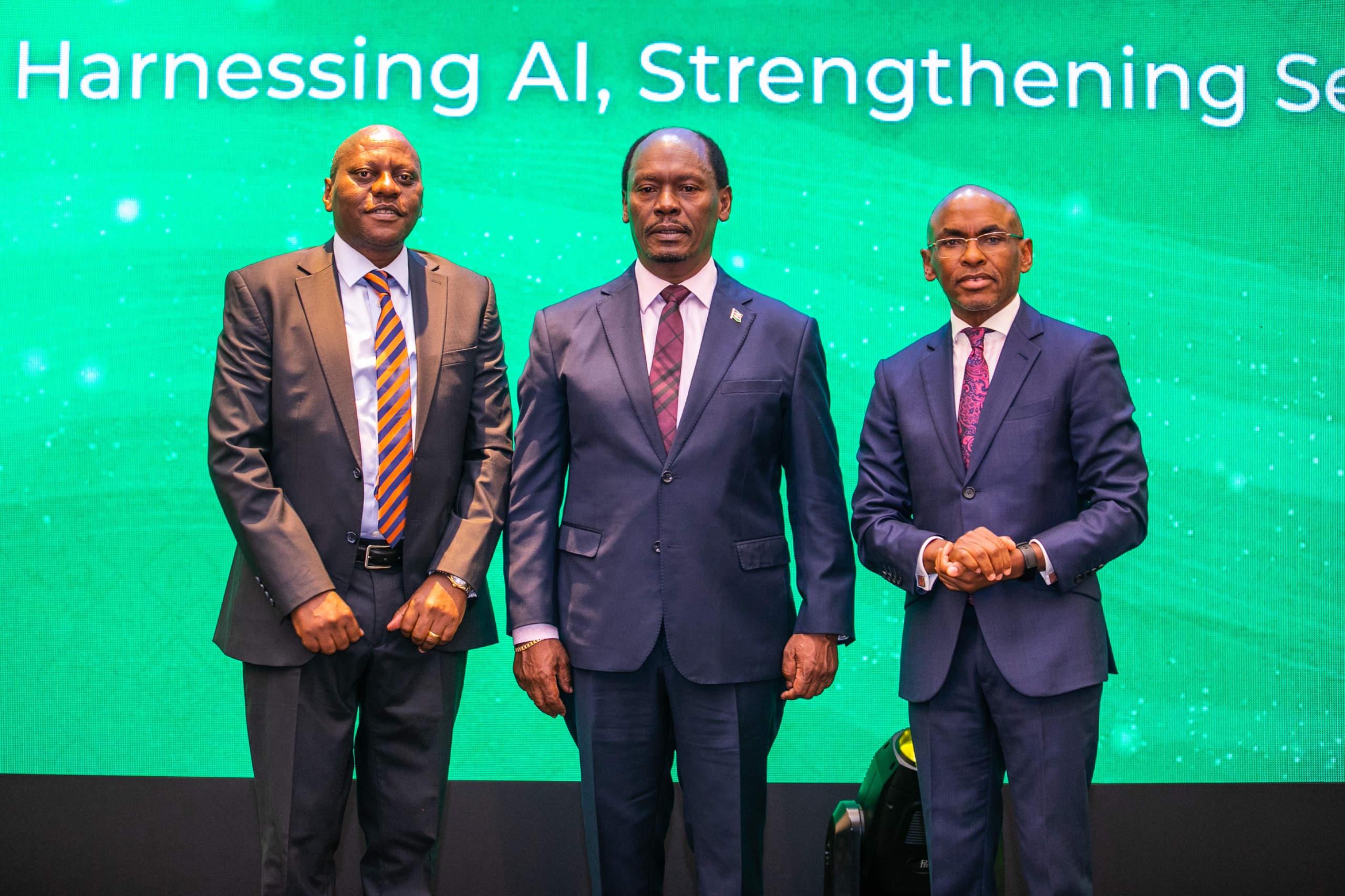
From left: Nicholas Mulila, Group Chief Risk Officer, Safaricom PLC; William Kabogo, Cabinet Secretary for Information, Communications and the Digital Economy; and Peter Ndegwa, Group Chief Executive Officer, Safaricom PLC, during the 4th Annual Safaricom Cybersecurity Summit at JW Marriott, Nairobi.
By Peace Muthoka
NAIROBI, Kenya, October 14, 2026 — Kenya recorded 11.12 billion cyber threat events in the last financial year, a 29 per cent increase from 8.62 billion in the previous year, underscoring the growing need for stronger digital security as artificial intelligence creates new challenges for businesses and institutions.
The figures from the Communications Authority of Kenya (CA), through the National Kenya Computer Incident Response Team–Coordination Centre, were highlighted as Safaricom hosted its fourth annual Cybersecurity Summit in Nairobi on Wednesday, October 14, 2026.
Held under the theme “Harnessing AI, Strengthening Security,” the summit brought industry leaders together to examine how organisations can harness artificial intelligence to improve cybersecurity while responding to increasingly sophisticated digital threats.
Discussions focused on emerging risks, including deepfakes, AI-generated impersonation, automated scams and ransomware, as organisations face growing pressure to protect their systems, customer information and digital transactions.
Safaricom Group Chief Executive Officer Peter Ndegwa said the opportunities presented by artificial intelligence must be matched with safeguards that protect users and strengthen trust in digital services.
“AI is expanding what is possible for businesses and society, but that opportunity must be built on trust,” Ndegwa said.
He called on organisations to make cybersecurity an integral part of developing digital products and services rather than treating it as an additional technical measure after deployment.
“Cybersecurity can no longer be treated as a technical safeguard added after a service is developed. It must be embedded from the start and strengthened through shared standards, responsible innovation and collaboration across sectors,” he said.
Ndegwa added that stronger safeguards were necessary to ensure digital transformation remained safe, inclusive and worthy of customers’ confidence.
Participants examined how AI-powered threat detection could help organisations identify suspicious activity, improve incident response and prepare for ransomware attacks. They also discussed the cybersecurity skills gap and the need to equip workers with the knowledge required to manage emerging digital risks.
Through expert discussions, live demonstrations and practical scenarios, the summit highlighted the importance of combining technology with clear procedures, accountability and a workforce capable of recognising and responding to cyber threats.
Organisations were encouraged to verify high-risk requests, identify unusual activity and act promptly when security breaches occur. The discussions emphasised that protecting digital systems requires not only advanced technology but also employees who understand their role in preventing attacks.
The concerns come as businesses and public institutions increasingly depend on digital platforms to deliver services, communicate with customers and conduct transactions.
While artificial intelligence can strengthen the detection of suspicious activity, it can also enable criminals to automate scams, create convincing fake content and impersonate legitimate individuals or organisations. This makes it increasingly important for institutions to review their security measures as they adopt new technologies.
Safaricom said it remained committed to supporting secure digital infrastructure as Kenya expands its use of emerging technologies, with particular attention to micro, small and medium enterprises (MSMEs).
The company said MSMEs account for about 70 per cent of Kenya’s gross domestic product (GDP), making the protection of their operations, customer information and digital transactions important to the resilience of the wider economy.
To help businesses strengthen their security, Safaricom offers Software-Defined Wide Area Network (SD-WAN) services, which provide secure, centrally managed connectivity across multiple business locations.
The company also offers a Managed Security Operations Centre (MSOC), which provides continuous threat monitoring, expert analysis and coordinated incident response.
According to Safaricom, the two solutions enable smaller businesses to access enterprise-grade security services without having to develop and manage complex cybersecurity systems entirely in-house.
By helping MSMEs protect their systems and respond to cyber incidents, the company aims to support business continuity, competitiveness and confidence in digital transactions.
Now in its fourth year, the Safaricom Cybersecurity Summit has established a platform for industry dialogue, knowledge sharing and collaboration on digital security in Kenya.
This year’s meeting underscored the need for organisations to strengthen cybersecurity governance, invest in appropriate technologies and build the skills needed to respond to evolving threats as artificial intelligence becomes more widely adopted.
As Kenya’s digital economy continues to expand, the rising number of reported cyber threat events highlights the importance of treating cybersecurity as a core part of digital transformation rather than an afterthought.