
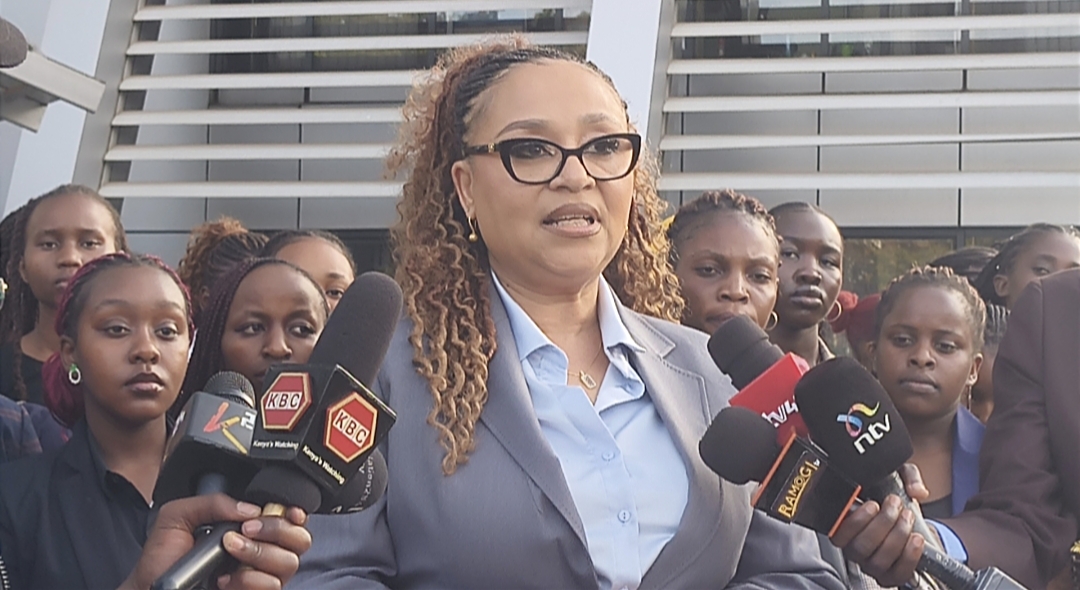
Ekaterina Handa Leads Women’s Petition Over Delayed Transmission of Two-Thirds Gender Court Order
By Peace Muthoka
NAIROBI — A group of women lawyers, students and advocates has petitioned the Commission on Administrative Justice, commonly known as the Ombudsman, over the alleged failure to transmit a 2017 High Court order directing Parliament to enact legislation to give effect to the two-thirds gender principle.
The group, led by High Court advocate Ekaterina Handa, is seeking the Ombudsman’s intervention to establish the status of the court order and determine why it has allegedly not been transmitted to the Speakers of the National Assembly and the Senate.
Reading the group’s statement, Handa said the matter dates back to a High Court ruling delivered on March 29, 2017, in Petition No. 371 of 2016, in which Justice John Mativo directed Parliament and the Attorney General to take steps to ensure that legislation implementing the two-thirds gender principle was enacted within 60 days. Kenya Law confirms that the court issued the order under Article 261 of the Constitution.
“We are here because in 2010, Kenyans gave themselves a Constitution that promised more than two-thirds of one gender in Parliament under Articles 27 and 81,” Handa said.
Article 27(8) requires the State to take legislative and other measures to implement the principle that no more than two-thirds of members of elective or appointive bodies should be of the same gender. Article 81(b) similarly provides that no more than two-thirds of members of elective public bodies should be of the same gender.
According to Handa, the group is concerned that despite the 2017 court order, the process of implementing the legislation has remained unresolved.
She said the Supreme Court had earlier, in its 2012 Advisory Opinion, set a timeline for putting in place a mechanism to realise the two-thirds gender principle. The deadline later passed without the required legislation being enacted, leading to further court proceedings. The High Court subsequently ruled in Petition No. 371 of 2016 that Parliament had failed to fulfil its constitutional obligation and issued the 60-day order.
The High Court order directed Parliament and the Attorney General to take steps to ensure that the required legislation was enacted within 60 days and to report progress to the Chief Justice. It further provided that if Parliament failed to comply, the petitioners or any other person could petition the Chief Justice to advise the President to dissolve Parliament under Article 261.
Handa said the group is now asking the Ombudsman to establish whether the 2017 order was transmitted and, if it was not, determine why the process was not completed.
She referred to proceedings in Petition No. 770 of 2026, saying a three-judge bench on June 5 found no evidence that the order had been transmitted, unless the transmission had taken place within the preceding four months.
The group wants the Commission on Administrative Justice to establish the status of the order, make its findings public and investigate the circumstances surrounding the alleged delay.
Handa said the issue has remained unresolved through successive general elections, including those held in 2013, 2017 and 2022, while Parliament has continued to operate without legislation fully giving effect to the constitutional requirement.
The matter has also been the subject of previous court proceedings. In September 2020, then Chief Justice David Maraga advised the President to dissolve Parliament over its failure to enact legislation to implement the two-thirds gender principle. Several petitions were subsequently filed challenging the advisory.
Handa said Justice Korir issued a conservatory order on September 24, 2020, suspending the process at the time and preventing the Registrar from transmitting the earlier court order.
She said the conservatory orders were lifted in 2025, clearing the way for the Registrar to proceed with the transmission process.
Under Article 261, the Constitution sets out a process to be followed where Parliament fails to enact legislation required by the Constitution. The High Court may transmit an order directing Parliament and the Attorney General to take steps to enact the required legislation within a specified period. If Parliament subsequently fails to comply with such an order, Article 261 provides for further constitutional steps, including advice by the Chief Justice to the President to dissolve Parliament.
Handa said transmitting the 2017 order would therefore set in motion the legal process contemplated by the Constitution.
She said the group believes the issue remains important ahead of the 2027 General Election because of the constitutional requirement for gender representation in elective bodies.
The group also linked the implementation of the gender principle to broader public policy and legislation affecting areas such as healthcare, gender-based violence and land rights, where women’s participation in decision-making remains an important concern.
Handa stressed that the group was not asking for special treatment for women but for the implementation of constitutional provisions adopted by Kenyans in 2010.
“We are here because in 2010, Kenyans gave themselves a Constitution that promised more than two-thirds of one gender in Parliament under Articles 27 and 81,” she said.
The petition places renewed attention on a constitutional requirement that has remained the subject of court battles and legislative efforts for more than a decade. Kenya Law records that the 2017 High Court decision found Parliament’s failure to enact the required legislation within the prescribed period unconstitutional and issued the 60-day mandamus order.