
Nairobi Trust Summit Adopts 29-Point Action Plan, Proposes UN Global Trust Facility
By Peace Muthoka
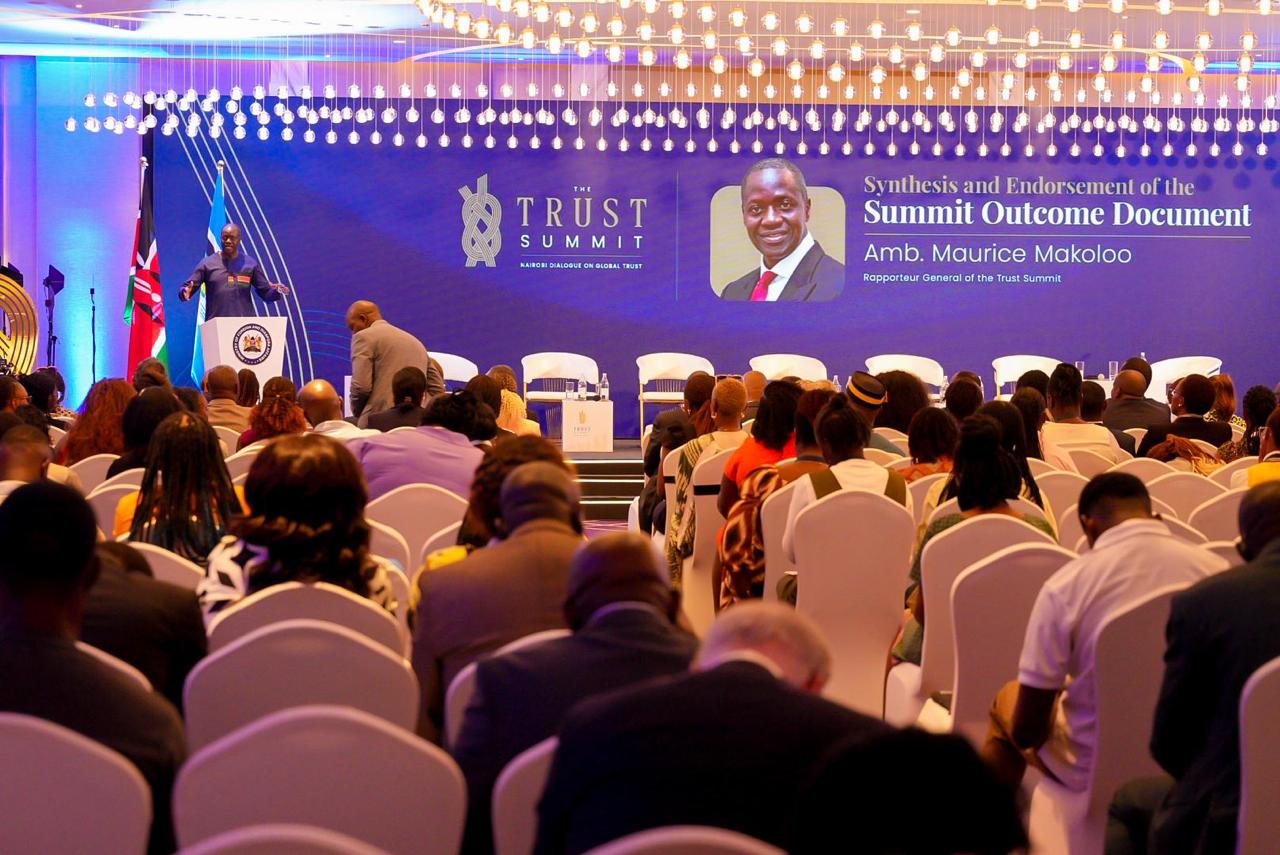
NAIROBI, Kenya, October 23, 2026 — The inaugural Trust Summit in Nairobi has adopted a 29-point Call to Action aimed at rebuilding public confidence in institutions worldwide, proposing reforms to multilateral systems, stronger accountability measures and a new Global Trust Facility under the United Nations.
The agreement followed a three-day summit held from October 21 to 23 under the theme, “Weaving Trust: Binding Strands for a Stronger Global Order.” The meeting brought together government representatives, international organisations, business leaders, civil society groups, academics, technology experts, media practitioners and young people to examine the growing trust deficit and its implications for global stability and prosperity.
To sustain the initiative beyond the summit, participants proposed three mechanisms: a Coalition on Global Trust, a Nairobi Trust Council to be hosted by Kenya, and a Global Trust Facility at the United Nations to finance initiatives that strengthen public institutions and international cooperation.
The Nairobi Call to Action identifies trust as a global public good and a foundation for effective governance, economic growth, peace, climate action and global health security. It stresses that public confidence cannot depend on communication campaigns alone. Instead, institutions must demonstrate accountability, honour their commitments and protect the public interest.
“Trust is a public good that must be deliberately nurtured, financed and strengthened. The true measure of this Summit will be the commitments we translate into tangible outcomes for our citizens,” said Korir Sing’Oei, Principal Secretary in Kenya’s State Department for Foreign Affairs.
Sing’Oei said the next phase would focus on developing a practical implementation plan and taking public engagement campaigns to counties. Through these campaigns, regulators and public institutions would explain their decisions, demonstrate accountability and show citizens how they protect the public interest.
He added that the summit had created space for inclusive dialogue and diverse perspectives. Organisers also plan to extend the Trust Dialogues to other countries.
Four priorities for rebuilding trust
The 29-point framework sets out four priorities for turning commitments into measurable action: restoring trust in public institutions, reforming multilateral systems, strengthening trust in the digital age, and promoting inclusion and belonging.
First, the agreement proposes an annual Regulatory Trust Index at national, regional and global levels. The index would assess public confidence in regulatory institutions and identify areas that require reform.
It also calls for stronger regulatory cooperation and mutual recognition through frameworks such as the East African Community and the African Continental Free Trade Area. These measures would help reduce unnecessary compliance costs arising from fragmented regulatory systems. In addition, subnational peer-review mechanisms could strengthen accountability and improve public confidence.
Second, the framework calls for reforms to multilateral institutions and the global financial architecture to make them more representative, transparent and accountable.
Among the proposals is a review conference on the United Nations Charter under Article 109. The agreement also advocates stronger global health governance, equitable access to medical countermeasures and better coordination among regional and continental organisations working to prevent and resolve conflicts.
Furthermore, it stresses that countries must match their climate commitments with predictable financing, technology transfer and capacity building, particularly in nations facing disproportionate climate risks.
Third, the Call to Action addresses the challenges that artificial intelligence, digital platforms and synthetic content pose to public discourse. It urges faster implementation of the Global Digital Compact and stronger international cooperation on AI governance.
The agreement also calls for greater African participation in global digital decision-making, more transparency around platform algorithms and synthetic content, and stronger protections for independent journalism and scientific integrity.
Finally, the framework focuses on inclusion and belonging. It calls for children, young people, women, persons with disabilities, displaced people and excluded communities to participate meaningfully in decisions that affect their lives.
It also advocates wider access to employment, entrepreneurship and finance for young people. At the same time, it recognises sport, culture and the creative economy as important tools for strengthening social cohesion.
Proposed mechanisms to drive implementation
Beyond setting out priorities, the agreement proposes new mechanisms to coordinate action and monitor progress.
The Coalition on Global Trust would provide an open platform where governments and non-state actors could share knowledge, coordinate initiatives and advance commitments across countries and sectors.
Meanwhile, the Nairobi Trust Council, which Kenya is expected to host, would bring together prominent figures from the public, private and philanthropic sectors to review progress and promote accountability.
Participants also agreed to champion the proposed Global Trust Facility at the United Nations. The facility would operate as a voluntary financing mechanism supported by state and non-state contributors over an initial four-year period.
According to the summit statement, the United Nations Development Programme would administer the facility, subject to further development and implementation.
Potential areas of support include national accreditation bodies, regulatory trust indices, data protection, cybersecurity authorities and judicial cooperation mechanisms.
To track progress, the Summit Secretariat will develop a Framework for Action with monitoring, tracking and reporting arrangements, including reviews every two years.
The Call to Action also encourages international organisations, including the United Nations Conference on Trade and Development, to conduct a study every two years examining the economic costs of distrust.
“The Nairobi Call to Action moves the world from diagnosing the trust deficit to doing something about it. Trust is a global public good, and no institution, sector or country can rebuild it alone,” said Awel Uwihanganye, chief executive officer of the Trust Summit.
“We invite every government, business, community and young person to join us,” he added.
Africa seeks a stronger role in global governance
The agreement also underscores Africa’s role as an equal partner in shaping global governance, financial cooperation, digital inclusion and access to global public goods.
With approximately 70 per cent of sub-Saharan Africa’s population under the age of 30, participants emphasised that young people must contribute actively to institutional reform, economic development and international cooperation rather than remain mere beneficiaries of policy decisions.
Looking ahead, organisers expect the Nairobi Trust Summit to convene every two years. They are also considering extending the Trust Dialogues to regional and international platforms.
However, adopting the Call to Action marks only the beginning. Its impact will depend on whether governments, international organisations, businesses, civil society and communities turn the commitments into practical reforms, allocate resources and demonstrate measurable results.
The summit therefore calls on governments, institutions, businesses, young people and civil society organisations to engage with the Coalition on Global Trust and help advance the Nairobi Call to Action.
About the Trust Summit
The Trust Summit: Nairobi Dialogue on Global Trust is a multi-stakeholder platform that develops practical approaches to rebuilding trust in public institutions, multilateral systems, economic infrastructure and digital technologies.
The 2026 summit took place in Nairobi from October 21 to 23 under the theme, “Weaving Trust: Binding Strands for a Stronger Global Order.”
The full Nairobi Call to Action is available at www.globaltrustsummit.org.