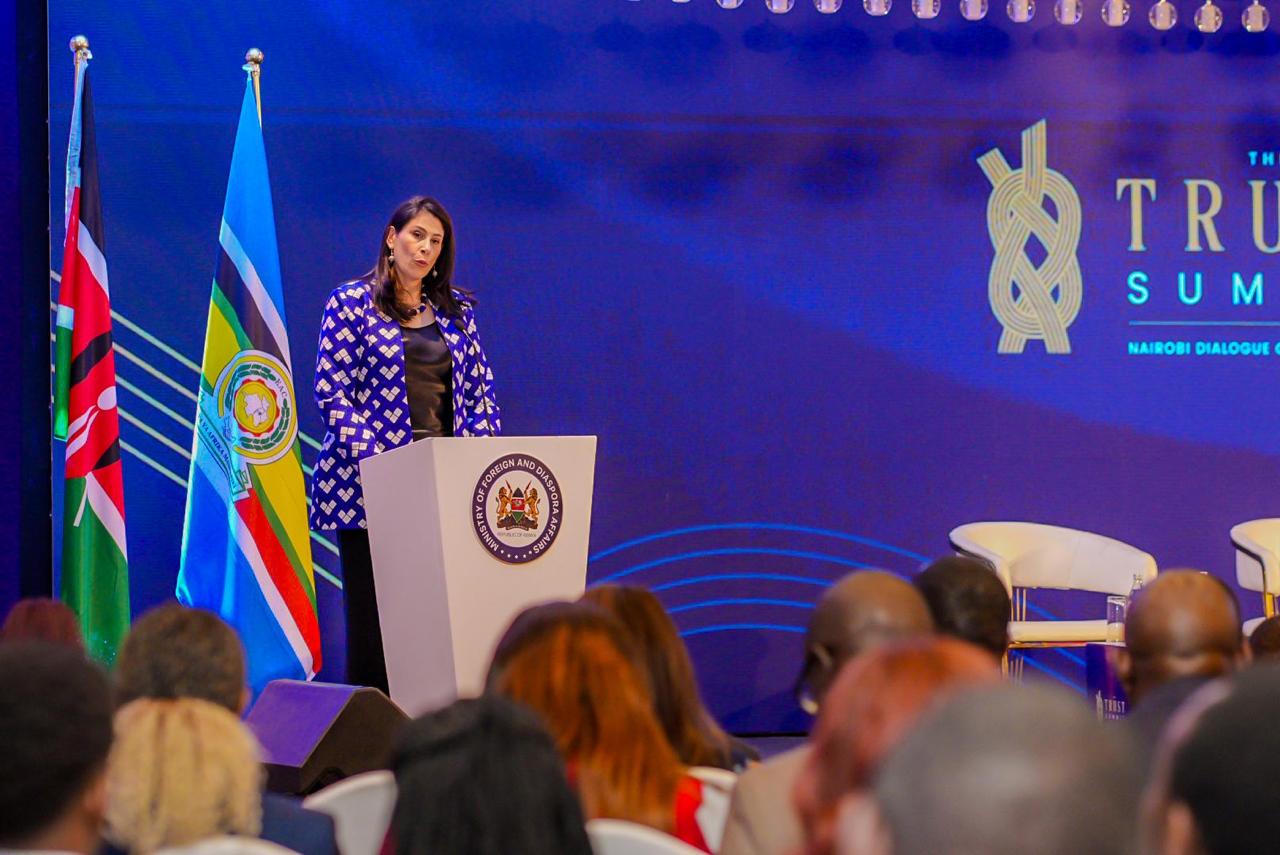
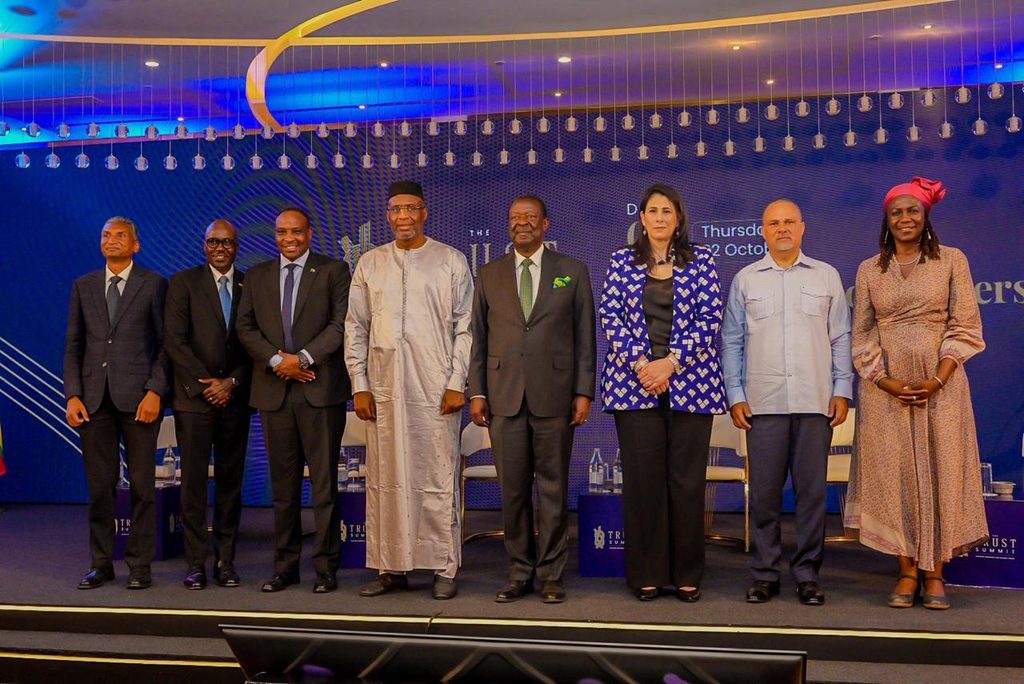
African Union Commission Deputy Chairperson Selma Malika Haddadi Speaking at the opening of the Trust Summit in Nairobi on Thursday
By Peace Muthoka
NAIROBI, Kenya, October 22, 2026 — African Union Commission Deputy Chairperson Selma Malika Haddadi has urged African and global leaders to rebuild trust in international institutions and honour their commitments, warning that growing mistrust is making it harder for countries to work together on shared challenges.
Speaking at the opening of the Trust Summit in Nairobi on Thursday, Haddadi said cooperation was increasingly necessary to address conflicts, climate change, economic uncertainty and rapid technological change, yet confidence between nations and institutions remained fragile.
“We have never needed one another more, while finding it increasingly difficult to trust one another,” she said.
The summit brought together senior government officials, including Prime Cabinet Secretary and Cabinet Secretary for Foreign and Diaspora Affairs Musalia Mudavadi, former Mali Prime Minister Moussa Mara, Tanzania’s Deputy Minister of Foreign Affairs and East Africa Cooperation James Ole Millya, and Kenya’s Principal Secretary for Foreign Affairs Abraham Korir Sing’Oei.
Haddadi said trust should be treated as an essential foundation for cooperation, just like the roads, railways, energy networks and digital connections that link countries. Without it, she argued, agreements and institutions alone could not guarantee that governments would work together or deliver on their promises.
“Trust is therefore not simply a moral aspiration. It is an essential condition of our collective capacity to act,” she said.
Her remarks placed accountability and the implementation of commitments at the centre of discussions on Africa’s integration and the future of international cooperation.
Haddadi said the African Union had made important strides since the establishment of the Organisation of African Unity, with initiatives including the Abuja Treaty, Agenda 2063 and the African Continental Free Trade Area providing a framework for closer continental ties. The challenge, she said, was to turn these agreements into lasting cooperation and shared responsibility among member states.
She called on the AU to continue earning the confidence of its members through effective leadership, accountability and tangible results. At the same time, she urged member states, African financial institutions and the private sector to provide reliable financial support to enable the Union to fulfil its mandate.
Sustainable funding, she said, was not merely a financial obligation but a sign that African countries and institutions believed in the Union and were willing to take collective responsibility for its work.
Haddadi also recognised President William Ruto’s role as the African Union Champion for Institutional Reform, citing the push for a more effective, accountable and financially sustainable continental body.
On peace and security, she said trust was critical to mediation and collective efforts to resolve conflicts. She pointed to provisions in the AU Constitutive Act and the protocol establishing the Peace and Security Council as evidence of the confidence member states had placed in continental mechanisms to address issues affecting their security.
However, she warned that such arrangements could not deliver lasting peace without confidence in the process, sustained cooperation and adequate funding.
“Trust is not merely an outcome of peace. It is also one of the conditions that makes peace possible,” she said.
Haddadi also turned her attention to the international system, calling for reforms that would make global institutions more effective and representative while upholding international law.
She welcomed the theme of the 81st session of the United Nations General Assembly, “Restoring Trust, Managing Transformation: A United Nations That Delivers for All,” and recalled UN Secretary-General António Guterres’s position that, despite its shortcomings, the organisation remained irreplaceable.
“Defending and preserving multilateralism and reforming it are not competing ambitions. They are mutually reinforcing responsibilities,” she said.
She said the UN@80 reform initiative offered an opportunity to strengthen accountability and effectiveness, but added that reforms must also address representation, fairness and the consistent application of international law if African countries were to have confidence in the global order.
The summit’s discussions on democracy, trade, investment, public health, climate change, security and artificial intelligence, she said, all came back to the same issue: whether institutions could be trusted to deliver on their promises.
Haddadi welcomed plans for a Nairobi Call to Action, saying its success would depend on whether participants took ownership of the commitments made and followed through with implementation.
She commended Kenya for hosting the summit, saying the meeting offered an opportunity to strengthen dialogue and cooperation among African countries and international partners.
“Trust cannot be proclaimed into existence. It must be earned through the way we govern, the way we cooperate and the commitments we honour,” she said.
She challenged delegates to ensure the summit produced more than statements of intent, urging them to leave Nairobi with a stronger commitment to building institutions and partnerships that people and countries could rely on.