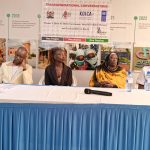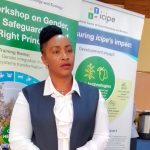

Tessie Musalia, Chair of the Ushiriki Wema Foundation, hands over neonatal incubators donated through the Okoa Malaika Programme to Tharaka Nithi, Embu and Meru counties during the International Women’s Day celebrations at Chuka County Referral Hospital in Tharaka Nithi County on March 8, 2026. Receiving the incubators are Tharaka Nithi First Lady Margaret Muthoni (left) and Njoki Mambo (centre).
By Peace Muthoka
Tharaka-Nithi County, March 8, 2025 -Healthcare workers, mothers and community leaders gathered to mark Phase 7 of the Okoa Malaika programme during the 2026 International Women’s Day celebrations.
The initiative, led by the Ushiriki Wema Foundation, continues to strengthen newborn care across Kenya by donating life-saving equipment to hospitals. Since its launch in November 2023, the programme has already supported neonatal units in 25 counties.
Now, the journey has reached counties 26, 27 and 28, with hospitals in Tharaka-Nithi, Meru and Embu receiving infant incubators aimed at giving premature babies a better chance to survive.
For many mothers, the equipment means more than technology. It represents hope during one of the most frightening moments a parent can face.
Chairperson of the foundation, Tessie Musalia Mudavadi, said the milestone was especially meaningful as it coincided with this year’s global call to advance women’s rights and equality.
“Today the 8th of March as we mark Phase 7 of our Okoa Malaika journey which has taken us through 25 Counties in Kenya (today marking county’s 26, 27 & 28) we are also celebrating International Women’s Day whose 2026 UN theme is: Rights. Justice. Action. For ALL Women and Girls. Rights. with its campaign theme being ‘Give to Gain,’,” she said.
Tessie explained that the “Give to Gain” campaign highlights a powerful truth: investing in women and girls strengthens families and builds stronger communities.
“The campaign on Give to Gain reminds us that every investment we make in women and girls returns multiplied in healthier families, stronger communities and a more prosperous nation,” she said.
She noted that the impact of such investments becomes painfully clear in neonatal units, where fragile newborns fight for survival every day.
Globally, prematurity remains one of the leading causes of newborn deaths. In Kenya, thousands of babies die each year due to inadequate neonatal intensive care facilities and equipment.
She said that behind every premature birth is often a mother carrying overwhelming emotional pain.
“Today as we donate the infant incubators I want us to look beyond the machines and focus on the women,” she said.

“When a baby is born too soon, it is often the mother who carries the emotional weight the fear, the guilt, the uncertainty. When we invest in infant incubators, we are not only saving newborn lives; we are protecting mothers from preventable grief. We are strengthening women’s mental health. We are preserving families.”
She emphasized that giving hospitals the right equipment creates a ripple effect across the entire community.
“When we give: We give hospitals the equipment they need. We give nurses the tools to do their jobs effectively. We give mothers hope. We give newborns a fighting chance,” she said.
“And what do we gain? We gain healthier children who grow into productive adults. We gain women who can return to their families and communities empowered rather than devastated. We gain economic stability… And finally, we gain a stronger Kenya.”
Tessie also linked the programme to national efforts to reduce maternal and newborn deaths, referencing remarks by President William Ruto during the 39th African Union Assembly in Addis Ababa.
Quoting the President, she said, “it is unacceptable that women should continue to die while giving birth.”
“Protecting the lives of women and children is a responsibility we must uphold without compromise,” she added.
She also highlighted government efforts to expand healthcare coverage to vulnerable mothers through the Social Health Authority, noting that the President had insisted that “cost should never be the reason a young woman is denied safe childbirth.”
However, Tessie said one challenge repeatedly raised during the foundation’s visits across the country is the struggle faced by mothers of premature babies once they leave hospital.

“Our visits to 25 counties have revealed a challenge that weighs heavily on mothers of pre-term babies,” she said.
“By law employed mothers must return to work after 90 days of maternity leave… While this may suffice for mothers of full-term infants it fails to account for the unique circumstances of caring for pre-term babies.”
She urged lawmakers to consider extending maternity leave for mothers with premature babies, noting that several African countries already provide longer leave periods.
“Extending maternity leave for mothers of pre-term babies is not charity but an investment. An investment in healthier children, stronger families and a more productive nation,” she said.
Tessie further called on the government, private sector and development partners to expand access to quality neonatal care across the country.
“On this International Women’s Day let us remember that when we give our time resources and support to a cause we gain healthier communities, empowered women and Kenya will gain generations of strength, resilience and possibility,” she said.
The programme’s Brand Ambassador, Njoki Mambo, said Okoa Malaika was created with one mission to prevent families from experiencing the heartbreak of losing a baby too soon.
“Okoa Malaika, a pre-term mitigation program, was born out of a vision to ensure that no family in Kenya suffers the heartbreak of losing a baby to prematurity,” she said.
“Since its inception in November 2023 during the World Prematurity Day, we have journeyed across the country, boosting newborn units in referral hospitals with incubators and other support equipment.”
Mambo described every incubator placed in a hospital as a symbol of life and reassurance to anxious mothers.

“When we give incubators, we are reducing preventable deaths among preterm infants by giving them warmth, protection, and support they need in their earliest, most vulnerable days,” she said.
“Each incubator we place in a hospital is therefore a symbol of hope. It is a promise to the mothers that their babies’ survival will never be left to chance.”
She also paid tribute to mothers caring for fragile newborns and the health workers who stand beside them.
“Indeed, on this International Women’s Day, we honour the incredible resilience of mothers who fight alongside their little angels in the neonatal units, and we also celebrate the dedicated healthcare professionals who support mothers and newborns in these units every single day,” she said.
As the incubators were handed over to referral hospitals in Tharaka-Nithi, Meru and Embu, the message of the day was clear every newborn life matters.
And for the families who will walk into those neonatal units tomorrow, the new equipment may mean the difference between heartbreak and hope.