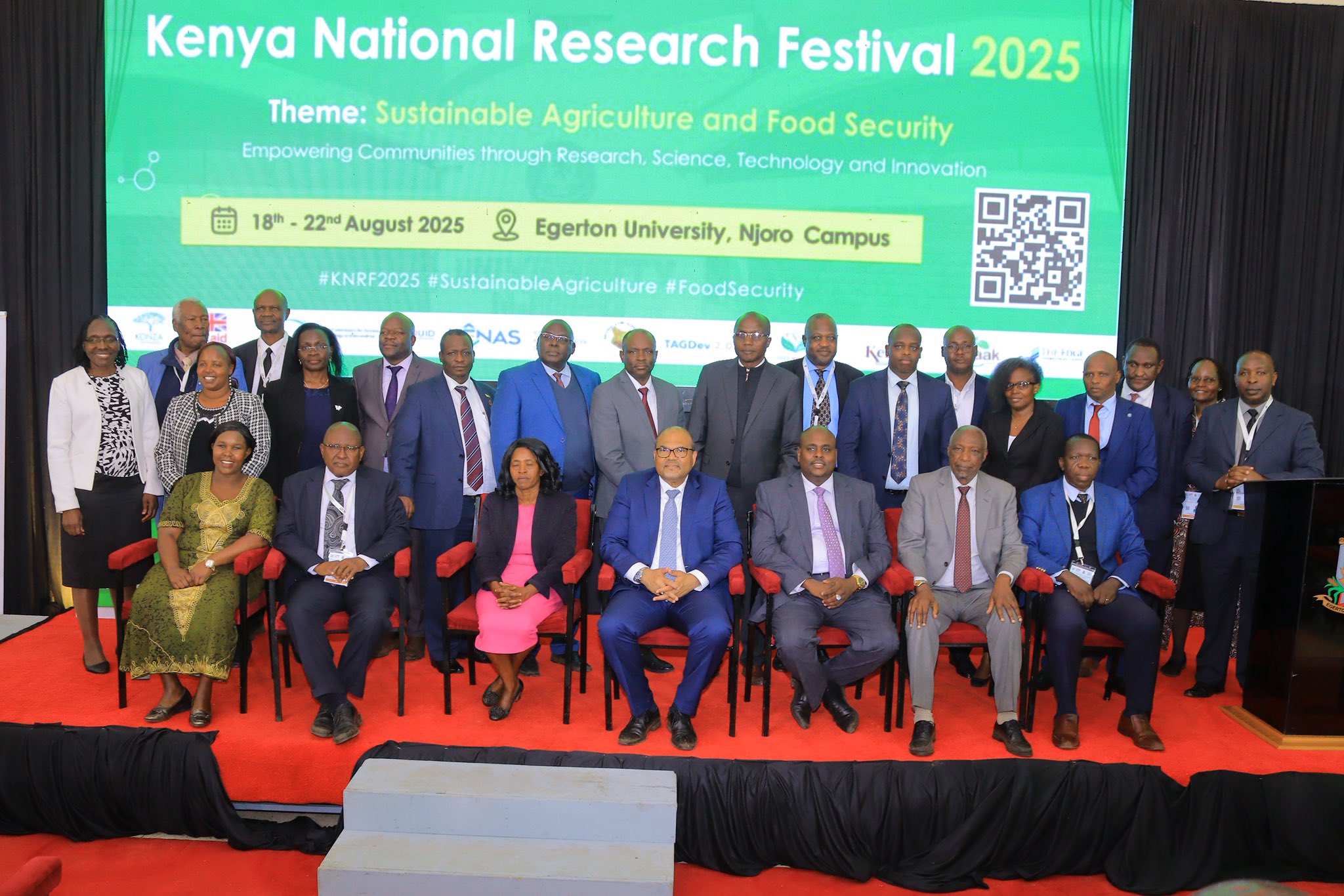
Different stakeholders, researchers and partners pose for a group photo during the Kenya National Research Festival at Egerton University on August 18, 2025.
By Peace Muthoka.
Njoro, August 18, 2025 — Kenya is stepping up efforts to harness science, technology, and innovation (STI) to boost food security and strengthen resilience against climate change. This was the key message during a media roundtable held at Egerton University as part of the Kenya National Research Festival.
The session, organized by ISAAA AfriCenter, the National Research Fund (NRF) and partners, brought together agriculture journalists to discuss how STI can reshape food systems. It was anchored on the Festival’s theme, Sustainable Agriculture and Food Security – Empowering Communities through Research, Science, Technology and Innovation.
Prof. Abdulrazak Shaukat, Principal Secretary for Science, Research and Innovation who was present at the festival, urged stakeholders to move beyond “projects” and instead focus on bold missions that turn research into real-world solutions.
“Food security is not only about avoiding hunger; it is about dignity, competitiveness, and creating opportunities for our farmers and innovators,” said Prof. Shaukat. “When a farmer in Makueni doubles yields with drought-tolerant seeds, or when youth use solar cold-chains to cut post-harvest losses, that is research with impact.”
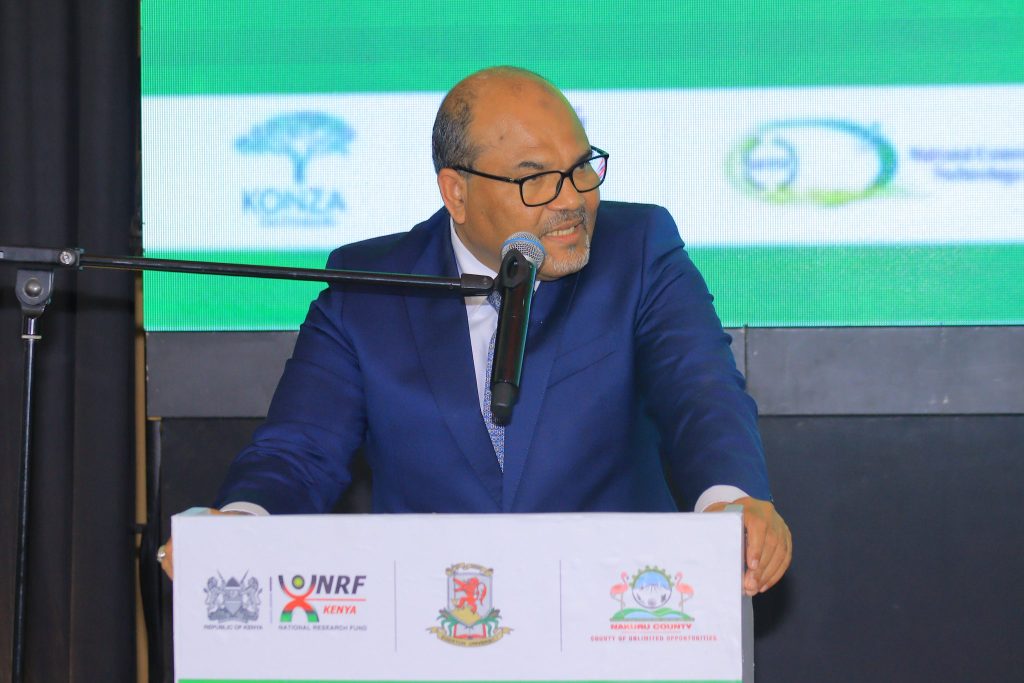
The government unveiled five key shifts to drive progress: focusing on national agricultural missions, ensuring research delivers practical solutions, building strong talent pipelines, strengthening partnerships, and blending public and private financing to commercialize innovations.
At the exhibition stands, farmers and researchers showcased climate-smart practices, post-harvest technologies, and digital tools already improving yields. One farmer from Narok County shared how new breeding programs supported by NRF had helped them transition from traditional bull breeding to artificial insemination, boosting productivity. He called for such initiatives to be expanded nationwide.
Hon. Joseph Makilap, MP for Baringo North, also urged lawmakers to prioritize funding for research and innovation. He proposed that part of Value Added Tax (VAT) be allocated to research, arguing that current allocations are too low to drive meaningful change. “If we commit even 3 to 5 percent of VAT to research, Kenya will transform,” he said. He further called for deliberate legislation to support local production, stop unnecessary imports, and establish specialized research centers dedicated to agriculture and technology.
The Festival also highlighted government plans to scale up investment in STI, aiming to increase allocation closer to the 1% of GDP target set for research and development. Leaders emphasized aligning efforts with the Bottom-Up Economic Transformation Agenda, Vision 2030, and the African Union’s Agenda 2063.
Prof. Shaukat closed with a call to unity, stressing the need for collaboration across counties, researchers, farmers, and the private sector. “If we align science with real-world problems, empower communities, and commercialize solutions, Kenya will not only be food secure we will be a food systems powerhouse,” he said.