Mastercard Report Warns Rising Cyberattacks Could Undermine Africa’s Digital Growth
By Peace Muthoka
JOHANNESBURG, South Africa, October 12, 2026 — Africa’s digital economy is expanding rapidly, with mobile money, online banking and e-commerce opening up new opportunities for businesses and consumers. But as more transactions move online, the continent is facing a growing challenge: how to protect that progress from cyberattacks.
A new Mastercard-commissioned whitepaper, Africa’s Digital Defense Race, warns that strengthening cybersecurity must go hand in hand with digital expansion if Africa is to sustain its growth and build confidence in online services.
The report shows that between 2016 and 2025, mobile money users across Africa grew 5.9 times, digital banking users increased 4.7 times and the e-commerce market expanded 5.3 times.
Africa’s digital payments economy is also projected to reach $1.5 trillion by 2030, highlighting the growing importance of secure and reliable digital systems to the continent’s economic future.
However, the growth in digital services has been accompanied by a sharp rise in cyber threats. Mastercard Cyber Insights recorded 69,236 cyber events targeting African organisations in 2025, equivalent to about one event every eight minutes.
The whitepaper further found that cyberattacks across Africa increased by more than 421 per cent between 2016 and 2025, compared with 307 per cent globally.
The figures raise concerns about the security of the systems that increasingly handle people’s money, personal information and access to essential services. The report says countries need to strengthen cybersecurity governance, invest in infrastructure and skills, and improve cooperation between governments and the private sector.
Shabir Ahmed, Mastercard’s Senior Vice President and Customer Solutions Center Lead for Africa, said protecting the continent’s digital progress had become a leadership priority as cyber threats became more sophisticated and coordinated.
“Africa’s digital growth is creating real opportunity for people and businesses across the continent, and protecting it has become a leadership priority,” Ahmed said.
He pointed to the Africa Cybersecurity Center of Excellence, established by Mastercard to bring public and private sector players together to share intelligence, knowledge and best practices.
“As threats become more sophisticated and coordinated, our response has to be just as coordinated,” he said, adding that collective action would help Africa continue to grow with confidence.
The report also shows that cyber risks differ across African countries, depending on their digital economies, financial systems and cybersecurity arrangements.
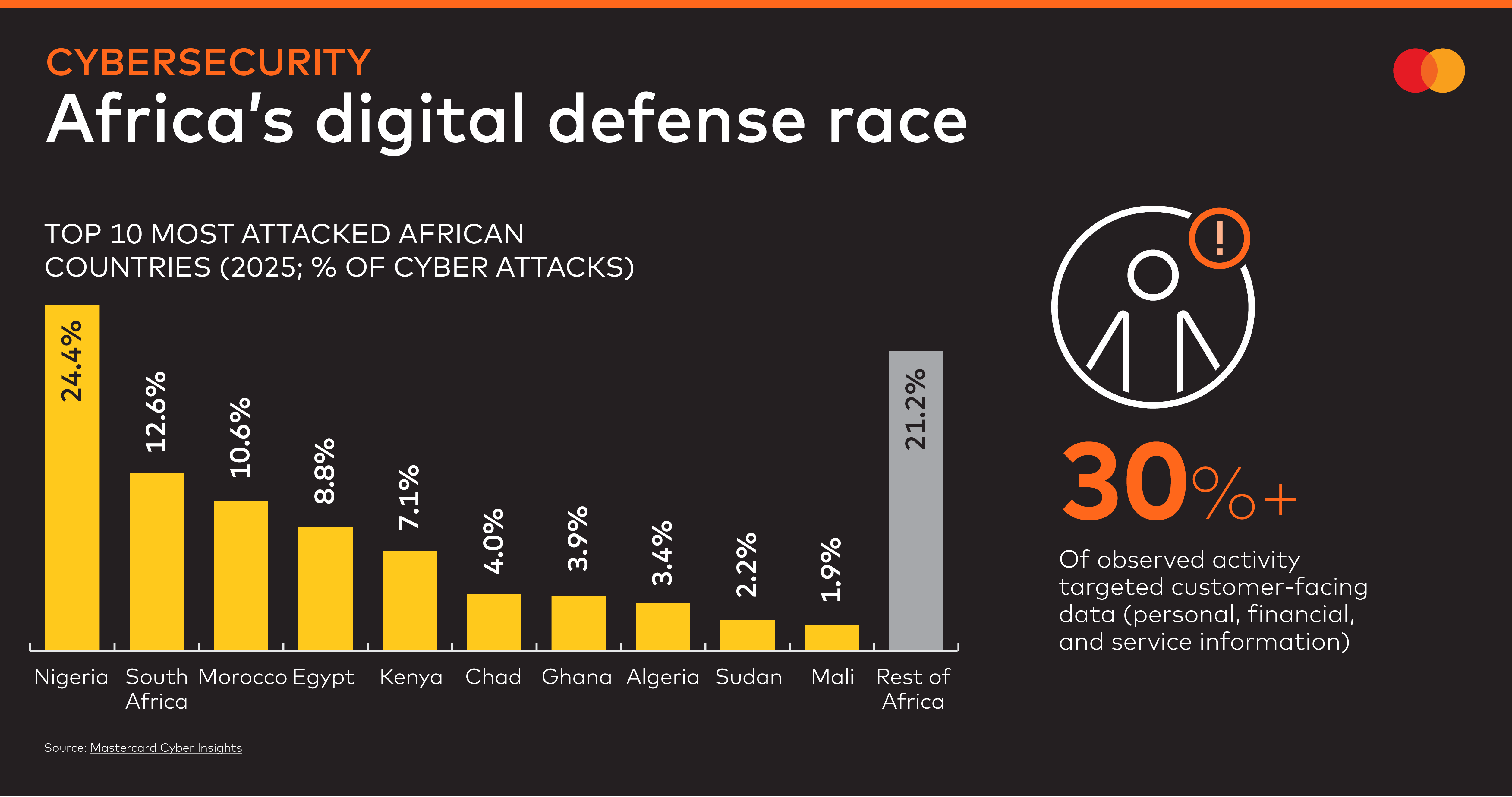
Nigeria, which has one of the continent’s largest financial technology ecosystems, accounted for a significant share of observed cyberattacks in 2026. In South Africa, the concentrated financial sector was the target of 12.6 per cent of the continent’s observed attacks.
Morocco has developed one of Africa’s more institutionalised cybersecurity governance structures as it strengthens its position as a technology hub linking North Africa to Europe.
For Kenya, the report highlights the need to protect the systems supporting financial inclusion and digital growth as more people and businesses rely on digital services.
The technology, public sector and financial services sectors together accounted for 44 per cent of observed cyber activity, according to the whitepaper. Their exposure reflects the value of the information they hold and the importance of the services they provide.
Personal information, financial information and customer-facing services accounted for 27 per cent of targeted assets. This makes cybersecurity more than a technical concern, as attacks can affect the individuals and businesses whose data and transactions depend on these systems.
Alongside stronger infrastructure and governance, the report identifies a shortage of cybersecurity professionals as one of Africa’s biggest challenges and opportunities.
Approximately 200,000 cybersecurity positions remained unfilled across the continent at the end of 2025, representing a shortage equivalent to 23 per cent of the existing cybersecurity workforce, according to figures cited in the report.
Closing that gap would help organisations build their capacity to identify threats, respond to attacks and protect digital services. It could also create opportunities for training and employment as demand for cybersecurity expertise grows.
The Africa Cybersecurity Center of Excellence is supporting these efforts by connecting security leaders and teams, promoting the exchange of knowledge and helping organisations prepare for threats through scenario-based exercises.
The report also points to cross-border cooperation as an important tool in tackling cybercrime. Between June and August 2025, Interpol’s Operation Serengeti 2.0 led to 1,209 arrests across 18 African countries and the recovery of $97.4 million.
The operation illustrates how coordinated action can help authorities respond to cybercrime networks that operate across national borders.
Mastercard says it works with governments, financial institutions and businesses of different sizes to share threat intelligence, monitor risks and strengthen collective defences.
As digital payments, banking and online commerce continue to expand, the report argues that cybersecurity must remain central to the continent’s development plans.
Africa’s digital future will depend not only on how many people gain access to online services, but also on whether those services remain secure and reliable. For businesses and consumers alike, confidence in the systems behind digital transactions will be critical to sustaining that growth.
The full Africa’s Digital Defense Race whitepaper is available on Mastercard’s website.