
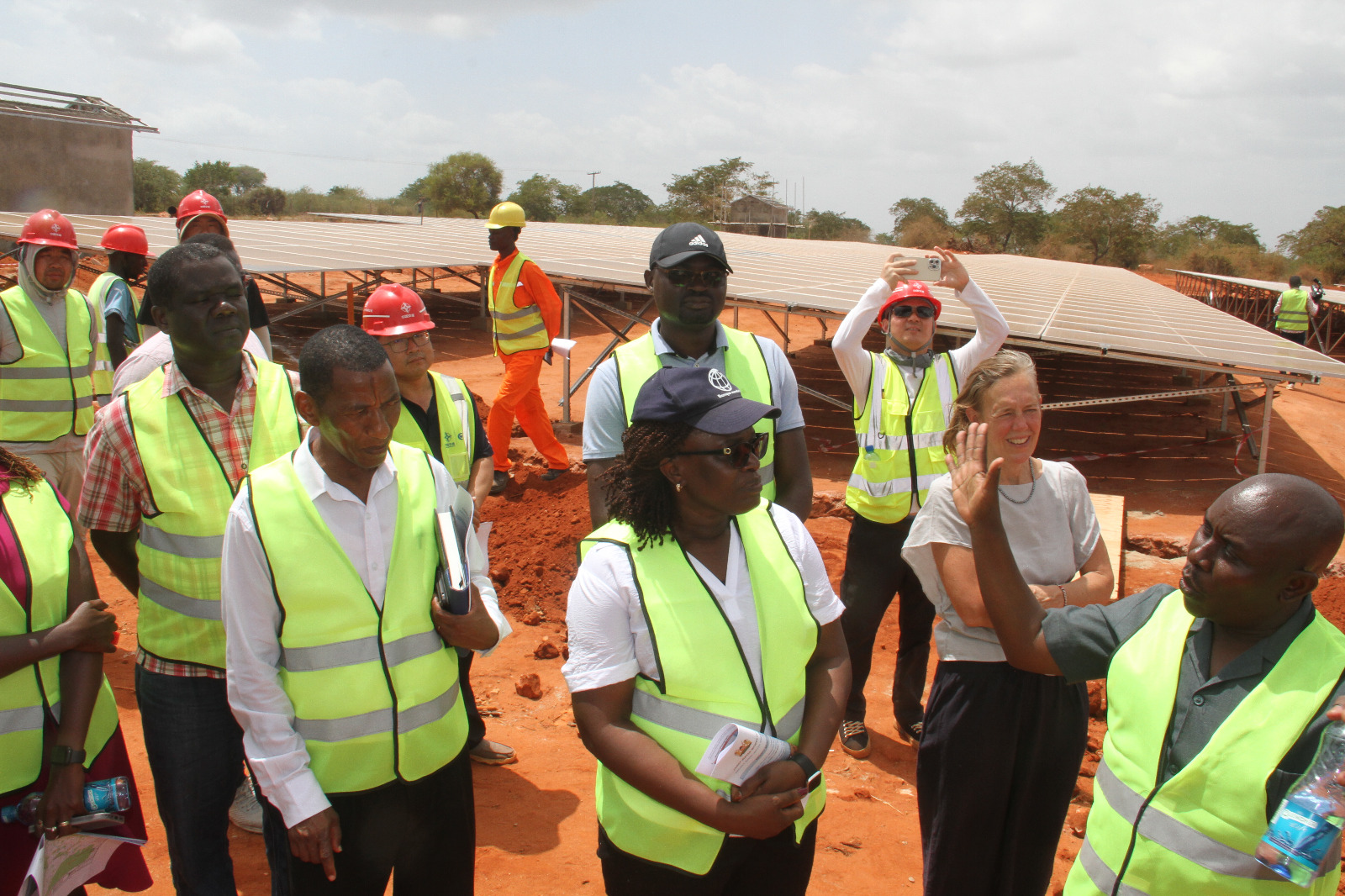
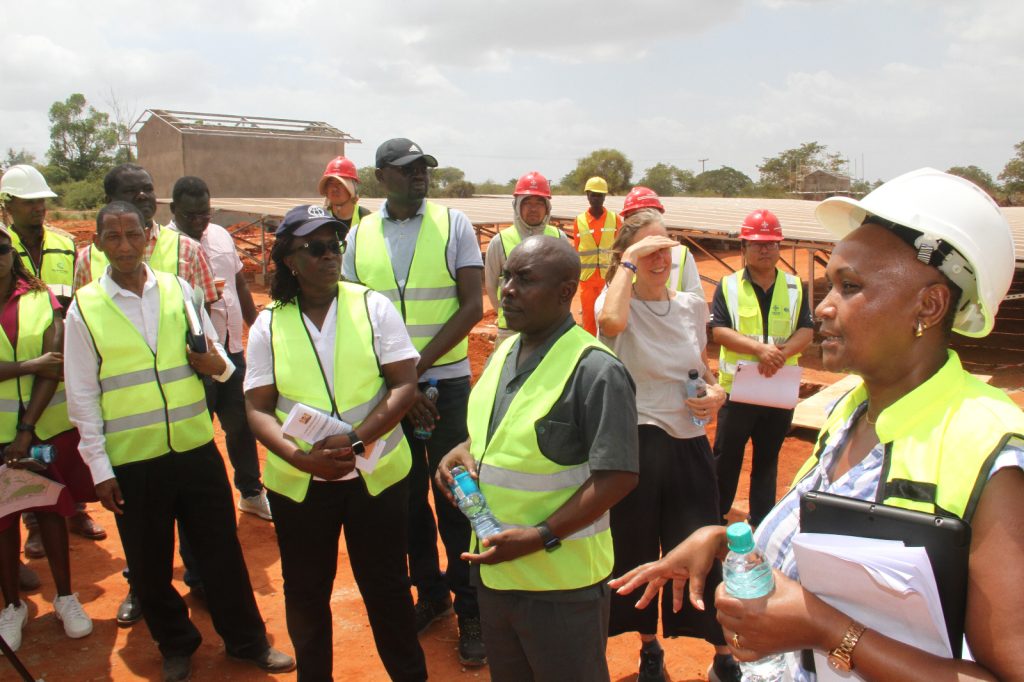
World Bank officials, Coast Water works Development Agency Kilifi county and Ministry of Water , and Irrigation officials during a site visit to inspect status progress of the Baricho solarization Project
By Editor.
Just after sunrise, workers move between rows of newly installed solar panels at the Baricho water system in Kilifi County. The heat builds quickly, yet the mood remains hopeful. For years, this vast water facility has battled one stubborn enemy: high electricity costs. Now, a sea of solar panels promises relief—not just for engineers on site, but for families in Kilifi, Malindi and Mombasa who depend on this water every day.
At the centre of this change is a World Bank–supported project under the Water and Sanitation Development Project, implemented by the Ministry of Water, Sanitation and Irrigation. Once fully operational, the solar power plant is expected to slash Coast Water’s monthly electricity bill by at least KSh10 million, down from the current average of about KSh60–70 million. More importantly, it signals a shift in how essential services can survive rising costs while protecting the environment.
For residents along the coast, the struggle behind the scenes has often gone unnoticed. Water from Baricho does not simply flow to taps. Instead, powerful pumps draw it from deep boreholes, lift it to treatment points and push it across long distances to towns and cities. Every stage consumes electricity. Every unit adds to the bill.
As a result, Coast Water has, at times, found itself walking a tightrope. Delayed payments have led to brief power disconnections, and even short interruptions can disrupt supply to thousands of homes.
“That pressure has always been there,” says David Kanui, the project coordinator at the Coast Water Implementing Agency. “When power is cut, pumping stops. When pumping stops, people feel it immediately.”
It is this reality that pushed Coast Water to seek alternatives. After negotiations, the World Bank agreed to finance the solarisation of the Baricho system as part of broader efforts to improve water and sanitation services across the country.
Today, that decision is taking physical shape.Standing near the control systems, solar engineer Serah Mbwaya watches technicians align panels under the open sky. She calls the project a turning point.
“We are installing a solar system to power the pumps here, starting with Malindi,” she explains. “It is the first of its kind for this system. So far, we are about 60 percent complete.”
If all goes as planned, the first phase will be commissioned by the end of the month. The remaining work should be finished by mid-February, well ahead of the official March 31, 2026 deadline.
For Mbwaya, the work is personal. She has seen how energy costs can quietly cripple public services.
“The main goal is to cut operational costs,” she says. “When you reduce power costs, you free up money. That money can go back into maintenance, expansion and better service.”
At full capacity, the solar plant will generate 4.6 megawatts of power. That energy will run 11 boreholes and the high-lift pumps supplying Malindi. This first phase, known as Base One, focuses on stabilising supply closer to the source.
“This water is pumped more than once before it reaches consumers,” Kanui explains. “That is why electricity costs have always been so high.”
Currently, the system relies on grid power for about 16 hours a day. Solar energy will now cover roughly eight daylight hours. While that may sound modest, the savings are significant. Coast Water expects to cut its bill by at least KSh10 million every month once phase one is fully operational.
“And that saving matters,” Kanui adds. “It means fewer financial shocks and fewer interruptions.”
Beyond the numbers, the project also brings environmental gains. Solar panels at Baricho have a lifespan of over 25 years, making them a long-term investment in clean energy. A small lithium-ion battery bank helps stabilise power during passing clouds, ensuring pumps do not suddenly shut down.
“The batteries are not for full nighttime use,” Mbwaya explains. “They smooth things out during the day. Their lifespan is about 10 to 15 years, and after that, they can be replaced.”
Looking ahead, Coast Water hopes to go even further. Plans are already in place for additional phases. Base Two, which will power the high-lift pumps supplying Mombasa, could reduce the electricity bill by up to 30 percent once funding is secured. Base Three could introduce larger battery storage, allowing pumping to continue at night using stored solar energy.
There is also hope for net metering. Once the Energy Ministry rolls out the framework, Coast Water could feed excess solar power into the national grid during the day and draw it back later.
“That would change everything,” Mbwaya says. “Instead of wasting excess energy, we could share it and still benefit.”
The project has not come cheap. At KSh670 million, it represents a major investment in public infrastructure. Yet supporters argue the cost is justified, given the long-term savings and improved service reliability.
For communities along the coast, the impact could be felt in small but meaningful ways. Fewer disruptions mean more predictable water supply. Lower operational costs could also ease pressure on water tariffs over time.
As the afternoon sun glints off the panels at Baricho, the symbolism is hard to miss. Energy from the same sun that has always beaten down on this land is now powering the pumps beneath it.
For Coast Water, the shift to solar is not just a technical upgrade. It is a statement of intent. A move toward sustainability. A promise that water so basic, yet so precious.