
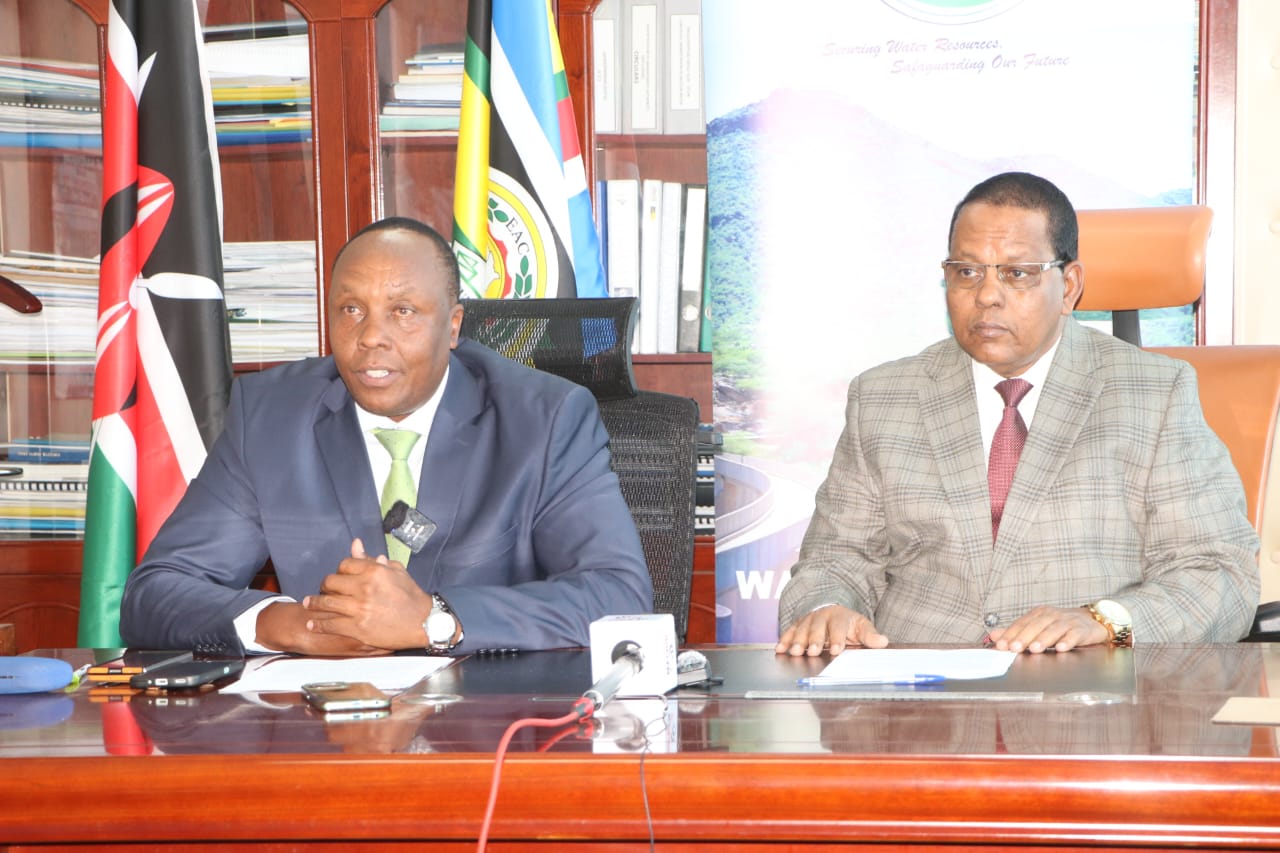
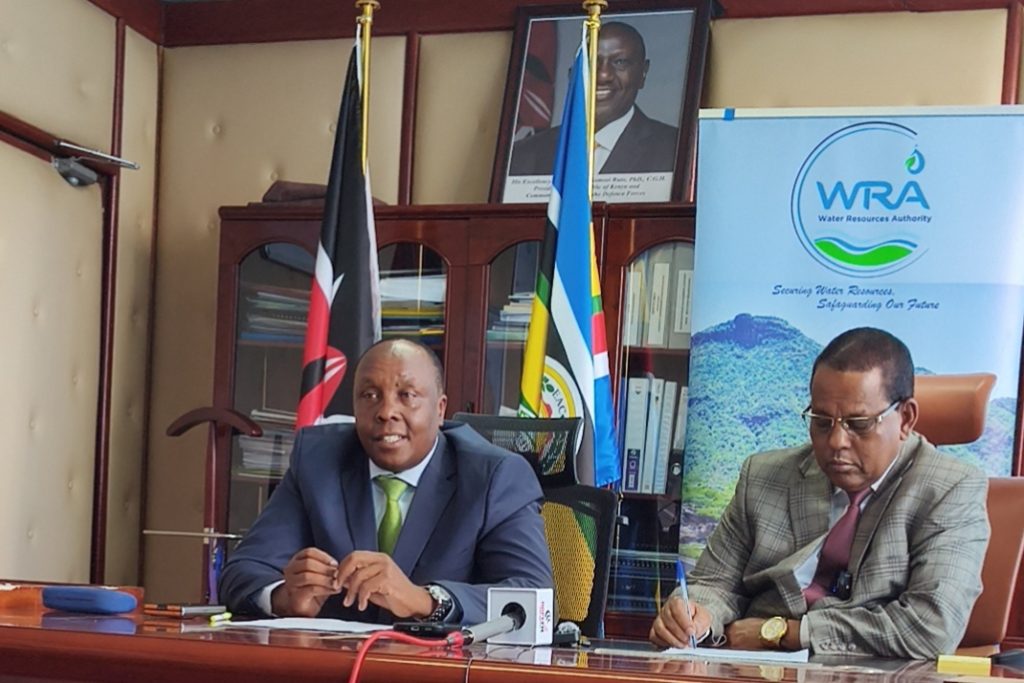
(L-R) WRA Governing Board Chairperson Donald K. Murgor and WRA Chief Executive Officer Mohamed Shurie during the media briefing.
By Peace Muthoka.
The Water Resources Authority (WRA) has raised fresh alarm over escalating violations of the Water Act 2016 and the Water Resources Regulations 2025, cautioning that continued non-compliance threatens Kenya’s already limited water supply. The Authority is now urging all water users to regularize their permits as part of a renewed national push for responsible and sustainable water use.
Speaking during a media briefing today, WRA Governing Board Chairperson Donald K. Murgor said the recent spike in illegal water abstraction and lapsed permits has become a major concern. He stressed that Kenya’s growing water scarcity demands strict and consistent regulation to protect communities and support long-term sustainability.
“Everyone who wants to access water must have a valid permit. Water is God-given, yes, but it is scarce and must be regulated so that all Kenyans can access it fairly,” Murgor said. He also clarified that WRA’s enforcement operations are neutral and nationwide. “We are enforcing the law across the country. We were in Mombasa, we were in Kisumu. This work is national. Nobody is being singled out.”
Addressing misinformation circulating in some areas, Murgor defended WRA enforcement teams against accusations of vandalism.
“We do not vandalise anyone’s property. When someone is not compliant, we disconnect legally. Once they comply, we reconnect. That is the procedure,” he explained.
Sharp Rise in Non-Compliance Prompts Urgent Action
WRA Chief Executive Officer Mohamed Shurie echoed the chairperson’s concerns and emphasized that all enforcement actions are grounded in laws approved by Parliament and the Senate. He criticised political leaders who encourage communities to resist compliance with regulations they helped create.
“It is awkward when a leader incites citizens to violate a regulation or Act that they passed in Parliament. WRA is simply implementing the law,” Shurie said.
He warned that illegal abstraction and expired permits pose long-term risks to water fairness and environmental stability.
“If upstream users take all the water, what happens to those downstream? Regulation ensures equity and protects communities, ecosystems, and future users,” he noted.
Shurie highlighted that WRA’s permit system, which is available through basin offices and it remains the backbone of transparent and science-based water management.
“Every citizen who wants to touch water must have a permit. This is global best practice,” he said.
He added that both private and public institutions will be held accountable for breaking the law.
“If an institution violates the law, the leaders in charge, whether managing directors or CEOs, will be liable. The law is very clear,” he said.
Grace Period as WRA Suspends Disconnections Until January 15
To allow Kenyans to celebrate the festive season without disruptions, WRA announced a temporary suspension of all disconnections for non-payment of water use fees.
“From today, 10 December 2025, WRA suspends all massive disconnections to allow Kenyans to celebrate the festivals. Enforcement of the Water Act will resume on 15 January 2026,” Shurie said.
He clarified that although disconnections will not take place, compliance monitoring continues throughout the festive period. Water users with expired permits are expected to renew them, while those without permits must apply immediately.
“Please visit our offices or apply through the e-permitting system. We are giving Kenyans time to regularize before enforcement resumes in January,” he said.
Appeal for Responsibility as Water Scarcity Deepens
Both leaders urged Kenyans to value water and comply with the law to safeguard the country’s fragile water resources.
Murgor reminded the public that water, like all essential services, must be paid for.
“Why would anyone want to get water for free when they pay for electricity, fuel, and park entry fees? Water is a finite resource. If we do not protect it, things will not work,” he said.
Shurie reaffirmed the Authority’s commitment to protecting the country’s water resources.
“We are not here to harm Kenyans. We are here to safeguard water for present and future generations,” he said.
WRA is now calling on abstractors, community leaders, and political actors to support compliance efforts and help ensure every Kenyan enjoys fair and sustainable access to water.










Access to clean and sufficient water is a community right enshrined in our constitution,2010. The regulations and fee charged should not negate the intent of the constitution by being too high, beyond the reach of Wanjiku. From 50 cents to 2.50 per Cubic meter is 500 percent increase and unaffordable to many. Smart Meter that Costs over 700k from a hand picked dealer is unreasonable. Permit fee from 25k to 90k is equally unreasonable. Fee rise is inevitable, but it should be within an acceptable and reasonable rate.