
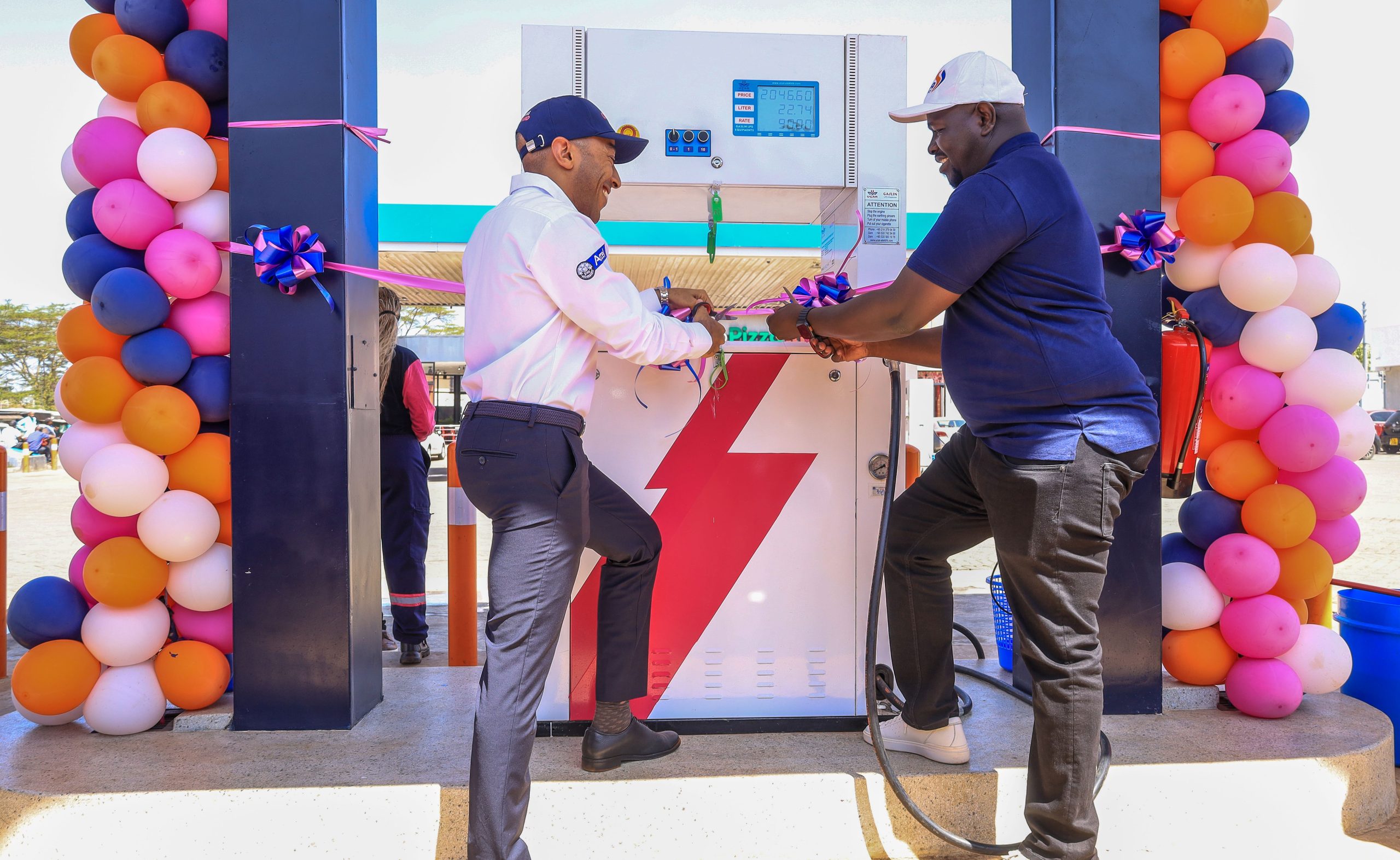
Mohamed Elhoderi (L), Managing Director, OLA Energy, and Joel Kamau, Chief Executive Officer, Proto Energy, cut the ribbon at the official launch of OTO Gas LPG pumps at OLA Energy’s Buru Buru station.
By Peace Muthoka
Proto Energy has partnered with OLA Energy to pilot automotive Liquefied Petroleum Gas (LPG) dispensing pumps at an OLA petrol station in Nairobi, marking a significant step toward cleaner and more affordable mobility in Kenya.
Launched on Wednesday, January 14, 2026, the initiative is being rolled out through Proto Energy’s OTO Gas brand. It forms the first phase of a broader plan to introduce LPG pumps across multiple OLA Energy stations, expanding access to alternative fuels for motorists across the country.
By leveraging OLA Energy’s established retail network and strong customer base, the partnership aims to accelerate the adoption of LPG as a practical alternative to petrol and diesel. The model targets vehicles converted to dual-fuel systems, which allow drivers to switch easily between LPG and conventional fuel, offering flexibility without compromising performance.
Globally, LPG has already proven its viability as an automotive fuel. More than 27 million vehicles worldwide run on Autogas, supported by over 70,000 refuelling stations. Studies show that LPG emits up to 20 per cent less carbon dioxide than petrol and produces far fewer particulates than diesel.
These benefits are particularly relevant for Kenya, where transport accounts for an estimated 40 to 45 per cent of urban air pollution. As cities grapple with rising congestion and deteriorating air quality, cleaner fuel options are becoming increasingly urgent.
Speaking during the launch, Proto Energy Managing Director Joel Kamau described the partnership as a turning point for automotive LPG in Kenya.
“Working with OLA Energy allows us to bring OTO Gas closer to everyday motorists by placing LPG within a trusted retail environment,” Kamau said. “This launch shows that LPG is no longer a niche option. It is a viable and scalable fuel that can support Kenya’s mobility needs while lowering costs and emissions.”
Kamau added that the initiative aligns closely with national policy goals. He noted that the government aims to increase LPG penetration to 70 per cent by 2028 under the National LPG Growth Strategy.
“At Proto Energy, we are fully aligned with this vision,” he said. “By investing in infrastructure and partnerships like this, we are translating policy into real solutions that reduce emissions, cut fuel costs and support economic productivity.”
For OLA Energy, the collaboration reflects a broader shift toward cleaner and more innovative energy offerings. Managing Director Mohamed Elhoderi said the partnership supports the company’s long-term sustainability strategy.
“Hosting LPG dispensing at our stations expands fuel choices for our customers while maintaining the safety, quality and reliability associated with the OLA brand,” Elhoderi said.
He added that co-locating LPG pumps within existing stations offers clear efficiencies.
“This approach allows us to introduce cleaner fuels without building entirely new infrastructure. It is commercially sound, scalable and aligned with the future of energy retail in Kenya,” he said.
Kenya already has a strong foundation for LPG growth. Between 24 and 31 per cent of households use LPG as their primary cooking fuel, supported by a well-established regulatory framework. This familiarity, industry players say, creates an opportunity to extend LPG use into the transport sector.
The Buruburu installation is the first of several planned under the Proto Energy–OLA Energy partnership. Both companies say they intend to scale the model to additional stations, targeting not only private motorists but also fleet operators, logistics firms and ride-hailing platforms looking to manage fuel costs and reduce their environmental footprint.
As Kenya seeks to balance economic growth with sustainability, the collaboration positions automotive LPG as a practical transition fuel—one that delivers immediate savings while contributing to cleaner cities and a more resilient energy future.