
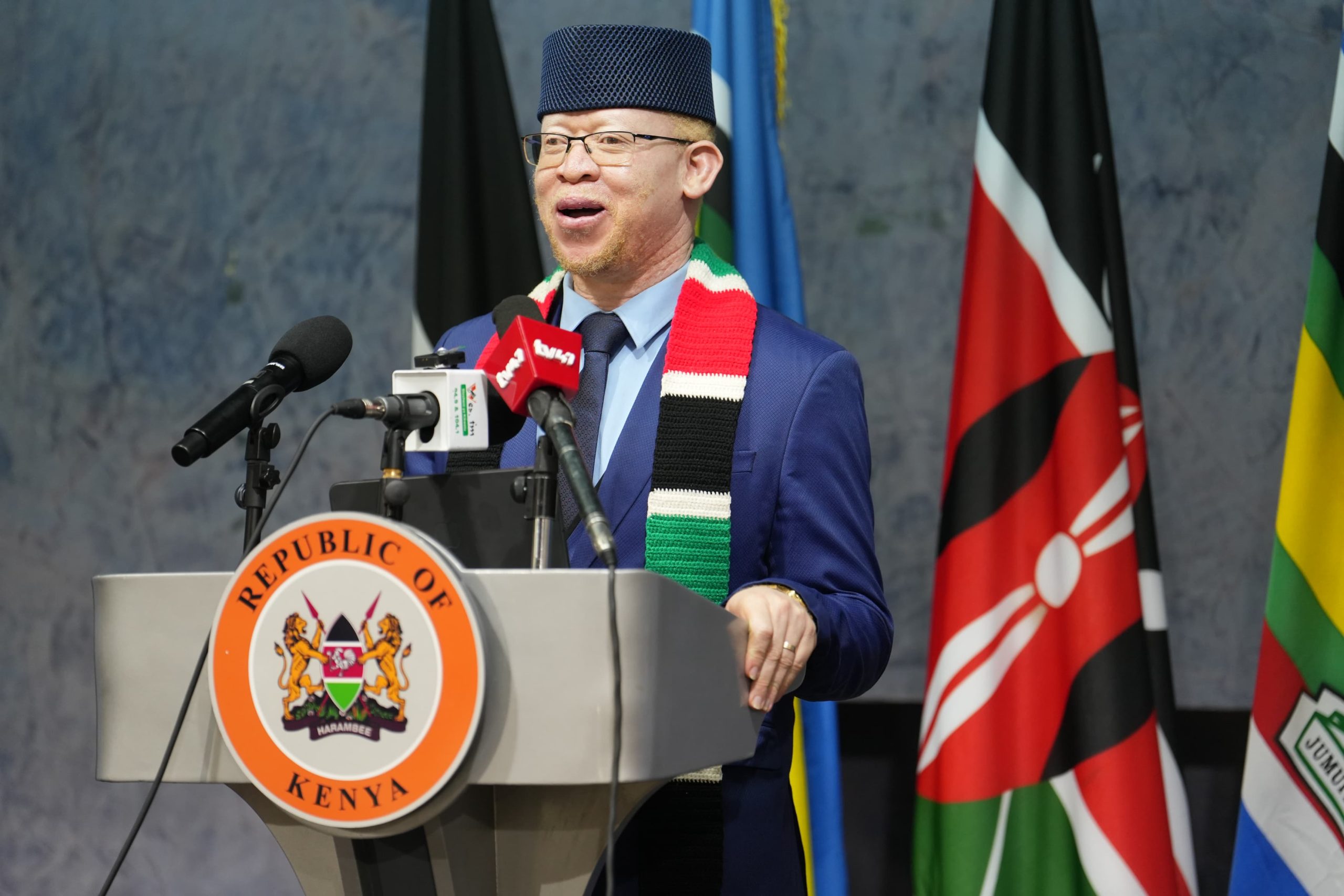
Government Spokesman Dr Isaac Mwaura Speaking on Monday at the Harambee Annex Media Centre
By Peace Muthoka
The government has intensified efforts to keep children in school, cushion drought-hit families and empower young entrepreneurs as economic pressure continues to bite across the country.
Speaking on Monday at the Harambee Annex Media Centre, Government Spokesman Dr Isaac Mwaura said the state is prioritising interventions that directly touch households, with youth empowerment emerging as a key pillar.
On education, Mwaura said the government remains concerned about learners who have not yet reported for Grade 10.
“It is true that some students have not yet reported to school and these are the ones we need to focus on as a government,” he said.
He noted that presidential, ministerial, county and parliamentary bursaries are being used to support affected families, while warning schools against locking out learners through illegal charges.
“Some schools exploit the system by demanding excessive fees,” Mwaura said. “Principals must follow the Ministry of Education guidelines so that we do not hinder students who want to return to school.”
Drought response also featured prominently, with the government scaling up food and water support in arid and semi-arid regions.
“Recently, the Deputy President chaired a meeting where the government committed billions of shillings to procure food for affected areas,” Mwaura said.
He said relief food distribution, water supply and livestock insurance are ongoing in counties such as Garissa and Wajir, while development partners have been invited to complement government efforts.
“We always step up to assist our people so that no one suffers from hunger,” he said, adding that the Meteorological Department has forecast rains in April and May.
However, it was the NYOTA youth empowerment programme that dominated the briefing, with the government describing it as one of the most ambitious economic inclusion projects ever rolled out.
“We have rolled out the NYOTA programme in a very big way,” Mwaura said, noting that President William Ruto has personally interacted with beneficiaries during disbursement events across the country.
He said the business component of NYOTA is designed to empower young entrepreneurs in every ward, following an upward revision of beneficiary targets after overwhelming demand.
“So far, over two million Kenyans have applied for the business component,” Mwaura said. “This confirms the enterprising nature of our youth.”
Unlike past youth funds, Mwaura stressed that NYOTA is not a cash-only programme.
“This is not just money that we are giving,” he said. “All selected beneficiaries undergo mandatory business skills training so that they know how to run sustainable businesses.”
The programme has already been implemented across most counties, reaching hundreds of wards and supporting young people from all walks of life, including single mothers, informal traders and persons with disabilities.
“You can now see the face of Kenya,” Mwaura said. “Young men, mothers, people with disabilities, all included.”
He said disbursement events also double as mentorship forums, linking beneficiaries to local business communities and experienced trainers.
“These events serve the purpose of high-level mentorship and connection to industry,” he said. “That has been missing in many past programmes.”
Mwaura added that some county governments have waived levies for NYOTA-supported startups to ease pressure on new businesses.
“This is extremely important so that we do not create gridlocks for startups,” he said.
He said the first phase of funding combines seed capital with a compulsory savings component to promote financial discipline, followed by continued mentorship at the local level.
Addressing questions on funding, Mwaura said the programme is transparent and jointly supported by the government and development partners.
“Yes, this is World Bank money, commingled with government resources, and that is how it should be,” he said.
He dismissed criticism of the programme, urging Kenyans to listen to beneficiaries themselves.
“Ask the young people,” Mwaura said. “See how happy they are. See how included they feel. This is helping dreams come true in a way that has not happened before.”