
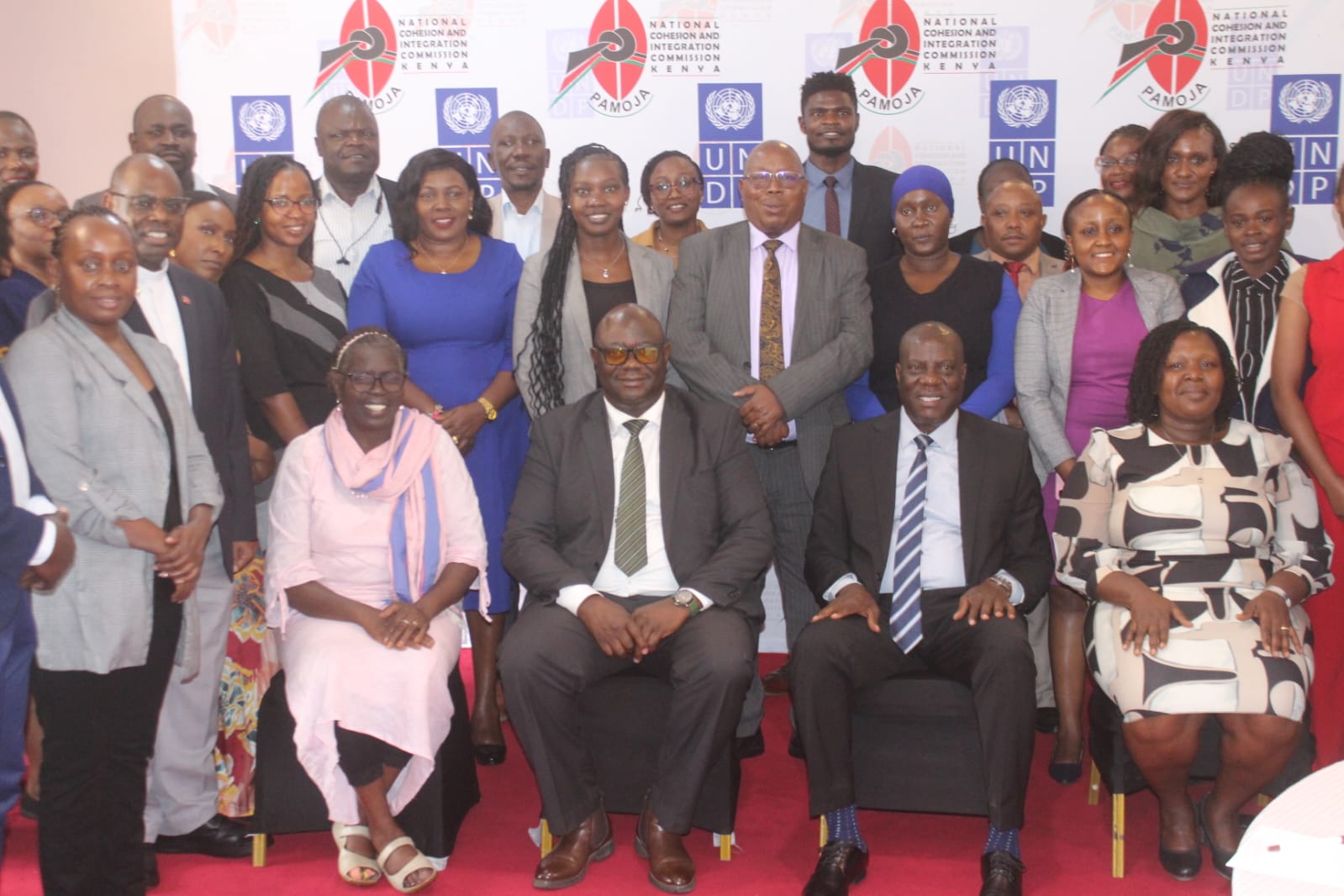
NCIC Officials, Government Representatives and Stakeholders pose for a group photo during the NCIC sensitisation forum on the Roadmap to a Violence-Free 2027 General Election and Beyond in Nairobi on October 6, 2026.
By Peace Muthoka
NAIROBI, Kenya — The National Cohesion and Integration Commission (NCIC) has taken its campaign for a violence-free 2027 General Election to Nairobi, with Commissioner Jackson Swadi Kedogo officially opening a two-day sensitisation forum aimed at bringing key stakeholders into the country’s peacebuilding efforts.
The forum, which started today, October 6, 2026, is being held under the “Uchaguzi Bila Noma” (Second Edition) initiative and focuses on taking the Commission’s Roadmap to a Violence-Free 2027 General Election and Beyond to the county level.
The engagement, supported by the United Nations Development Programme (UNDP) and the Korea International Cooperation Agency (KOICA), has brought together representatives from the county government, national government administration, security agencies, political parties, religious and cultural groups, youth and women organisations, the media, civil society and faith-based organisations.
Opening the forum, Kedogo said the roadmap had been launched recently at the Commission’s offices but was now being taken directly to stakeholders as part of efforts to build a common understanding of what is required to keep the 2027 elections peaceful.
“This forum is for violence-free 2027 election. It is a roadmap launched a few days ago in our offices, but now we are bringing it to the people,” Kedogo said.
He said the Nairobi engagement was intended to give stakeholders an opportunity to discuss how each could contribute to a peaceful election rather than leaving the responsibility to the NCIC and other state institutions alone.
The discussions are focusing on peace messaging, prevention of hate speech, incitement and violent extremism, as well as strengthening local early warning and early response mechanisms that can help identify and address tensions before they escalate.
Political parties have also emerged as a key focus of the Commission’s preparations.
Kedogo said NCIC expects to convene another forum with political parties soon to allow them to sign a charter aimed at encouraging greater responsibility among political actors and their supporters.
He said the signing had been postponed during an earlier engagement because major political parties were involved in other activities and could not attend.
“We are expecting to have that forum very soon for the political parties to sign the charter,” Kedogo said.
The Commissioner said political parties have an important role to play in regulating the conduct of their members, particularly where political statements could fuel incitement or hate speech.
His remarks come as the NCIC seeks to address concerns over inflammatory political rhetoric ahead of the 2027 polls.
Kedogo also defended the Commission’s handling of politicians accused of making divisive remarks, saying NCIC was taking action in accordance with the law and due process.
He dismissed suggestions that the Commission only summons politicians without taking further action, saying the Commission’s work should not be measured by arrests.
“After summoning, we are taking actions. But what we are doing, we are following the law, the Act, the NCIC Act and the laws of Kenya,” he said.
According to Kedogo, NCIC’s primary responsibility is to promote cohesion, integration and peace rather than simply arresting individuals.
“Our major mandate is to make sure that Kenya is cohesive and peaceful. It is not about arresting people,” he said.
He also rejected claims that the Commission is selective in the people it summons, saying it has taken action against individuals across the political divide.
“We are not favouring anybody. The Commission is not biased. We are just joining and we are acting,” Kedogo said.
NCIC Director of Research and Knowledge Management Millicent Okatch said the Commission was using lessons from Kenya’s past to strengthen preparations for the 2027 election.
Okatch said political intolerance, hate speech and ethnic divisions remain among the issues that require collective attention if the country is to avoid violence during and after the elections.
“We’ve had a past that has not been so good. Kenya gets into hate and political intolerance, ethnic division, and it’s important that we rally all Kenyans, the citizens, all the stakeholders, so that we work collectively towards preserving our country to remain standing during and after the election,” she said.
She said the roadmap was launched about a month ago and NCIC was now moving into the dissemination phase to ensure stakeholders understand the risks identified and the role they can play in addressing them.
Okatch identified lack of trust, political intolerance and divisive politics as some of the vulnerabilities that could undermine efforts towards a violence-free election if they are not adequately addressed.
Young people, she added, require particular attention because of their central role in communities and political activities.
“We want to encourage all the stakeholders working with youth to ensure that they are involved and they hear their voices,” Okatch said.
She said NCIC wants young people to be part of peacebuilding efforts and to serve as ambassadors of peace rather than being drawn into violence.
The Commission’s peace roadmap is being taken to several counties with support from UNDP and KOICA.
Okatch said engagements had already been held in Busia and Taita Taveta, with Nairobi being covered this week. Further engagements are planned in Laikipia, Kisumu, Kilifi, Marsabit, Isiolo and Mombasa.
She said the response from stakeholders had so far been positive, pointing to cooperation between security actors and boda boda riders in Busia as an example of local efforts to address security concerns.
Okatch also highlighted concerns over gunism, saying the issue requires serious attention because of its potential to contribute to violence during the election period.
The Office of the Registrar of Political Parties (ORPP), represented at the forum by Lucy Kemunto said political parties have a major responsibility in ensuring that elections remain peaceful.
Kemunto said peaceful elections should not only be viewed through what happens on election day, but also through how political parties conduct their affairs before the polls.
This includes internal party processes, nominations and the conduct of political leaders and supporters.
She warned that political competition should not turn into hate, intimidation or exclusion, particularly during party nominations where grievances can emerge.
She also stressed the importance of upholding the Constitution and ensuring that special interest groups are included in political activities.
Kemunto noted that peaceful elections cannot be achieved by one institution working alone but require cooperation among all actors involved in the electoral cycle.
“As ORPP, we remain committed to working with stakeholders, all the stakeholders involved in the electoral cycle,” she said.
The office called for political competition based on issues, ideas, policies and leadership choices, rather than activities that could trigger violence.
For NCIC, the Nairobi forum marks another step in efforts to start addressing potential sources of electoral tension before the 2027 campaign period gathers momentum.