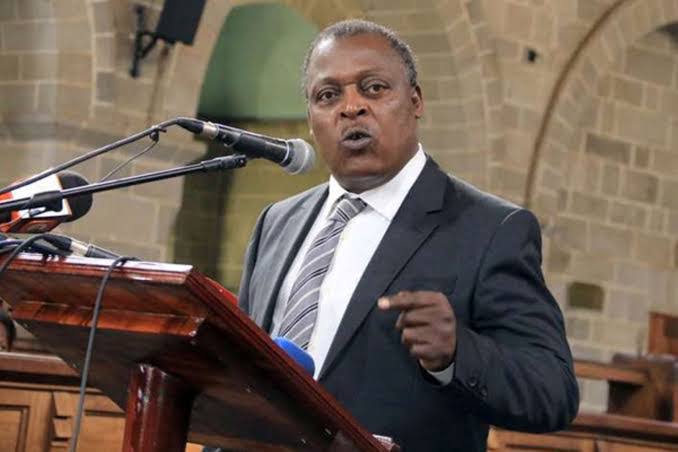
Former Lugari MP, Cyrus Jirongo.
By Editorial Team.
Cyrus Jirongo’s name still carries weight in Kenya’s political memory. Long after his death, it evokes power, controversy, ambition, and unanswered questions. He was admired and feared in equal measure. To some, he symbolised everything that went wrong in Kenya’s politics during the transition to multiparty democracy. To others, he was a sharp businessman who understood power before most people did.
His rise did not follow a straight line. Instead, it moved through corridors of influence, quiet boardrooms, political mobilisations, and risky deals that blurred the line between business and the State. At the centre of it all stood a man who believed he could bend systems to his will, and for a long time, he succeeded.
Jirongo burst into national consciousness in the early 1990s through Youth for Kanu 92, the powerful campaign machine that helped President Daniel arap Moi secure re-election after the return of multiparty politics. At a time when the country was tense and uncertain, YK92 dominated the political space with money, energy, and fearlessness. Jirongo, still young and confident, became its public face.
That moment changed his life forever. Overnight, he became a symbol of raw political power. Yet that same moment planted the seeds of controversy that would follow him for decades. The campaign was widely blamed for triggering massive inflation after huge sums of money were printed to fund political mobilisation. For many Kenyans, the economic pain of that period became inseparable from Jirongo’s name.
Still, behind the politics was a man deeply immersed in business. Long before YK92, Jirongo was already building a reputation as a dealmaker who moved fast and thought big. He believed opportunity favoured those bold enough to seize it. That belief would later shape one of the most controversial projects in Kenya’s public finance history.
The Sololo project did not begin as a scandal. It started as a housing dream. In the late 1980s, Jirongo identified a large tract of land in Nairobi’s South B area. His idea was simple but ambitious. He wanted to build a modern housing estate for middle-income Kenyans, complete with social and commercial facilities. At the time, such integrated developments were rare.
However, Jirongo knew that size alone was not enough. He needed access, influence, and institutional buyers. That need drew him closer to Dr Davy Koech, then the Director of the Kenya Medical Research Institute. Their relationship began casually at a construction site along Mbagathi Road, where Jirongo was already developing another project.
That encounter proved decisive. Koech expressed interest in the property on behalf of Kemri. A business relationship quickly formed. Jirongo even lent Koech Sh1 million when he faced financial pressure while buying a house in Lavington. In return, doors began to open.
Through Koech, Jirongo gained access to senior government figures. He was introduced to people who mattered, people who could move files and shape decisions. Soon, Koech was also helping lobby for construction jobs for friendly companies linked to State projects. For Jirongo, the results spoke for themselves. Projects were delivered, trust was built, and confidence grew.
It was in this environment that Sololo Outlets Limited was born. Jirongo and Koech agreed to partner equally. Their roles were clear. Jirongo would raise the money and handle financing. Koech would use his network to secure institutional buyers, especially within government.
The National Social Security Fund became the main target. At the time, NSSF controlled massive worker savings but had limited investment options under the law. Jirongo saw an opportunity. If the Fund could be convinced to buy the entire housing estate, Sololo would be guaranteed instant success.
Letters were written. Meetings followed. Senior officials were engaged. The proposal was bold. NSSF would buy the whole estate for nearly Sh1 billion. Payments would be staggered. Sololo would develop the project, while the Fund would become the final owner. On paper, it looked like a win for workers and a win for business.
Yet the law stood in the way. NSSF was not allowed to invest directly in real estate. That obstacle did not stop the discussions. Instead, it shifted them into more creative territory. Alternative financing structures were explored. City Finance Company entered the picture. Deposits, placements, and bridging finance became part of the conversation.
As talks dragged on, pressure mounted. Costs began to rise due to inflation and political uncertainty. Jirongo pushed harder. He wrote more letters. He demanded decisions. He believed delays would kill the project. His tone grew aggressive, especially as Kenya moved closer to the 1992 elections.
At the same time, personal relationships complicated matters. Gifts were exchanged. Familiarity replaced formality. Boundaries blurred. When money changed hands with junior staff, even casually, suspicion followed. What Jirongo saw as generosity was interpreted by others as corruption.
The tide turned quietly but firmly. Powerful figures within government began to distance themselves. Files stalled. Attitudes shifted. Jirongo found himself increasingly isolated. The same system that once welcomed him now treated him as a liability.
Soon, investigators arrived. The Sololo project became a national issue. NSSF’s near collapse shook public confidence. Court cases followed, stretching over years. Jirongo, once untouchable, became a man fighting to defend his name and his legacy.
Yet even in disgrace, he remained defiant. He insisted that Sololo was a legitimate business idea destroyed by politics, jealousy, and shifting power centres. He argued that the rules changed midway and that he was punished for being too visible, too bold, and too close to power.
In later years, Jirongo softened in public. He spoke more about family, faith, and reflection. He acknowledged mistakes but rejected the label of villain. To his supporters, he remained a victim of selective justice. To his critics, he never fully answered for the damage done.
Cyrus Jirongo’s story is not simple. It is a mirror of Kenya’s political economy during a turbulent era. It reveals how ambition, access, and weak institutions can collide. It shows how proximity to power can elevate and destroy in equal measure.
Above all, it is a reminder that in Kenya, politics and business have long shared the same table. Jirongo understood that truth early. He lived by it. In the end, it defined him.
His legacy remains contested, uncomfortable, and deeply instructive.