
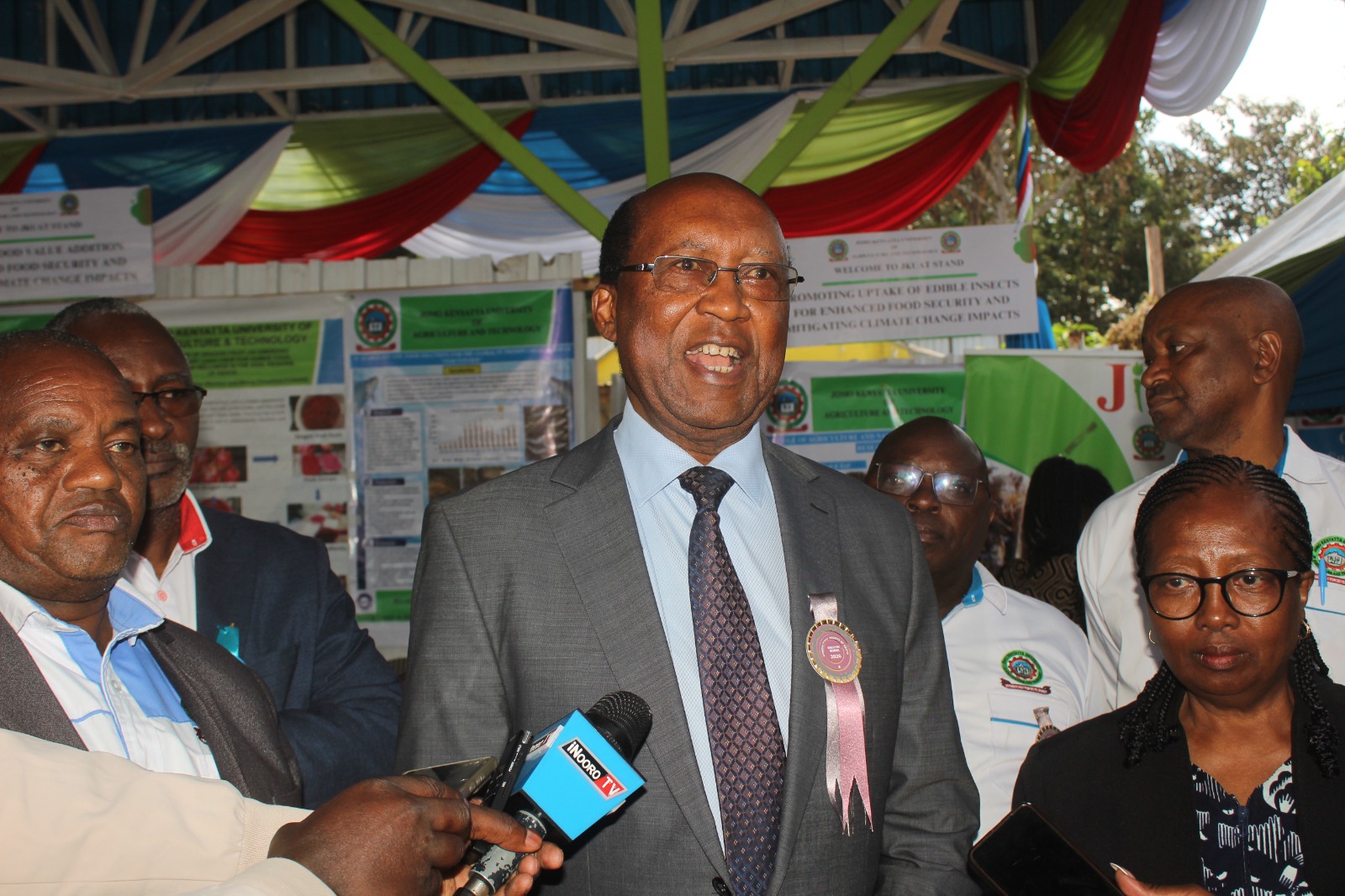
JKUAT Council Chair Dr James Micah Onsando (centre) speaking during an interview at the Nairobi International Trade Fair.
By Peace Muthoka
NAIROBI, Wednesday, September 30, 2026 — Farmers seeking higher yields and faster-growing crops are getting a glimpse of what science can offer at the Nairobi International Trade Fair, where researchers from Jomo Kenyatta University of Agriculture and Technology (JKUAT) are showcasing innovations aimed at improving the production of bananas, plantains and potatoes.
At the university’s stand, researchers are demonstrating how a small piece of plant tissue can be multiplied into thousands of seedlings, offering farmers access to planting materials that are free from pests and diseases and capable of producing high yields.
Speaking at the exhibition, JKUAT Council Chair Dr James Micah Onsando said the university was showcasing engineering prototypes, consumer products and body care products developed through scientific research, many of which are approaching commercial readiness.
He said the exhibition provides an opportunity for Kenyans to understand the range of products being developed at the university and their potential for the market.
As a university focused on agriculture and technology, JKUAT is also advancing digital solutions, including software for medical diagnosis and drone-based applications for crop spraying and disease detection. The technology is intended to help farmers target the application of chemicals rather than spray crops indiscriminately.
Another innovation on display is the Smart Bee Project, which uses software to monitor beehive conditions, assess their suitability for beekeeping and indicate when honey is ready for harvesting.
Onsando said the innovations serve different commercial sectors and reflect the university’s efforts to turn research into practical solutions for Kenya.
Vice-Chancellor Prof. Victoria Wambui Ngumi said JKUAT was also showcasing research in alternative foods, food processing, clean energy and value addition, inviting visitors to explore the university’s stand and learn more about its work.
Among the innovations are foods made from crickets and snails, tissue culture seedlings for plantain and dragon fruit, and technologies that make fuller use of the coconut by turning its different parts into food and other products.
The university has developed tissue culture protocols for plantain and dragon fruit, with seedlings available for purchase by farmers. Ngumi said the technologies offer opportunities for farmers to diversify production and explore new crops.
She also highlighted JKUAT’s food-processing initiatives, which demonstrate how fruits can be turned into juices and other products, helping farmers and entrepreneurs get more value from their produce.
The university is further developing biogas solutions for kitchen use, while its food fortification laboratory adds vitamins and minerals to grains and trains farmers on the process.
Ngumi said visitors could engage with experts at the university’s Research, Production and Extension Division for explanations and training on the various innovations.
The practical demonstrations at JKUAT’s stand include tissue culture plantain propagation, which allows researchers to produce large numbers of seedlings from a single piece of plant tissue.
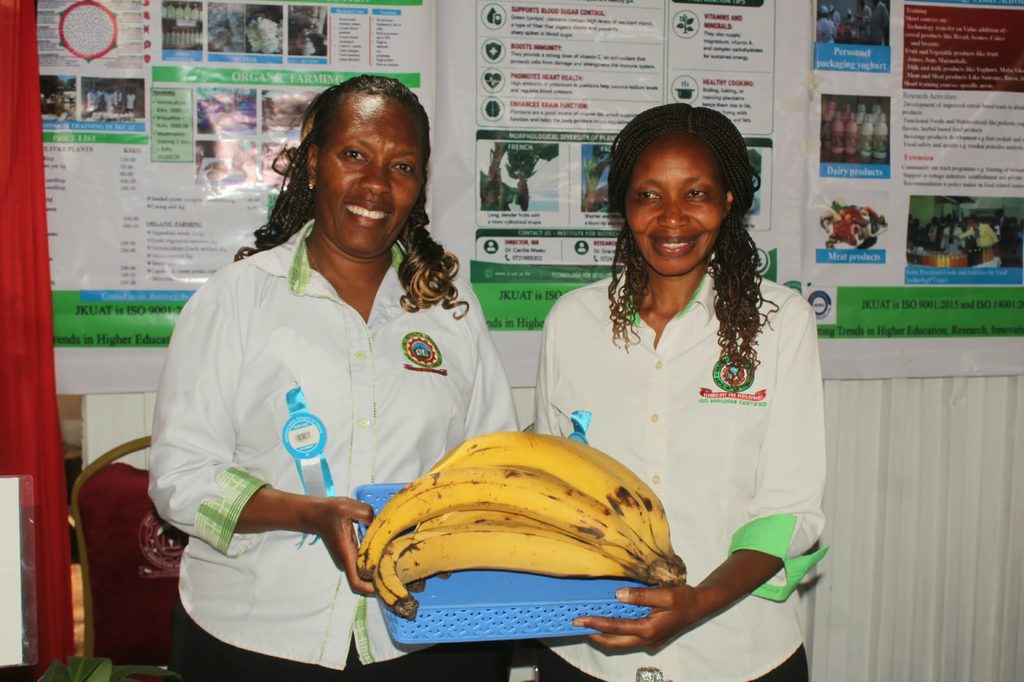
Jane Njambi, the technical person at JKUAT, explained that the plant material passes through several stages, beginning with initiation before moving to multiplication, where it produces numerous shoots that are later subdivided.
“From one tissue, you are likely to get 200,” Njambi said, describing the scale of multiplication possible through the process.
The plantlets are then transferred to the rooting stage before undergoing hardening, also known as acclimatisation, which prepares them for conditions outside the laboratory.
For farmers, the benefits extend beyond the number of seedlings produced. Njambi said tissue culture plants offer higher yields, are free from pests and diseases, and can be produced in large quantities.
They also take considerably less time to mature than conventionally planted bananas. While ordinary bananas may take between two and three years to produce fruit, tissue culture varieties can be ready within nine months to one year.
“The difference between the plantain and the tissue culture is that they take a shorter time, and of course the yield will be high,” she said.
JKUAT is making the seedlings available to farmers and offering short courses in tissue culture banana production, other tissue culture crops, mushroom production and value addition.
The university’s work extends to Irish potatoes, with researchers demonstrating how tissue culture can support the multiplication of the Shangi variety, a key crop in efforts to strengthen food production.
Dr Grace Mungai, a researcher at JKUAT’s Institute for Biotechnology Research, said the process begins with a single eye from a potato, which can be used to produce thousands of cuttings.
“We start with an eye. This is the eye of the potato. Just one eye can give us 10,000 cuttings,” she said.
The research seeks to increase the availability of planting materials by producing large numbers of clean plantlets and cuttings for breeders. These are then multiplied further before being distributed to farmers.
Mungai said the use of healthy planting materials helps protect the crop from interruptions caused by pests and diseases, supporting better yields at the end of the production cycle.
She also clarified that the process does not involve genetic modification.
“Actually, it is not GMO, because we have not touched the genetic makeup of this plant. All that we have done is take it through a cleaning and multiplication process. This is very different from genetic modification,” she said.
The tissue culture demonstrations form part of JKUAT’s broader effort to bring university research closer to farmers and the market.
The Nairobi International Trade Fair, which opened on Monday, September 28, at Jamhuri Park, runs until Sunday, October 4, bringing together institutions, businesses and innovators to showcase products and technologies across agriculture and other sectors.