
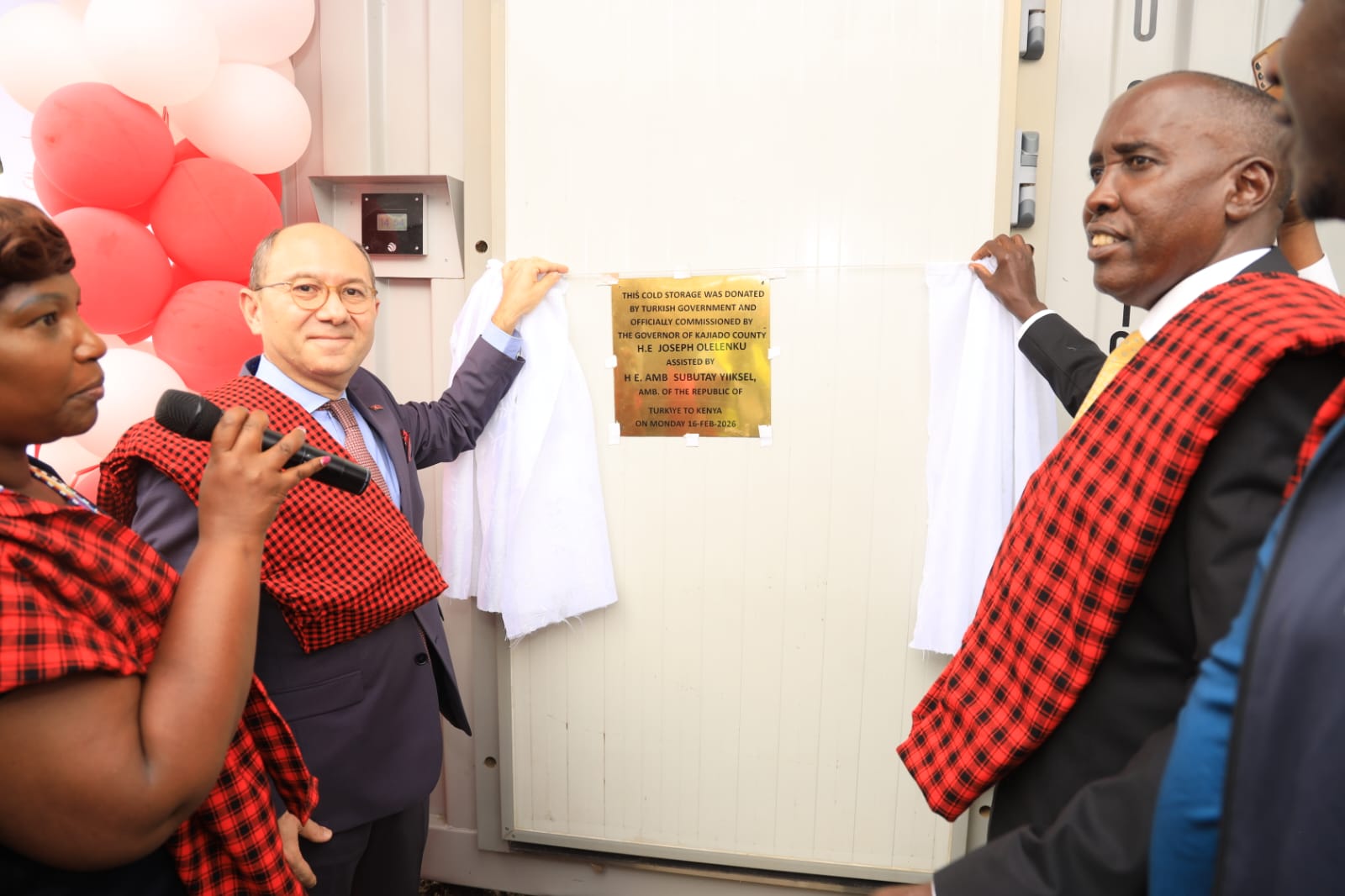
Turkish Ambassador to Kenya Subutay Yüksel and Kajiado County Governor Joseph Ole Lenku during the launch of Kitengela Market solar powered cold storage – zero waste project initiated by Tika Nairobi on Monday February 16th, 2025
By Peace Muthoka
KITENGELA, Kajiado County, Feb 16, 2025 — Traders at Kitengela Market received a major boost on Monday after the launch of a solar-powered cold storage facility aimed at cutting post-harvest losses and protecting livelihoods.
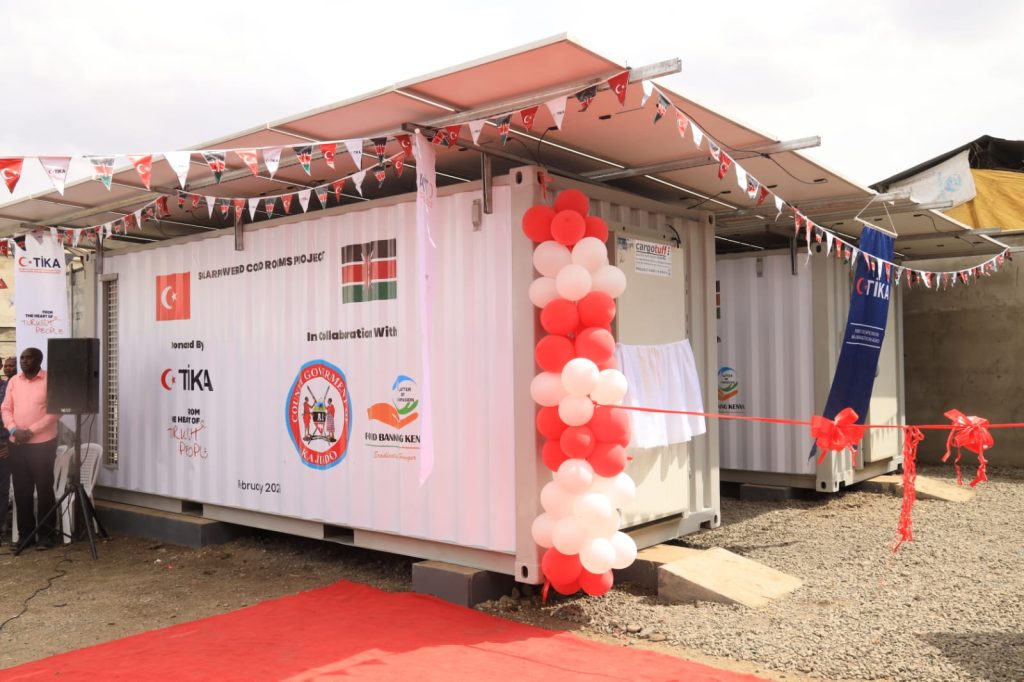
The project, initiated by the Turkish Cooperation and Coordination Agency (TİKA) Nairobi in partnership with Food Banking Kenya and the Kajiado County Government, introduces two 20-foot solar-powered cold room containers at one of the county’s busiest markets.
Speaking during the launch, Subutay Yüksel said the initiative marks a significant step in strengthening food security while promoting environmental sustainability.
“This initiative represents an important milestone in our shared commitment to reducing food loss, strengthening livelihoods, and promoting environmental sustainability,” he said.
Standing beside him, Joseph Ole Lenku welcomed the partnership, noting that traders in Kitengela handle large volumes of perishable goods daily but lack adequate storage facilities.
“Without proper storage, traders lose income within hours. This facility will directly protect their earnings while strengthening food security in our county,” Lenku said.
For years, traders at the open-air market have borne the brunt of extreme heat and unpredictable demand. Fresh tomatoes soften quickly under the sun. Spinach and kale wilt before midday. Fruits lose freshness long before the evening rush. Consequently, many traders sell at heavily discounted prices or discard unsold stock altogether.
“I buy vegetables at dawn from farmers,” said Mary Naserian, a trader who has operated at the market for six years. “By afternoon, if customers are few, I start counting losses. Sometimes you go home with almost nothing.”
Her experience mirrors that of thousands of small-scale traders across Kenya. Open markets form the backbone of local food supply chains, feeding millions of households daily. However, despite their critical role, most lack refrigeration and modern preservation systems. As a result, post-harvest losses remain high, eating into profits and contributing to widespread food waste.
Recognizing this gap, TİKA Nairobi implemented the zero-waste cold storage project inspired by the global Zero Waste Programme championed by Emine Erdoğan. The programme advocates responsible resource use, waste reduction, and environmental protection worldwide.
At Kitengela Market, that vision now operates through a hybrid energy system. The cold rooms run primarily on solar power, reducing reliance on conventional electricity and lowering operational costs. At the same time, they connect to the national grid to guarantee uninterrupted service when necessary.
This design ensures reliable cooling while promoting renewable energy use. More importantly, it allows traders to preserve fruits and vegetables for longer periods, giving them more time to secure fair market prices.
Ambassador Yüksel emphasized that reducing food loss is not only an environmental responsibility but also an economic necessity.
“By preventing avoidable waste at the market level, we protect natural resources and strengthen community livelihoods,” he said.
Food waste contributes significantly to environmental degradation and climate change. When produce rots, it releases greenhouse gases. Additionally, wasted food means wasted water, land, and labor. Therefore, preventing spoilage directly supports climate action and sustainable development goals.
Governor Lenku added that the facility provides a scalable model that can be replicated in other markets across Kajiado and beyond.
“We want to see this model extended to more markets so that traders across the county can benefit,” he said.
For traders like Naserian, the cold rooms represent more than infrastructure. They offer stability and peace of mind.
“When vegetables don’t spoil, I don’t panic,” she said with a smile. “I can plan for school fees and household expenses without fear.”
As the ribbon was cut and the solar-powered units switched on, traders crowded around the containers, eager to see how the new system works. The mood was hopeful, reflecting a shared belief that innovation can transform everyday struggles.
Beyond its local impact, the project underscores the growing partnership between Kenya and Türkiye in areas of sustainable development, environmental protection, and food security.
Ambassador Yüksel thanked the Kajiado County Government, Food Banking Kenya, market leaders, and other stakeholders for their collaboration in bringing the project to life.
With sunlight now powering refrigeration in Kitengela, traders have gained a practical tool to safeguard their businesses. If replicated nationwide, the model could significantly reduce food waste while strengthening incomes for thousands of market vendors.
For the men and women who rise before dawn to stock Kenya’s markets, the new facility signals a future where hard work no longer ends in preventable loss.