
Swiss Poll: Ruto Leads 2027 Race as Kalonzo Tops Opposition Field
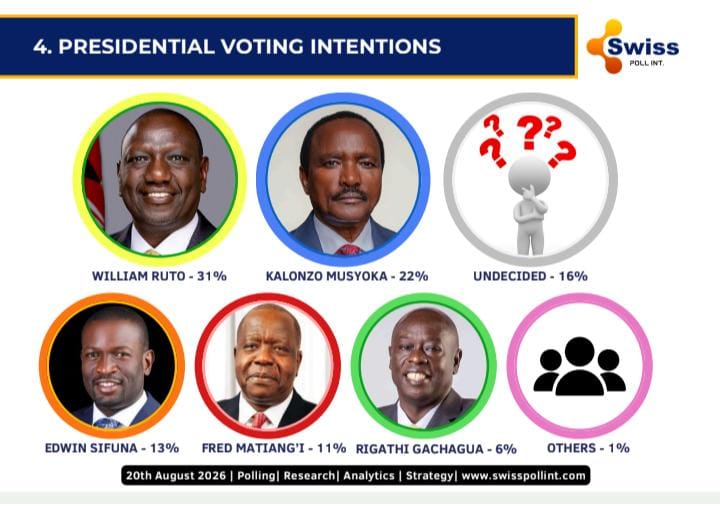
NAIROBI, Kenya — President William Ruto is leading individual contenders in the race for Kenya’s 2027 presidency, although his support has dropped five percentage points since March, according to a new Swiss poll.
The survey puts Ruto’s current support at 31 percent, down from 36 percent in March, signalling a shift in voter sentiment as the country heads into the final year before the General Election.
While Ruto remains ahead of individual presidential contenders, the opposition field is taking shape, with former Vice President Kalonzo Musyoka emerging as the leading choice among those seeking the opposition ticket.
Kalonzo commands 41 percent support in the opposition presidential preference poll, followed by ODM Secretary-General Edwin Sifuna at 26 percent.
Former Interior Cabinet Secretary Fred Matiang’i comes third with 17 percent, while former Deputy President Rigathi Gachagua records 9 percent. Another 8 percent of respondents remain undecided.
The figures give Kalonzo a clear numerical advantage over the other opposition figures surveyed, placing him at the centre of the emerging debate over who could carry the opposition banner into the 2027 presidential contest.
However, the poll reveals a significant generational divide in the opposition race, with Sifuna attracting particularly strong backing among younger voters.
Fifty-eight percent of Sifuna’s supporters are aged between 18 and 35, highlighting his appeal among a demographic expected to have considerable influence on the outcome of the 2027 election.
ODM Leads Party Preference
The survey also paints a competitive picture at the party level, with ODM emerging as the most preferred political party at 23 percent.
It is followed closely by respondents who said they have no party preference, at 22 percent, while Ruto’s United Democratic Alliance (UDA) commands 20 percent.
The Democratic Congress Party (DCP) attracts 15 percent, while Wiper and Jubilee record 9 percent and 7 percent, respectively.
The relatively narrow gap between the leading parties suggests that Kenya’s political landscape remains fluid, with a sizeable section of voters yet to firmly align themselves with a political party.
The findings also underscore the importance of political alliances ahead of 2027. Although Ruto leads the individual presidential preference, opposition candidates could significantly alter the race if they unite behind a single candidate and consolidate their respective support bases.
With the election still ahead, party negotiations, coalition-building and the ability of presidential hopefuls to attract younger voters are expected to become increasingly important.
The Swiss poll therefore presents a race that is far from settled, with Ruto holding an early advantage but the opposition retaining significant potential to reshape the contest through strategic alliances and a unified presidential ticket.