
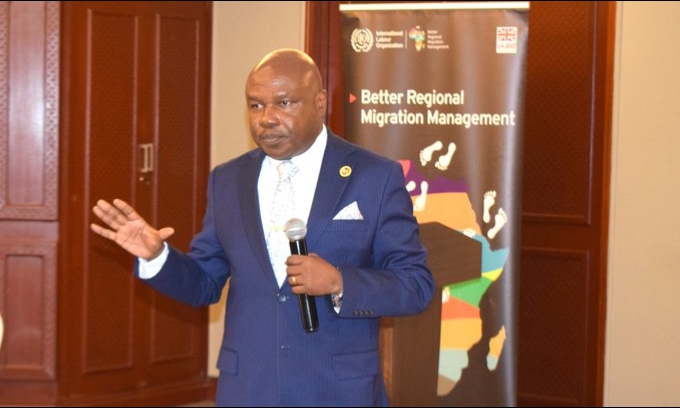
Kenyan government, Shadrack Mwadime, Principal Secretary for the State Department for Labour and Skills Development.
By Peace Muthoka.
Nairobi, 23 September 2025 — The role of the media in shaping the narrative on labour migration took centre stage today at a high-level Media Breakfast Meeting hosted by the International Labour Organization (ILO) in Nairobi. Under the theme “Enhancing Media’s Role in Promoting Safe, Regular, and Fair Labour Migration,” the event brought together journalists, policymakers, and labour stakeholders to spotlight Kenya’s growing efforts in managing labour migration and the critical role of the media in ensuring accurate and rights-based reporting.
Organized under the Better Regional Migration Management (BRMM) programme—funded by the UK Foreign, Commonwealth and Development Office (FCDO) the meeting aimed to deepen collaboration between the media and migration actors, urging journalists to help combat misinformation and promote safe migration pathways.
Media as a Catalyst for Rights-Based Migration
In her remarks, Aida Awel, Chief Technical Advisor for the BRMM programme, called on the media to play a stronger role in creating clarity around migration issues.
“There’s often confusion between trafficking, smuggling, and labour migration,” said Awel. “The media plays a vital role in clarifying these dynamics and ensuring the public understands both the risks and the legitimate pathways to employment abroad. That’s why we’re here today to equip the media with accurate information and engage them as partners in promoting ethical migration governance.”
Awel pointed to Kenya’s leadership in the region, highlighting major policy milestones such as the National Labour Migration Policy, the Labour Migration Bill, and the development of a national skills strategy for labour mobility the first of its kind in the East and Horn of Africa.
“Kenya is not just developing policy it’s implementing real frameworks that place migrant rights at the centre. This kind of leadership sets a precedent for the rest of the region,” she added.
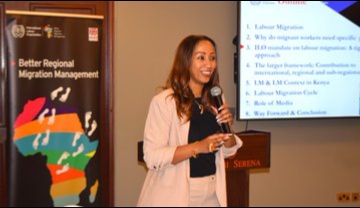
Aida Awel, Chief Technical Advisor for the BRMM programme.
A Migration Agenda with Structure, Safety, and Dignity
Representing the Kenyan government, Shadrack Mwadime, Principal Secretary for the State Department for Labour and Skills Development, reaffirmed Kenya’s commitment to structured and dignified labour migration.
“In the past three years alone, over 150,000 Kenyans have accessed jobs abroad,” said Mwadime. “But we’re not just pushing for numbers we want Kenyans to access quality jobs that offer fair pay, skill development, and a chance to come back home and invest.”
He expressed concern over unregulated recruitment practices and underscored the need for public awareness to prevent exploitation by unscrupulous agencies.
“It is wrong for any Kenyan to be duped into a job that leads to abuse or exploitation,” he said. “That’s why we are introducing legal safeguards, a migrant welfare fund, and comprehensive bilateral labour agreements to protect our citizens.”
Mwadime also revealed plans to deploy labour attachés in destination countries and send young legal professionals to study foreign labour laws in popular job markets like Saudi Arabia and the Gulf.
“Our goal is to ensure every Kenyan abroad is protected not just from physical harm, but also from long working hours, lack of rest, and non-payment of wages. These rights must be guaranteed.”
A Regional and Global Vision
The BRMM programme complements Kenya’s commitments under several regional and global frameworks, including the African Union’s Agenda 2063, the AU Revised Migration Policy Framework (2018–2030), and the UN’s Global Compact for Migration.
“Kenya is aligning its strategies with continental and global agendas,” Awel explained. “From the Abidjan Declaration to the Ouagadougou+10 Plan, the country is showing that labour migration, if well-managed, can contribute significantly to social justice and development.”
She also emphasized the importance of data-driven reporting and urged the media to ground their stories in reliable information and regional context.
Looking Ahead: Media as Guardians of the Migrant Story
As the meeting concluded, both Awel and Mwadime underscored the importance of sustained engagement with the media to shape migration narratives that are factual, balanced, and human-centred.
“This breakfast is just the beginning,” said Mwadime. “We want to work with you the media to ensure every Kenyan pursuing opportunity abroad does so with knowledge, support, and protection.”
Journalists at the event welcomed the call for deeper collaboration and stressed the need for regular briefings, access to migration data, and capacity-building opportunities to enhance reporting on migration issues.
In a region where labour migration is both a source of opportunity and vulnerability, the message was clear: a well-informed media can be a powerful ally in promoting safe, fair, and regular migration not just for Kenya, but for the entire region.