
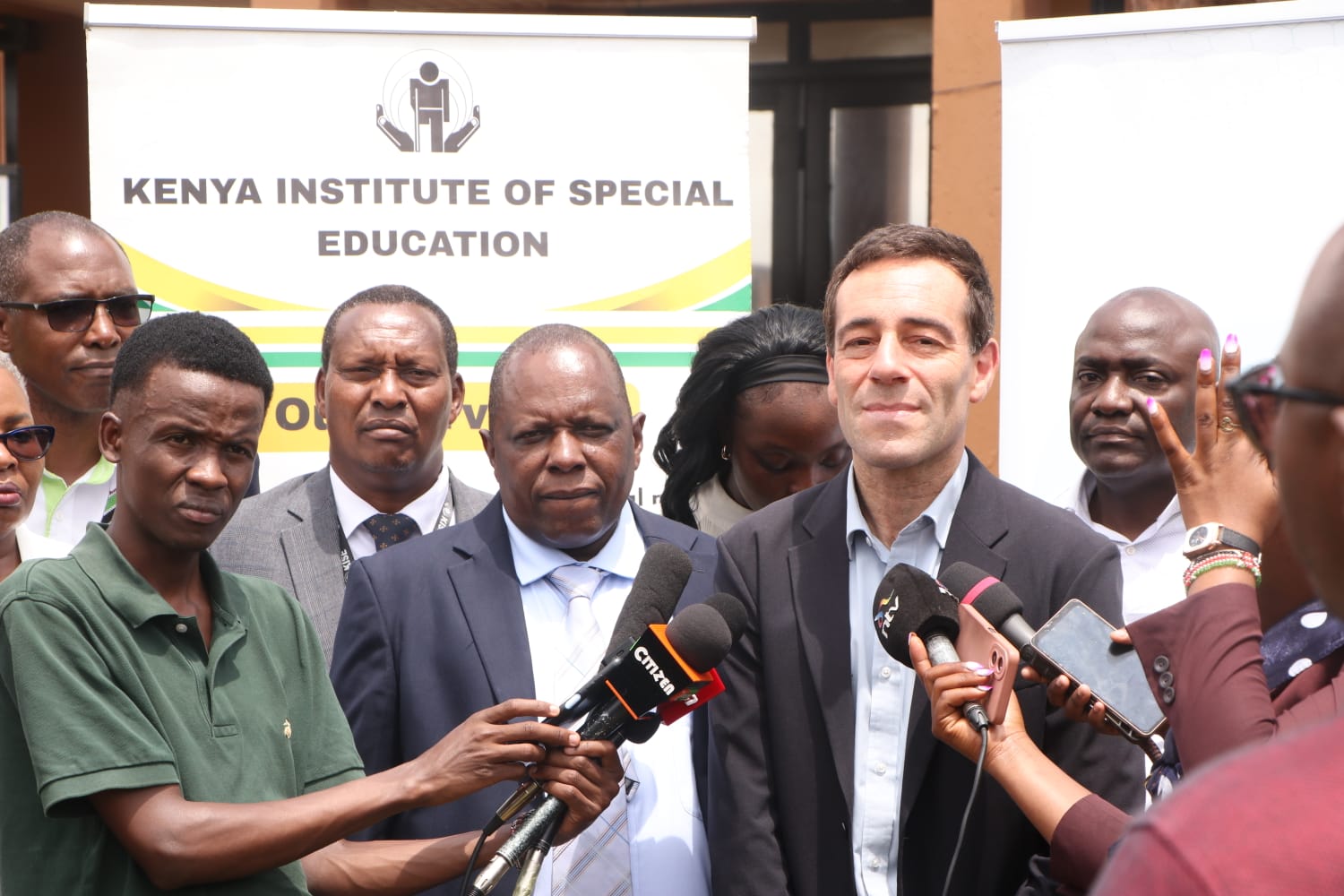
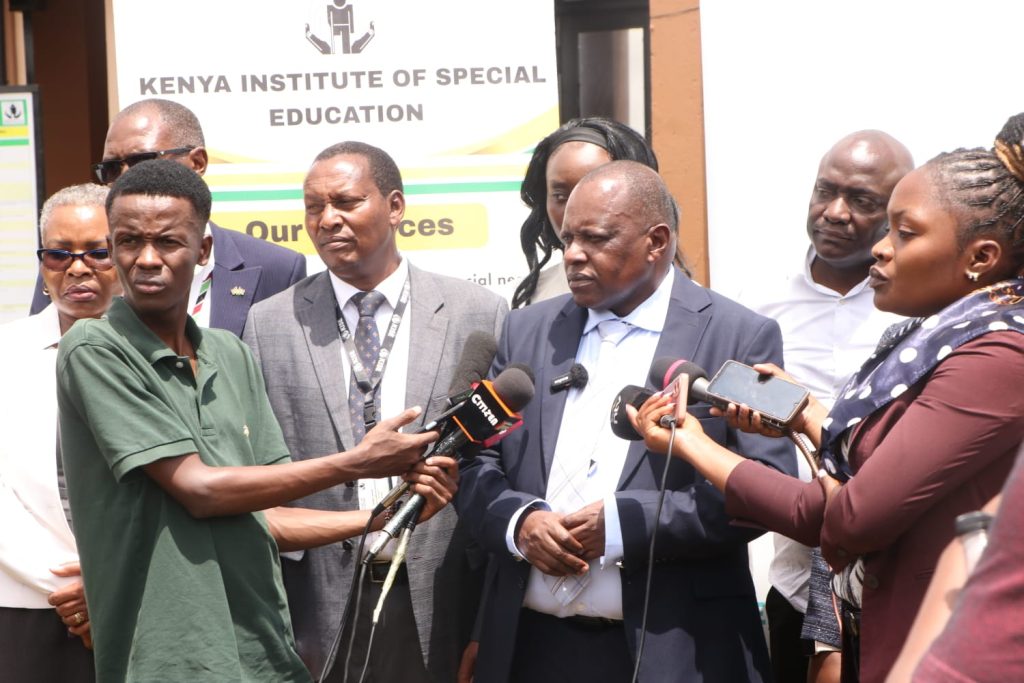
Officials and stakeholders address journalists during a media tour at the Kenya Institute of Special Education in Kasarani, highlighting the role of AI and assistive technologies in advancing inclusion and opportunities for persons with disabilities.
By Peace Muthoka
Nairobi, April 2026 — Kenya is accelerating efforts to bridge the employment gap for persons with disabilities, as stakeholders turn to artificial intelligence and digital technologies to scale up locally developed assistive solutions.
The renewed push took centre stage during a media tour at the Kenya Institute of Special Education (KISE) in Kasarani, where journalists were given behind-the-scenes access to one of the country’s leading institutions supporting learners and persons with disabilities. The tour highlighted how partnerships, innovation and technology are being harnessed to tackle long-standing barriers to inclusion, employment and entrepreneurship.
At the heart of the initiative is KISE’s transition from pilot innovations to full-scale implementation. Director Dr. Norman Kiogora Stephen said solutions developed during a 2024 AI hackathon, organised in partnership with Huawei, the Assistive Technologies for Disability Trust (AT4D), UNESCO and other stakeholders, are now ready for expansion.
“These innovations have now evolved beyond the concept stage and need to be scaled up into a fully resourced programme,” he said. He added that scaling up will increase access to assistive technologies, support inclusive learning environments and open up opportunities for skills development, entrepreneurship and employment. “For persons with disabilities, this means greater independence, enhanced participation in society and the dignity that comes with equal access to opportunity.”
Inside the institute, that vision is already unfolding. KISE is strengthening its capacity to design and manufacture assistive devices locally using digital design systems, artificial intelligence and advanced technologies. At its production facility, the institute is working to turn ideas into scalable, affordable and user-specific solutions.
During the tour, media visited key facilities including assessment and rehabilitation units such as hydrotherapy, earmould production and sensory integration, alongside digital classrooms powered by smart technologies and a national assistive devices production unit expected to boost local manufacturing.
The initiative comes amid growing concern over rising disability cases in Kenya, particularly autism among children. Dr. Kiogora said early findings from ongoing research indicate an increase in autism cases, especially among boys, prompting further investigation into the causes.
“The numbers are rising, and we are working with stakeholders to understand what is driving this trend,” he said, noting that the pattern reflects a broader global concern.
Despite these challenges, access to assistive tools, education and employment remains limited for many persons with disabilities. Dr. Kiogora stressed that technology is central to changing this reality.
“To many people, technology makes things easier, but for persons with disabilities, it makes things possible,” he said, explaining that many mainstream innovations, including touchscreens, were originally designed to support persons with visual impairments. He described artificial intelligence as a game changer but cautioned that it must be used responsibly to avoid exclusion or misuse.
The initiative is also backed by government support, including the establishment of a national assistive devices factory aimed at making equipment more affordable and technologically advanced. Dr. Kiogora said the facility will be a “game changer” in ensuring modern, accessible devices while strengthening inclusion efforts. He also cited the 2024 Disability Act as a key step in safeguarding the rights of persons with disabilities.
Technology partners say collaboration will determine the success of the programme. Adam Lane, Director for Policy and Partnerships at Huawei Kenya, said a new programme set to launch will build on the 2024 hackathon by supporting innovators to refine and scale their ideas.
“We recognised a huge opportunity for local innovators to collaborate and develop solutions that can help teachers, learners, parents and caregivers,” he said, adding that the initiative will expand participation and strengthen support for young developers using AI and digital tools.
Lane noted that advances in technology now allow for more personalised solutions tailored to individual needs. “It is now much easier and cheaper to build software and hardware that can adapt to individual users,” he said. “Many disabilities require customised solutions, and technology allows us to design for individuals rather than a one-size-fits-all approach.”
He added that such innovations could benefit a wider population, including the elderly and those with visual or hearing impairments, significantly expanding their impact. He emphasised that technology must remain purposeful and inclusive. “Technology for its own sake is not enough. It must improve lives, strengthen communities and support economies,” he said.
Ensuring accessibility remains a central pillar of the programme. George Siso of inABLE Kenya said his organisation will help ensure all solutions meet accessibility standards.
“Our role is to ensure that whatever is developed is accessible and usable by persons with disabilities,” he said, pointing to the implementation of the KS2952 standard on inclusive products and services.
The urgency of the initiative is reflected in employment statistics. Only about one per cent of adults with disabilities in Kenya are employed, despite a legal requirement that five per cent of public sector jobs be reserved for them. Current representation stands at just 1.32 per cent, highlighting a persistent gap between policy and reality.
Stakeholders say the programme offers a practical pathway to address this challenge by linking innovation with skills development and entrepreneurship. By supporting young innovators and expanding access to assistive technologies, the initiative aims to unlock new economic opportunities for persons with disabilities.
Beyond policy and technology, the programme is also expected to highlight human stories of innovation and transformation, from developers creating assistive solutions to young beneficiaries whose lives could change through digital inclusion. It also positions Kenya as a leader in using artificial intelligence responsibly to address social and economic challenges.
As the country moves to scale up these efforts, stakeholders say sustained investment, strong partnerships and a firm commitment to inclusion will be critical. For Dr. Kiogora, the message remains clear: “Human beings are human beings first and foremost. The aspirations are the same. What we must do is ensure everyone has the tools and opportunities to achieve them.”