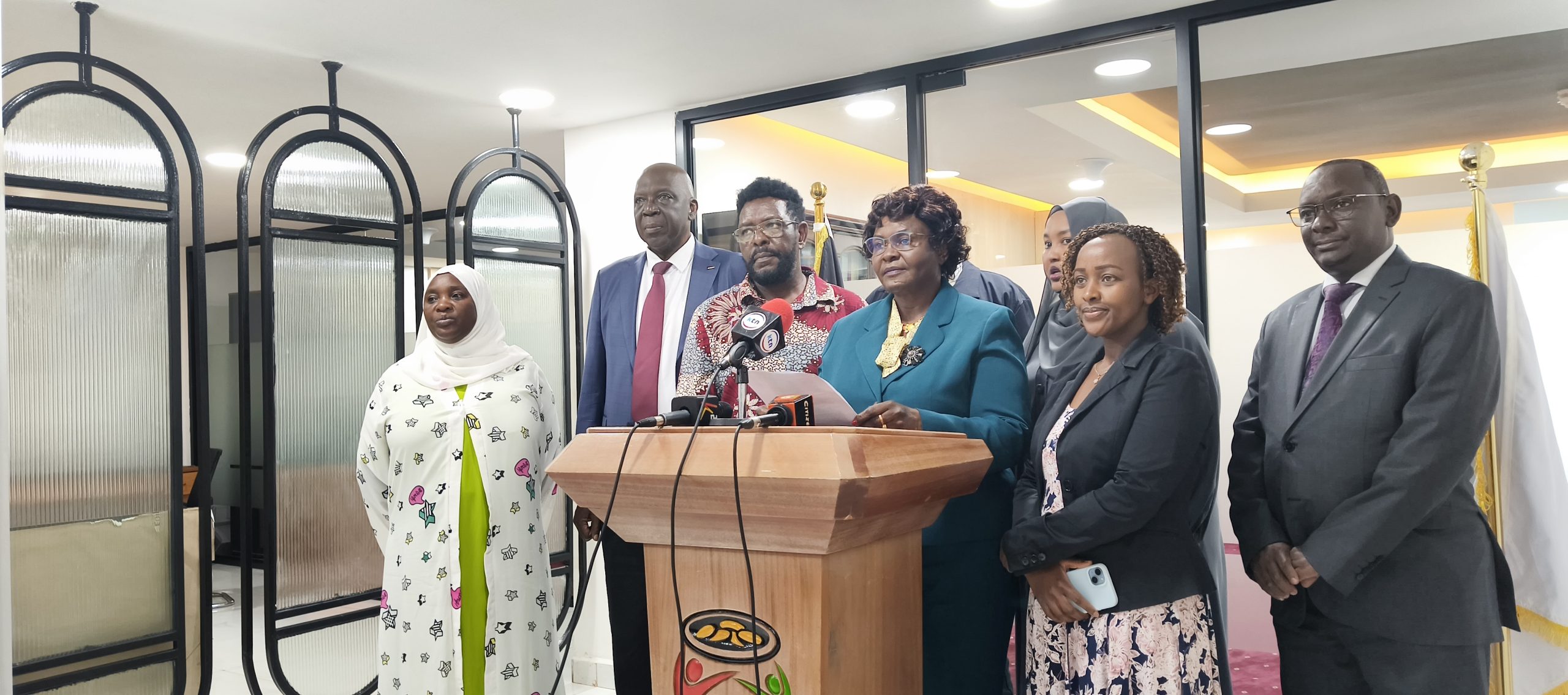
Commission on Revenue Allocation (CRA) Chairperson Mary Wanyonyi Chebukati accompanied by other commissioners, addresses journalists during a media briefing in Nairobi on the commission’s recommendation to increase county governments’ equitable share of revenue to KSh457.28 billion for the 2027/28 financial year.
By Peace Muthoka
NAIROBI, Kenya — County governments could receive KSh457.28 billion in the 2027/28 financial year, an increase of KSh29.28 billion, under new recommendations by the Commission on Revenue Allocation (CRA) aimed at strengthening service delivery and meeting rising operational costs.
CRA Chairperson Mary Wanyonyi Chebukati announced the recommendation during a media briefing, where she was accompanied by other commissioners. The proposal would raise the counties’ equitable share from KSh428 billion allocated in the current financial year to KSh457.28 billion.
The commission said the proposed increase responds to counties’ growing financial obligations, including healthcare staffing costs, public servants’ remuneration and the need to sustain services across devolved units.
“Our recommendation is evidence-based, constitutionally grounded and responsive to the financing needs of county governments. Our objective remains clear: no Kenyan should be left behind,” Wanyonyi said.
The proposed allocation comes as county governments continue to shoulder responsibilities in essential sectors, particularly healthcare, where staffing and operational costs place pressure on available resources.
According to the CRA, the additional funding would help counties meet remuneration obligations linked to Universal Health Coverage (UHC) staff, the fourth cycle of Salaries and Remuneration Commission (SRC) salary and benefit reviews for state and public officers, and the collective bargaining agreement between the Kenya National Union of Nurses and Midwives and the relevant employers.
The commission also factored in an estimated three per cent growth in the cost of providing county services.
Under the proposal, the national government would receive KSh2.782 trillion from projected shareable revenue of KSh3.249 trillion, while KSh10.25 billion would go to the Equalisation Fund.
The CRA said the proposed county allocation represents 22.3 per cent of the most recent audited and approved nationally raised revenue. This is above the constitutional minimum of 15 per cent set aside for county governments.
Beyond the equitable share, the commission has recommended a total of KSh76.22 billion in recurrent expenditure ceilings for county assemblies and county executives.
County assemblies would receive a proposed ceiling of KSh50.367 billion, while county executives would have a ceiling of KSh25.853 billion.
The commission attributed the proposed increase in county assembly funding to various obligations, including Members of County Assembly remuneration, operational and maintenance expenses, vehicle reimbursements, induction and training, and staffing costs.
For county executives, the proposed adjustment takes into account village administration data from Bungoma County, as well as operational and maintenance expenses, induction and training requirements.
The recommendations are expected to inform the next stage of the national budget-making process, with the commission set to submit them to the relevant constitutional offices for consideration.
Wanyonyi said the proposals seek to balance the need for sustainable public finances with the resources counties require to provide services and support equitable development.
If adopted, the proposed increase would give county governments additional resources to address their financial obligations and sustain essential services. However, the final allocations will depend on the subsequent budget-making process.
The CRA’s recommendations place county financing at the centre of discussions on how public resources should be shared to support devolved services and address the needs of communities across Kenya.