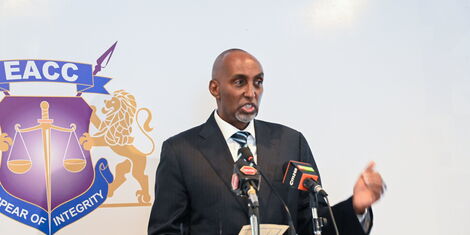
Ethics and Anti-Corruption Commission CEO Abdi A. Mohamud speaking during the Anti-Corruption Workshop for Media in Nairobi, April 14, 2026.
By Peace Muthoka
NAIROBI, April 14 — The Ethics and Anti-Corruption Commission has defended its record in tackling corruption, pointing to stronger conviction rates and rising recovery of stolen public funds, even as it warned that graft remains widespread.
Speaking during an anti-corruption workshop for journalists in Nairobi, EACC Chief Executive Officer Abdi A. Mohamud said the commission has recorded a 72 per cent conviction rate over the past two years. At the same time, he noted that at least KSh7.8 billion in public funds has been recovered, describing the figures as a sign of steady progress in enforcement.
However, even with these gains, the commission cautioned that corruption continues to evolve, calling for stronger collaboration across sectors to contain the vice.
During the same forum, EACC Chairperson David Oginde shifted focus to the role of the media, urging journalists to take a more sustained approach in exposing graft. He said while many corruption cases gain attention when they first break, public interest often fades before accountability is achieved.
“The media does not just report events; it shapes outcomes,” Oginde said, challenging journalists to maintain pressure on institutions through consistent follow-up reporting.
He emphasized that the commission is increasingly prioritizing prevention, which relies heavily on public awareness and informed citizens. In this effort, he described the media as a critical partner rather than just an observer.
To drive his point home, Oginde referenced global experiences, including reforms in Hong Kong in the 1970s, where persistent investigative reporting helped expose deep-rooted corruption within the police service.
He warned that corruption thrives when scrutiny fades, urging journalists to keep stories alive beyond the initial headlines.
“Corruption does not survive exposure—it survives forgetfulness,” he said, calling for a continuous national conversation that keeps both citizens alert and institutions accountable.
The workshop, held at Sarova Stanley, brought together key players from the media and governance sectors. Patrick Kiage, a judge of the Court of Appeal, attended as the chief guest.