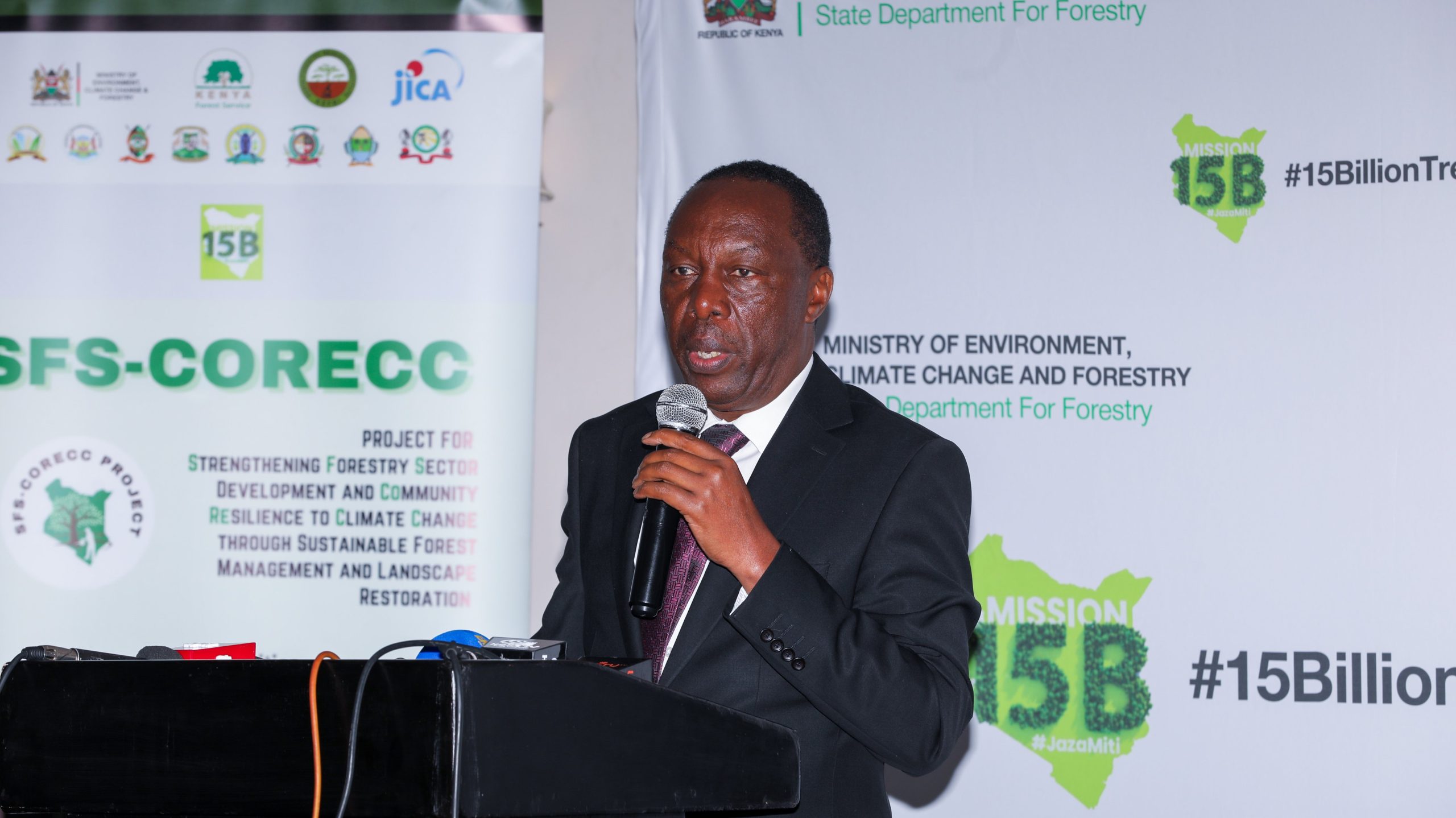
Forestry Principal Secretary Gitonga Mugambi
By Peace Muthoka
NAIROBI, Kenya, July 22, 2026 — The Government has intensified its push for greater investment in forest conservation and landscape restoration, calling on development partners, the private sector and local communities to join hands in restoring degraded ecosystems and helping Kenya achieve 30 percent tree and forest cover by 2032.
The appeal was made during the Donors’ Round-Table Breakfast Meeting convened by the Ministry of Environment, Climate Change and Forestry, through the State Department for Forestry, in collaboration with the Japan International Cooperation Agency (JICA), at Fairmont The Norfolk Hotel in Nairobi on Wednesday.
Speaking during the meeting, Forestry Principal Secretary Gitonga Mugambi said the restoration of Kenya’s forests, drylands and coastal ecosystems cannot be achieved by government alone, stressing that broad partnerships are essential to unlocking the country’s environmental and economic potential.
He said Kenya’s arid and semi-arid lands account for about 89 percent of the country’s landmass and possess enormous natural wealth that remains largely underutilized despite offering significant opportunities for biodiversity conservation, climate action and sustainable economic growth.
“Our drylands and coastal ecosystems are not just environmental assets. They are economic resources that can transform livelihoods while strengthening climate resilience and biodiversity conservation,” Mugambi said.
The Principal Secretary noted that the country continues to grapple with environmental challenges including deforestation, land degradation, biodiversity loss, desertification, prolonged droughts and the growing effects of climate change.
To address these challenges, he said the government has adopted the National Landscape and Ecosystem Restoration Strategy 2023-2032, which aims to restore 10.6 million hectares of degraded landscapes while supporting the national target of achieving 30 percent tree and forest cover by 2032.
According to Mugambi, the strategy goes beyond environmental restoration by creating green jobs, improving food security, enhancing community resilience and stimulating sustainable economic growth.
“The restoration agenda is not simply about planting trees. It is about restoring ecosystems, creating employment opportunities, reducing poverty and improving livelihoods for millions of Kenyans,” he said.
He emphasized that successful implementation of the strategy will require close collaboration between the national and county governments, development partners, research institutions, civil society organizations, local communities and the private sector.
Mugambi said the donors’ meeting was convened to strengthen these partnerships, mobilize financial resources and develop strategic alliances that will accelerate restoration efforts, particularly in Kenya’s drylands and coastal ecosystems.
He added that investment in ecosystem restoration should be viewed as an investment in climate action, peace building, biodiversity conservation and long-term economic development.
The Principal Secretary further noted that the government’s restoration agenda aligns with the Constitution of Kenya, Vision 2030, the National Forest Policy 2023, the Forest Conservation and Management (Amendment) Act 2026 and Kenya’s international climate commitments.
Beyond seeking donor support, Mugambi urged partners to invest in initiatives that generate both environmental and economic returns.
He highlighted agroforestry as one of the government’s key priorities, saying commercial tree farming and fruit tree cultivation have the potential to create thousands of jobs while increasing household incomes.
Among the flagship initiatives is an ambitious programme to introduce cocoa farming on a large scale in Kenya.
“We have already launched the cocoa programme, and our initial target is to plant one billion cocoa trees across the country,” he said.
Mugambi noted that the initiative could eventually expand beyond six billion trees, describing cocoa as a high-value crop capable of generating substantial income for farmers and contributing significantly to the national economy.
He also announced plans to expand avocado production through the planting of an additional one billion avocado trees, saying the programme is expected to create employment opportunities while boosting export earnings.
In addition, the government is encouraging the cultivation of oil-producing trees to reduce Kenya’s dependence on imported cooking oil and strengthen local agricultural value chains.
The Principal Secretary appealed to development partners to support the programmes by financing seedling production or directly donating seedlings for priority crops such as cocoa, avocado and oil-producing trees.
“We are asking our partners to help us with seedlings or financial support so that more communities can participate in these programmes,” he said.
Mugambi also underscored the importance of community-led conservation, saying the government has shifted from a model where forest restoration was viewed solely as the responsibility of the Kenya Forest Service to one that places local communities at the centre of conservation efforts.
He cited the successful restoration model in Kaptagat Forest, which has since been replicated in other parts of the country through close collaboration between communities, county governments and conservation agencies.
The model, he said, demonstrates that when communities are provided with alternative livelihoods, pressure on forests declines significantly while household incomes improve.
“People destroy forests because they are looking for livelihoods. If we create alternative sources of income, communities become active partners in conservation instead of contributing to forest degradation,” he said.
Among the innovations highlighted was the establishment of communal livestock management centres where farmers keep their animals instead of grazing them inside forests.
The approach has reduced forest encroachment while improving livestock productivity through better feeding and management practices.
Mugambi urged community leaders to champion restoration initiatives within their local areas, saying conservation efforts are more sustainable when driven by local ownership.
He also encouraged development partners to support grassroots organizations already working alongside government agencies to restore degraded ecosystems.
Earlier, Chief Conservator of Forests at the Kenya Forest Service, Alexander Lemarkoko ‘ndc’ (K), said forestry has become a central pillar of Kenya’s sustainable development agenda, with recent restoration initiatives demonstrating the sector’s growing contribution to environmental conservation, economic development and community livelihoods.
Lemarkoko said achieving the country’s forest cover target will require sustained financing, stronger partnerships and greater community participation.
He added that recent conservation programmes have demonstrated the importance of involving local leadership more directly in forest management.
“As we review our participatory forest management approaches, we must recognize the critical role of local leadership in ensuring the success of conservation programmes,” he said.
Lemarkoko further observed that forests support agriculture, livestock production, water security, climate resilience and rural livelihoods, while also contributing to improved security in some parts of the country.
He called for innovative financing mechanisms to increase investment in forest restoration, arguing that the forestry sector has become a strategic driver of Kenya’s environmental sustainability and economic transformation.