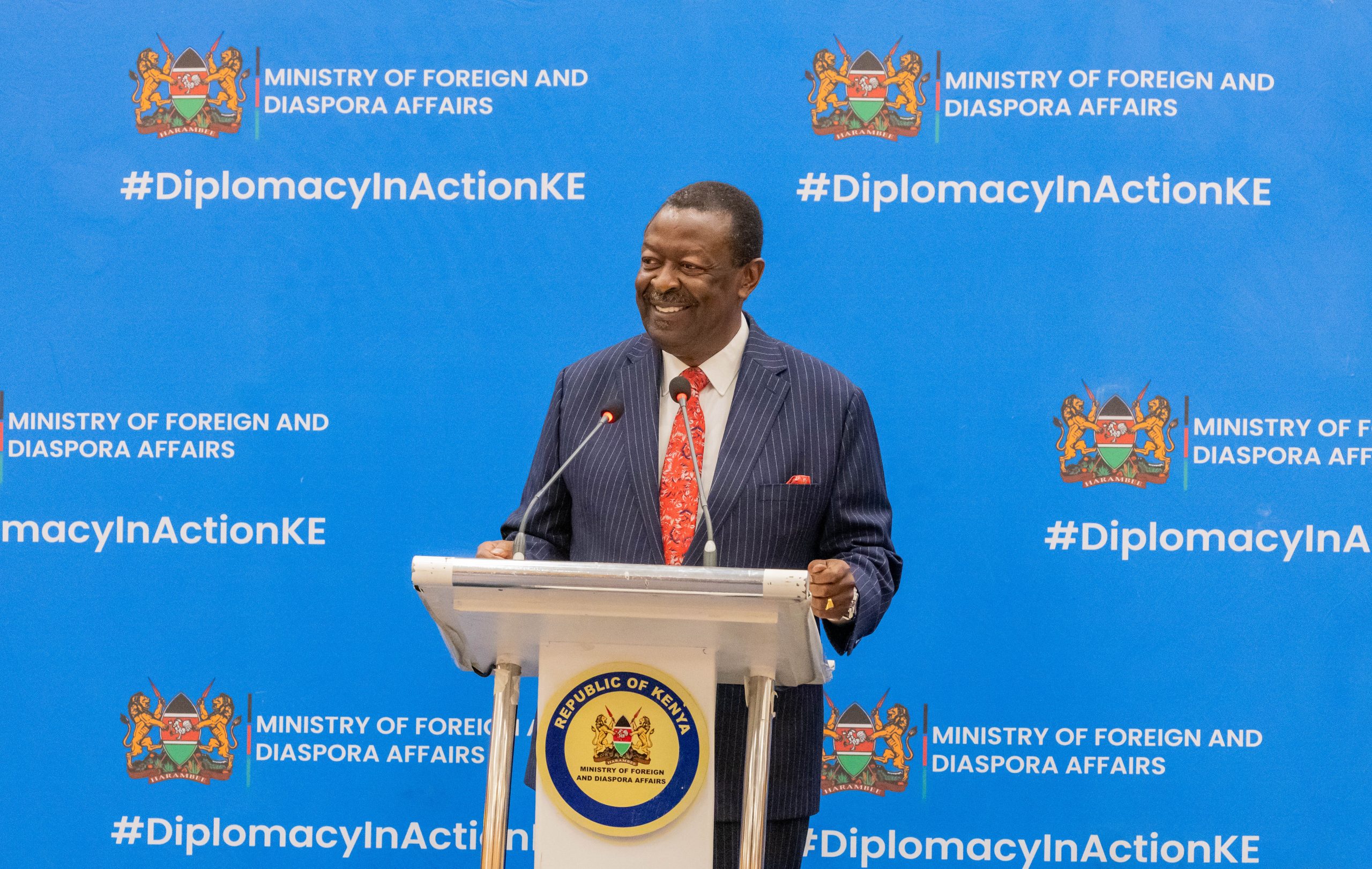
Prime Cabinet Secretary and Cabinet Secretary for Foreign and Diaspora Affairs Musalia Mudavadi Speaking on Thursday during the quarterly Diplomatic Briefing to the Diplomatic Corps at Serena Hotel in Nairobi
By Peace Muthoka
NAIROBI, Kenya, September 10, 2026 — Prime Cabinet Secretary and Cabinet Secretary for Foreign and Diaspora Affairs Musalia Mudavadi has assured Kenya’s diplomatic partners that the country remains politically stable, economically resilient and committed to regional integration as it prepares for the 2027 General Election.
Speaking on Thursday during the quarterly Diplomatic Briefing to the Diplomatic Corps at Serena Hotel in Nairobi, Mudavadi outlined the Government’s priorities on the economy, democratic governance, regional security, food security, investment and Kenya’s wider diplomatic engagement.
With the August 10, 2027 General Election approaching, Mudavadi urged diplomats to support Kenya’s constitutional institutions and democratic processes, saying the Government was committed to a safe, free and peaceful election.
“The Electoral Commission must be allowed to discharge its constitutional mandate independently and professionally. We should not seek to discredit the Commission,” he said.
Mudavadi said Kenya’s democracy depended on strong institutions and respect for established rules rather than individual interests. He added that security agencies were strengthening coordination to identify and respond to emerging threats ahead of the polls.
He also pointed to the National Cohesion and Integration Commission’s Uchaguzi Bila Noma roadmap as part of efforts to promote a peaceful electoral process, warning that anyone who threatens peace and security would be held accountable regardless of political affiliation or status.
Turning to the economy, Mudavadi presented Kenya as a resilient and increasingly attractive destination for investment.
He said the economy grew by 5.3 per cent in the first quarter of 2026, up from 4.9 per cent during the same period the previous year. Foreign exchange reserves stood at US$14.9 billion in August, equivalent to 6.2 months of import cover.
The Nairobi Securities Exchange also crossed the KSh4 trillion market capitalisation mark for the first time, which Mudavadi said reflected growing opportunities within Kenya’s financial markets.
He urged diplomatic missions to help strengthen connections between Kenyan businesses and investors, financial institutions and companies in their respective countries.
Mudavadi further asked diplomats to engage with the Kenya Development Corporation and the Nairobi International Financial Centre, which are supporting long-term development financing, investment and the positioning of Nairobi as a financial-services hub.
Beyond attracting capital, he said Kenya was seeking to increase value-added exports, expand trade and investment, facilitate technology transfer, strengthen local manufacturing and accelerate growth in the digital economy.
“Kenya is more than a destination for capital. It is strategically positioned to serve as a manufacturing base and a launchpad for digital growth across the continent,” Mudavadi said.
The Government is also creating investment opportunities through the National Infrastructure Fund and Sovereign Wealth Fund, with international partners being encouraged to explore public-private partnerships, co-investments and other long-term financing arrangements.
Mudavadi also used the briefing to clarify Kenya’s position on foreign nationals engaged in small-scale businesses following directives announced by President William Ruto on September 2.
He said the measures were intended to protect vulnerable sectors, promote fair competition and safeguard the livelihoods of Kenyan citizens, but stressed that they did not amount to a blanket ban on foreign nationals conducting small-scale business.
“Kenya is open to small and large-scale trade by foreign nationals, as long as they are compliant with immigration, work-permit, registration and licensing requirements,” he said.
He described the Government’s approach as regulatory rather than discriminatory and reaffirmed that foreign nationals operating legitimate businesses in Kenya would continue to have their rights protected.
On the regional front, Mudavadi reaffirmed Kenya’s commitment to the African Union, East African Community, IGAD, the International Conference on the Great Lakes Region and the African Continental Free Trade Area.
Kenya is preparing to host the fourth COMESA-EAC-SADC Tripartite Summit in Nairobi, bringing together three regional blocs representing 29 countries, more than 700 million people and a combined economy of more than US$1.4 trillion.
Mudavadi said Kenya wanted to see an Africa where goods are increasingly produced on the continent, traded across African markets and consumed within Africa.
He also highlighted Kenya’s voluntary move to Tier One of the African Union scale of assessment, which will raise the country’s annual contribution to about US$14.6 million from 2027.
The move, he said, demonstrated Kenya’s willingness to take greater responsibility for continental priorities and strengthen the African Union.
Meanwhile, Mudavadi described the Kenyan diaspora as an important source of investment, innovation, skills and expertise.
He said the Government was implementing a Diaspora Investment Strategy and establishing a Diaspora Investment Support Office to make it easier for Kenyans abroad to invest and participate in national development.
Kenya is also seeking stronger international partnerships in labour mobility, mutual recognition of qualifications, research, skills development, technology transfer and technical and vocational education and training.
“We welcome collaboration in research, skills development and technology transfer,” Mudavadi said, describing Kenya’s workforce as young, skilled and adaptable.
Security remained another major focus of the briefing, with Mudavadi reiterating Kenya’s support for African-led solutions to African challenges.
He said Kenya remained concerned about terrorism and transnational crime and called for stronger international cooperation to prevent terrorist financing, recruitment and radicalisation.
On Somalia, Kenya called for adequate funding for the African Union Support and Stabilisation Mission and implementation of UN Resolution 2719 on financing African Union-led peace support operations.
Mudavadi also said the situation in Sudan required coordinated mediation alongside a humanitarian truce rather than a military solution.
He further raised concern over instability in the Middle East, warning of its potential effects on maritime trade, energy supplies and global commodity chains. Kenya, he said, continued to support freedom of navigation under international law.
Domestically, Mudavadi raised concern over Kenya’s food security following below-average rainfall in major cereal-producing areas.
The dry conditions have contributed to crop failure, with national harvest projections indicating a 30 to 40 per cent decline in food production this year.
In response, the Government has reduced the price of subsidised fertiliser to KSh2,000 for a 50-kilogramme bag, while meeting half the cost of certified maize seed and expanding investment in irrigation.
Mudavadi said Kenya could also import maize to supplement domestic supplies, maintain adequate market availability and cushion consumers against possible price distortions.
At the same time, the Government is preparing for possible El Niño or unusually wet conditions between October 2026 and January 2027. A Cabinet Committee chaired by the Deputy President is coordinating national preparedness.
Kenya is also seeking greater international cooperation on weather forecasting, irrigation and post-harvest storage while leading negotiations towards a Protocol on Drought Management.
Mudavadi called for increased international financing for drought resilience and climate adaptation, particularly as Kenya continues to face recurrent climate-related shocks.
Ebola preparedness
The regional Ebola outbreak also featured in the briefing, with Mudavadi saying Kenya remained on heightened preparedness despite having no reported cases of Ebola Virus Disease.
The Government continues to maintain surveillance and passenger screening at major points of entry, including Jomo Kenyatta International Airport.
He expressed solidarity with affected countries and thanked international partners supporting Kenya’s preparedness and response measures.
Looking beyond immediate regional concerns, Mudavadi reaffirmed Kenya’s commitment to multilateralism as the country prepares for the 81st Session of the United Nations General Assembly.
He invited members of the diplomatic community to participate in the inaugural Global Trust Summit, scheduled for October 22 and 23, 2026, in Nairobi under the theme “Weaving Trust: Binding Strands for a Stronger Global Order.”
Kenya will also host the inaugural Diplomatic Conference on the Provision, Administration and Management of Privileges and Immunities to the Diplomatic Community in Kenya on November 23 and 24 at the Kenyatta International Convention Centre.
Mudavadi further sought diplomatic support for Kenya’s candidates for international judicial positions, including Judge Phoebe Okowa’s candidature to the International Court of Justice for the 2027–2036 term and Justice Njoki Ndung’u’s candidature to the International Criminal Court for the same period.
Championing Africa’s economic interests
Mudavadi also highlighted Kenya’s efforts to advance Africa’s economic interests on the global stage, thanking the diplomatic community for its participation in the African Forward Summit held in Nairobi.
He pointed to President William Ruto’s participation in the 52nd G7 Summit in France in June, where Kenya championed greater processing of Africa’s natural resources and minerals on the continent instead of continuing to export raw materials.
Such an approach, Mudavadi said, would support local manufacturing, create jobs and open opportunities for Africa’s rapidly growing youth population.
The President also called for reforms to the global financial architecture to make it more responsive to the needs of developing countries.
Mudavadi said Kenya’s foreign policy remained anchored in international law, human rights, peace, stability and democratic governance.
“Kenya is also a country that honours its commitments. We respect international law, uphold human rights and defend the rule of law,” he said.
Mudavadi said Kenya’s international role extended beyond attracting investment, pointing to its contribution to peacekeeping, mediation, counterterrorism, humanitarian support and refugee protection.
He said Kenya would continue working with its international partners to strengthen regional stability, expand economic opportunities and advance African interests while positioning Nairobi as an important platform for diplomacy, trade, investment and digital growth.
The briefing brought together ambassadors, high commissioners, representatives of international organisations and senior Kenyan officials.