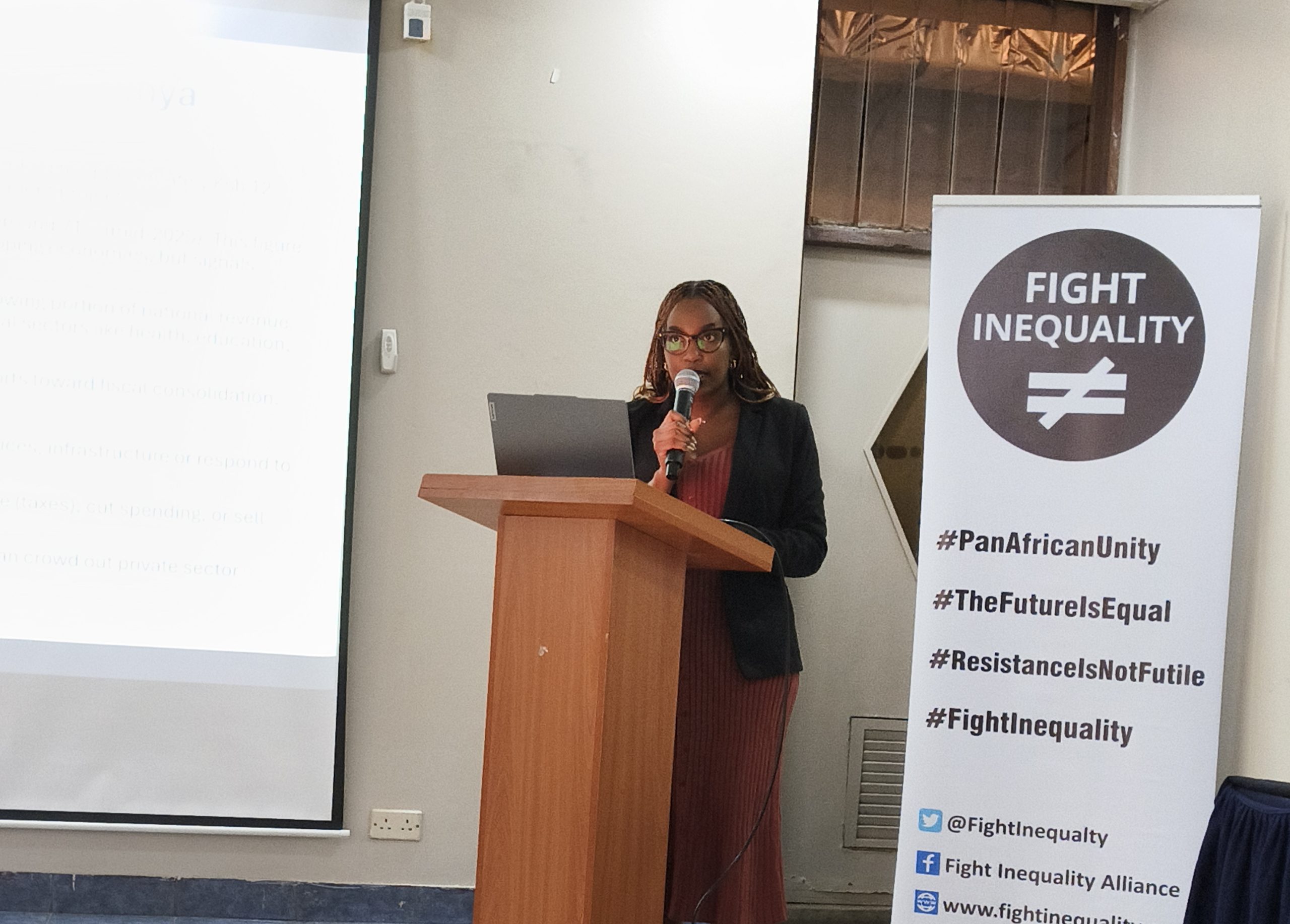
FIA Kenya National Coordinator Brenda.
By Peace Muthoka.
The Fight Inequality Alliance Kenya (FIA Kenya) is sounding the alarm over the country’s accelerating privatization agenda, warning that the sale of state institutions risks widening inequality and putting essential public services beyond the reach of ordinary citizens.
Speaking during a press briefing in Nairobi, FIA Kenya National Coordinator Brenda Osoro said the government’s decision to fast-track the Privatization Bill into law marks a dangerous shift in economic policy. She explained that the law, signed by the President in October 2025, opens the door for the sale or transfer of more than 30 state-owned enterprises in key sectors such as ports, water, transport, agriculture, and energy.
She noted that the move comes at a time when Kenya’s public debt has surged past KSh 11.8 trillion, pushing the country into what she termed “a debt-driven race toward austerity and asset stripping.”
“As we speak, more than 65% of all tax revenue is going directly to debt repayment,” Osoro said. “When a nation reaches such a point, the temptation is always to sell public assets. But we must ask: at what cost, and to whose benefit?”
Osoro said the push for privatization is not homegrown but heavily influenced by international lenders. She highlighted that Kenya’s ongoing program with the International Monetary Fund (IMF) and the World Bank continues to impose strict conditionalities, including austerity and structural reforms that prioritize privatization.
She argued that while privatization is often sold as a solution to fiscal challenges, history tells a different story. She pointed to the cases of Kenya Airways and Telkom Kenya, whose partial privatization led to job losses, ballooning debt, and eventual government bailouts.
“Privatization has never been a cure for economic struggle,” she said. “Instead, it becomes a catalyst for deeper inequality. When essential services are handed to profit-driven entities, ordinary Kenyans are the ones who pay the price.”
Osoro said the human cost must remain at the center of the debate. She warned that privatization could trigger job cuts, increase the cost of living, and reduce access to basic amenities such as water, electricity, and transport—services that many communities already struggle to afford.
“Every time a public asset is sold, we lose a piece of our collective safety net,” she said. “We risk creating a country where only the wealthy can access quality services, while millions are left behind.”
She emphasized that sustainable alternatives exist. FIA Kenya is calling for the abolition of unnecessary tax incentives, enforcement of taxes on wealth, and stronger debt transparency measures. These, she said, offer a more just and sustainable path than selling public property.
To stop what she called “a fast-moving economic crisis,” FIA Kenya issued a list of urgent demands. These include an immediate moratorium on all privatization; full public consultation and parliamentary oversight on any economic reforms; protection of workers’ rights; and the rejection of IMF and World Bank loan conditions that require austerity measures.
She also called for debt cancellation and fairer international financial practices, arguing that Kenya should not be forced to choose between debt repayment and the welfare of its people.
“Public services belong to everyone, not a privileged few,” Osoro said. “Unchecked privatization threatens to dismantle the very systems that hold our society together. We must defend our public resources before they disappear into private hands.”
Osoro urged the media to highlight the risks, noting that parliamentary decisions on privatization are imminent. She appealed for a national conversation that centers the needs and voices of ordinary Kenyans.
“We’re at a crossroads,” she said. “The question is simple but urgent: will we sacrifice our public resources for quick profit, or will we protect them for generations to come?”