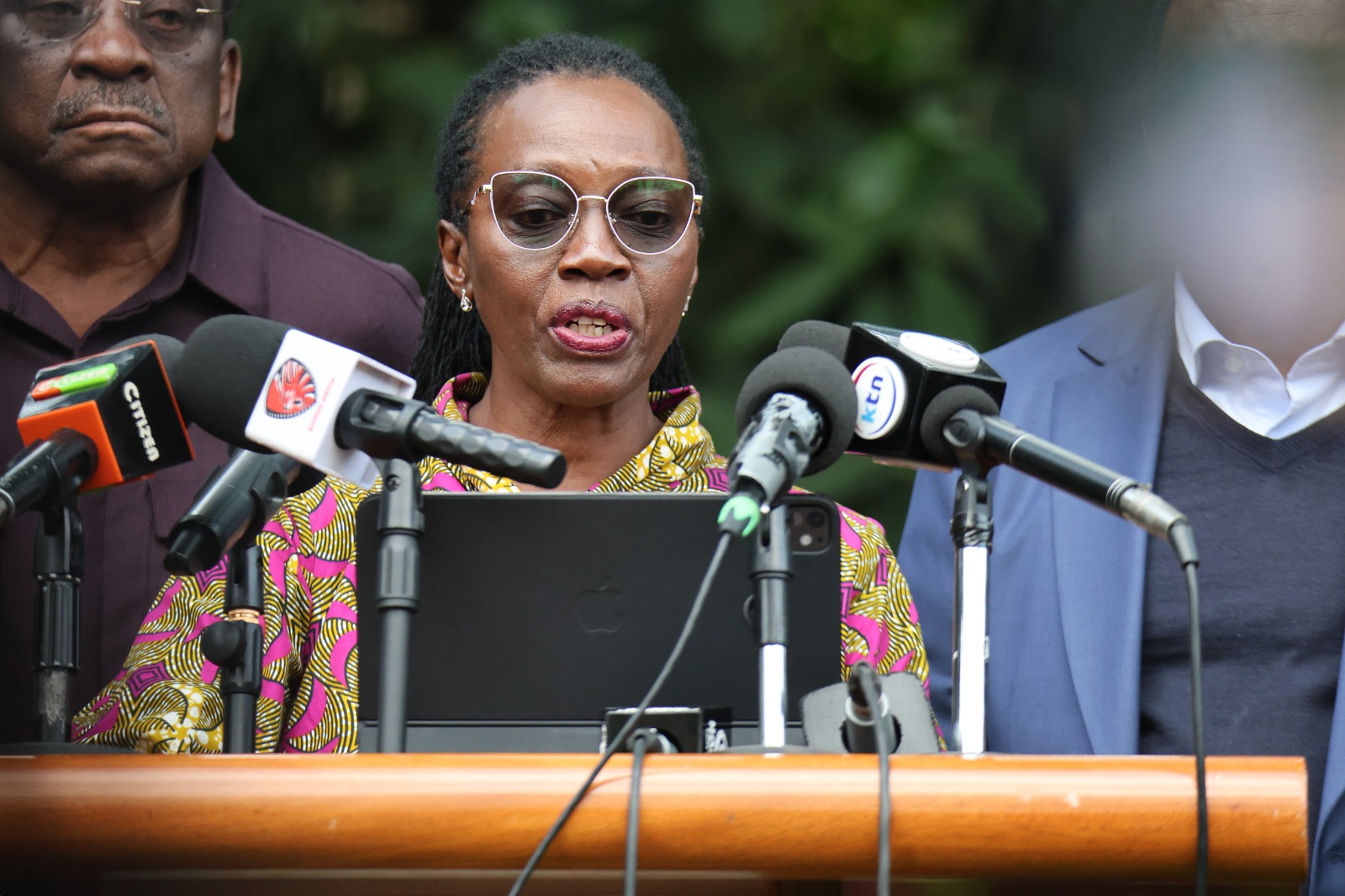
People’s Liberation Party leader Martha Karua reading a joint statement by United Alternative Government on Wednesday during a joint press briefing in Nairobi.
By Peace Muthoka.
NAIROBI, Kenya — August 19, 2026 — The United Alternative Government has raised the alarm over what it describes as a troubling rise in political violence and intimidation across the country, warning that the trend threatens Kenya’s democratic space ahead of the 2027 General Election.
The opposition leaders spoke on Wednesday during a joint press briefing in Nairobi, where they condemned a series of reported attacks and disruptions targeting opposition politicians, journalists and ordinary citizens.
The leaders said the incidents were evidence of growing political intolerance and warned that allowing violence to take root could undermine national cohesion, the rule of law and the constitutional freedoms of Kenyans.
In a statement read by People’s Liberation Party leader Martha Karua, the United Alternative Government cited several incidents involving opposition leaders and political activities in different parts of the country.
They pointed to reported confrontations involving former Deputy President Rigathi Gachagua in Rongai Constituency, Nakuru County, and former Cabinet Secretary Dr Fred Matiang’i in Mulot, Bomet County.
The leaders also raised concerns over reported violence and disruptions during political activities in Homa Bay and Keumbu in Kisii County.
They expressed particular concern over allegations that organised groups were being mobilised to disrupt political gatherings, questioning how such groups could allegedly assemble and operate openly while attacking politicians, journalists, civilians and, in some cases, police officers.

The opposition warned that the incidents should not be dismissed as isolated clashes between rival political supporters, saying they could point to a broader pattern of political violence as the country approaches the 2027 elections.
“We cannot allow violence and intimidation to become part of Kenya’s political culture,” the leaders said, calling for urgent action to protect the country’s democratic space.
They demanded prompt, independent and transparent investigations into all reported cases of political violence and urged security agencies to ensure that anyone found responsible is held accountable, regardless of political affiliation.
The United Alternative Government also appealed to Kenyans, religious leaders, civil society organisations and the media to remain vigilant and firmly reject violence, intimidation and any attempts to undermine democratic freedoms.
The leaders further called on the international community to pay close attention to developments in Kenya as the country moves towards the 2027 General Election.
They urged the Independent Electoral and Boundaries Commission (IEBC), security agencies and other constitutional institutions to discharge their mandates impartially and protect the integrity of the electoral process.
According to the opposition, strong and independent institutions will be crucial in ensuring that the 2027 elections are free, fair, credible and peaceful.
As part of its efforts to strengthen electoral preparedness, the United Alternative Government announced plans to establish a People’s Forum for Electoral Preparedness.
The forum is expected to bring together political parties, civil society organisations, religious leaders, the media and other stakeholders to promote electoral integrity, democratic accountability and public participation.
The initiative will also provide a platform for stakeholders to monitor preparations for the 2027 elections, raise concerns and advocate for measures aimed at protecting the democratic process.
The United Alternative Government reaffirmed its commitment to peaceful political engagement, insisting that the next General Election must be determined by ideas, policies and the ballot rather than violence, intimidation or fear.
The leaders urged Kenyans and political actors to embrace tolerance and respect each other’s democratic rights, stressing that the sovereign will of the people must remain at the centre of the country’s electoral process.