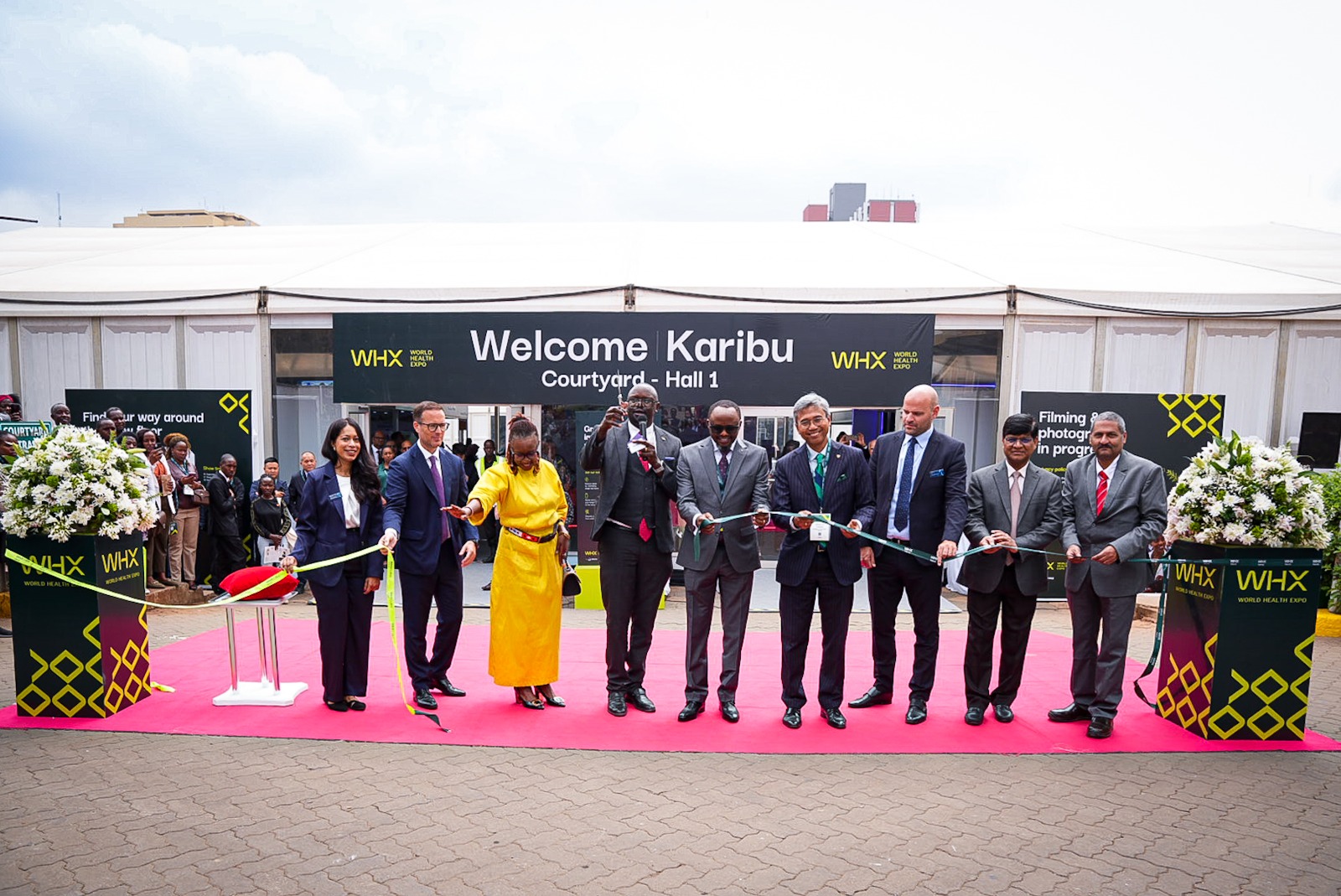
Dr. Joe Lenai, Director for Primary Healthcare, Preventive and Promotive Health, Ministry of Health Kenya; Witjaksono Adji, Indonesian Ambassador to Kenya; and Daniel Green, Exhibition Manager, WHX Nairobi, among other dignitaries, cut the ribbon to officially open WHX Nairobi at the Kenyatta International Convention Centre (KICC), marking the start of the three-day exhibition running from 16–18 September 2026…
By Peace Muthoka
Nairobi, September 16,2026 – Kenya is seeking to strengthen its position as a regional healthcare manufacturing and investment hub as the World Health Expo (WHX) Nairobi 2026 opened at the Kenyatta International Convention Centre (KICC), bringing together manufacturers, healthcare buyers, investors, policymakers and technology providers from across Africa and beyond.
The three-day expo, officially opened on Wednesday, September 16, by Dr Joe Lenai, Director for Primary Healthcare, Preventive and Promotive Health at the Ministry of Health, is placing local manufacturing, stronger supply chains and cross-border partnerships at the centre of discussions on the future of healthcare in East Africa.
Dr Lenai, who represented the Cabinet Secretary, Principal Secretary and Director-General of the Ministry of Health, welcomed international participants and said Kenya viewed them not simply as visitors but as strategic partners in transforming healthcare delivery in the country and across the continent.
“Health is no longer simply a social expenditure. It is an engine of economic growth, an imperative of national security and a fundamental human right,” Dr Lenai said, linking the country’s healthcare reforms to the need for reliable equipment, technology and locally sustainable supply chains.
He said Kenya’s investment in primary healthcare must be matched by practical tools, pointing out that community health promoters need reliable diagnostic equipment, rural maternity units require dependable surgical equipment and medical oxygen, while laboratories need functioning equipment, reagents and reliable power.
That need, he said, creates an opportunity for manufacturers and investors to deepen their presence in Kenya while helping the country reduce vulnerabilities associated with dependence on imported medical products and equipment. The government is also encouraging public health buyers to consider the long-term value of products rather than focusing only on their initial purchase price.
Dr Lenai urged county health leaders, clinicians and procurement officers to assess the total life-cycle cost of equipment, including energy efficiency, maintenance requirements, availability of spare parts and the training offered by suppliers. The approach, he said, would help ensure that equipment remains useful throughout its intended lifespan.
“Africa must no longer be an equipment graveyard,” Dr Lenai said, calling on manufacturers, aggregators and vendors to provide comprehensive service-level agreements covering maintenance and spare parts. He also urged companies to support technology transfer and train Kenyan and African biomedical engineers and technicians.
He further called for partnerships to establish mobile and stationary calibration laboratories, saying such facilities would help ensure medical equipment operates safely and accurately while strengthening local technical expertise.
The expo is also providing a platform for direct engagement between manufacturers and public health buyers, a model Dr Lenai said could help reduce unnecessary intermediary costs. He singled out the India Pavilion, led by the Export Promotion Council for Medical Devices, and the Andhra Pradesh MedTech Zone as examples of international partnerships bringing medical technology and expertise closer to the African market.
India is among the international participants at the expo, alongside exhibitors and stakeholders from countries across Africa, Asia, Europe and the Americas. Indonesia is also represented, with its ambassador highlighting the participation of Indonesian companies and the opportunity to explore business and investment possibilities between the two countries.
The event has also attracted the Africa Centres for Disease Control and Prevention, GE and other regional and international healthcare organisations, alongside government institutions, regulatory bodies, professional boards, research institutions, medical innovators and healthcare businesses.
WHX Nairobi is hosting more than 200 exhibitors from more than 30 countries and is expected to attract more than 5,500 attendees. The exhibition covers areas including medical equipment and devices, imaging and diagnostics, laboratory solutions, pharmaceuticals, healthcare infrastructure, IT systems and healthcare services.
The mix of manufacturers, distributors, procurement professionals, healthcare providers and investors is creating opportunities for companies to identify local distributors, explore manufacturing partnerships and develop supply arrangements across East Africa. The expo’s dedicated networking programme is bringing together buyers, manufacturers, suppliers, distributors and healthcare decision-makers to explore commercial and partnership opportunities.
For Kenya, the conversations go beyond displaying new medical technologies. They are also about how international companies can work with local manufacturers and institutions to transfer skills, establish production and maintenance capacity and build stronger regional supply chains.
The government’s focus on local capacity comes as healthcare systems across the region seek more reliable access to medical equipment, pharmaceuticals and other essential supplies. Stronger local production and regional partnerships could help shorten supply chains while creating opportunities for investment, jobs, technology transfer and the growth of Kenyan healthcare businesses.
Dr Lenai said Kenya welcomed the partnerships emerging from WHX Nairobi and expressed hope that the engagements would translate into stronger local manufacturing capacity, better-equipped health facilities and a more self-reliant African health sector.
As WHX Nairobi continues through September 18, the focus will remain on connecting manufacturers and investors with healthcare buyers and decision-makers. For Kenya, the expo offers an opportunity to turn those connections into long-term investment, local production and cross-border partnerships that can strengthen the country’s role in East Africa’s healthcare economy.