
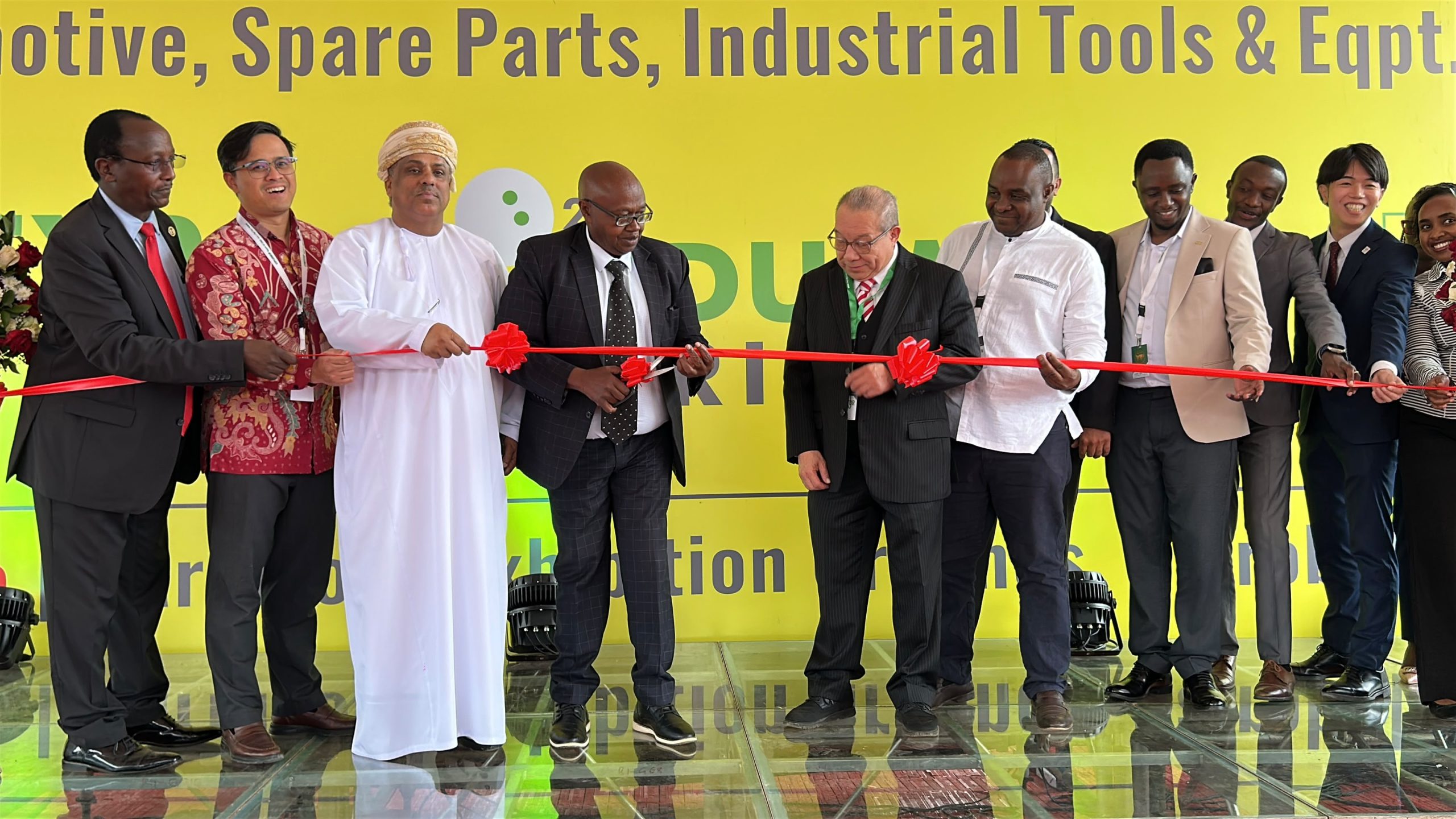
Government officials, industry stakeholders, exhibitors and partners pose for a group photo after jointly cutting the ribbon during the official opening ceremony of AutoExpo Africa 2026 at the Carnivore Exhibition Grounds in Nairobi on Wednesday.
By Peace Muthoka
NAIROBI, June 3, 2026 — The government plans to stop buying fully imported vehicles and instead prioritise those assembled in Kenya as part of renewed efforts to strengthen local manufacturing and grow the country’s automotive industry.
The announcement was made on Wednesday during the opening of the 27th AutoExpo Kenya 2026 at the Carnivore Exhibition Grounds in Nairobi. The three-day exhibition, running from June 3 to 5, has brought together manufacturers, investors, distributors and exhibitors from more than 30 countries across Africa and the rest of the world.
Government officials and industry players attending the expo called for stronger investment in local vehicle assembly and manufacturing, saying Kenya has the potential to become a regional automotive hub if more emphasis is placed on local production and sourcing of components.
Speaking during the official opening of the 27th AutoExpo Kenya 2026, Secretary Administration in the State Department of Industry Samuel Karanja Njora said the government remains committed to supporting initiatives that expand local manufacturing, particularly in the automotive sector, which continues to play an increasingly important role in Kenya’s industrialisation agenda.
Njora said the expo provides an important platform for local manufacturers, startups and investors to interact with international players, explore emerging technologies and identify ideas that can be adapted to strengthen Kenya’s growing industrial base.
“We are here to support stakeholders involved in manufacturing, particularly in automotive, because the government wants to encourage local production of vehicles and motorcycles,” Njora said.
He urged small-scale manufacturers, especially those operating in industrial areas such as Kariobangi, to take advantage of the exhibition by learning from global manufacturers and identifying opportunities for innovation and business growth. However, he cautioned local businesses to comply with international intellectual property laws when adapting ideas from foreign markets.
At the centre of the government’s strategy is the proposed Local Content Bill, which seeks to ensure that some components used in vehicle and motorcycle assembly are sourced locally. Njora said the bill, which has already undergone public participation and received broad support, is now nearing completion and is expected to significantly boost local manufacturing.
Currently, he said, about 14 components used in motorcycle assembly are already being produced locally, including side mirrors and carriers. He noted that Kenya has the capacity to manufacture more automotive parts and that the proposed law will create demand for locally produced products while reducing reliance on imports.
“We have the capacity to make some of these products here. What we want is to grow the number of components sourced locally,” he said.
The government is also seeking to discourage the importation of fully assembled vehicles and motorcycles by encouraging investors to bring in parts for local assembly. In what could mark a major shift in procurement policy, Njora revealed that government institutions will soon only purchase vehicles assembled in Kenya.
“We will stop buying imported vehicles from outside. Government will only buy vehicles assembled locally,” he said, adding that the move is expected to create jobs, expand local industries and strengthen supply chains.
Even so, Njora acknowledged the challenges of competing with countries that are already advanced in industrialisation but said Kenya is investing in technology and research to close the gap. He cited plans for a nanotechnology laboratory at the Kenya Industrial Research and Development Institute (KIRDI) as part of efforts to strengthen innovation and industrial growth.
“We know the struggle of competing with countries already ahead in industrialisation, but we are working hard to catch up,” he said.
Industry players welcomed the government’s renewed push for local sourcing, saying it could unlock business opportunities for Kenyan manufacturers and small enterprises.
Automotive Parts Manufacturers Association of Kenya (APMA) board member Margaret Muchoki said the association has continued working closely with the Ministry of Industry and Trade to strengthen the country’s automotive manufacturing ecosystem. She said APMA represents manufacturers producing components used in vehicles and motorcycles, including batteries, brake pads, filters and carriers.
Muchoki noted that international exhibitions such as the 27th AutoExpo Kenya 2026 provide opportunities for partnerships, investment and skills transfer between foreign companies and local manufacturers, helping strengthen Kenya’s industrial capacity.
“We recognise the role international investors can play through partnerships and transfer of skills,” she said.
She added that the government’s push for local content is already encouraging vehicle assemblers to source products from Kenyan manufacturers instead of relying heavily on imports. According to her, businesses producing items such as batteries stand to benefit significantly if local assemblers increasingly buy from domestic suppliers.
Muchoki said the Automotive Bill, now in its final stages, is expected to strengthen local assembly while creating opportunities for smaller businesses to supply parts to major vehicle assemblers already operating in Kenya.
“If companies are assembling vehicles in Kenya, then local businesses should also have an opportunity to supply the parts,” she said.
As the 27th AutoExpo Kenya 2026 continues in Nairobi, industry players say stronger local sourcing policies could help reduce import dependence, create employment opportunities and position Kenya as a regional hub for automotive manufacturing.