
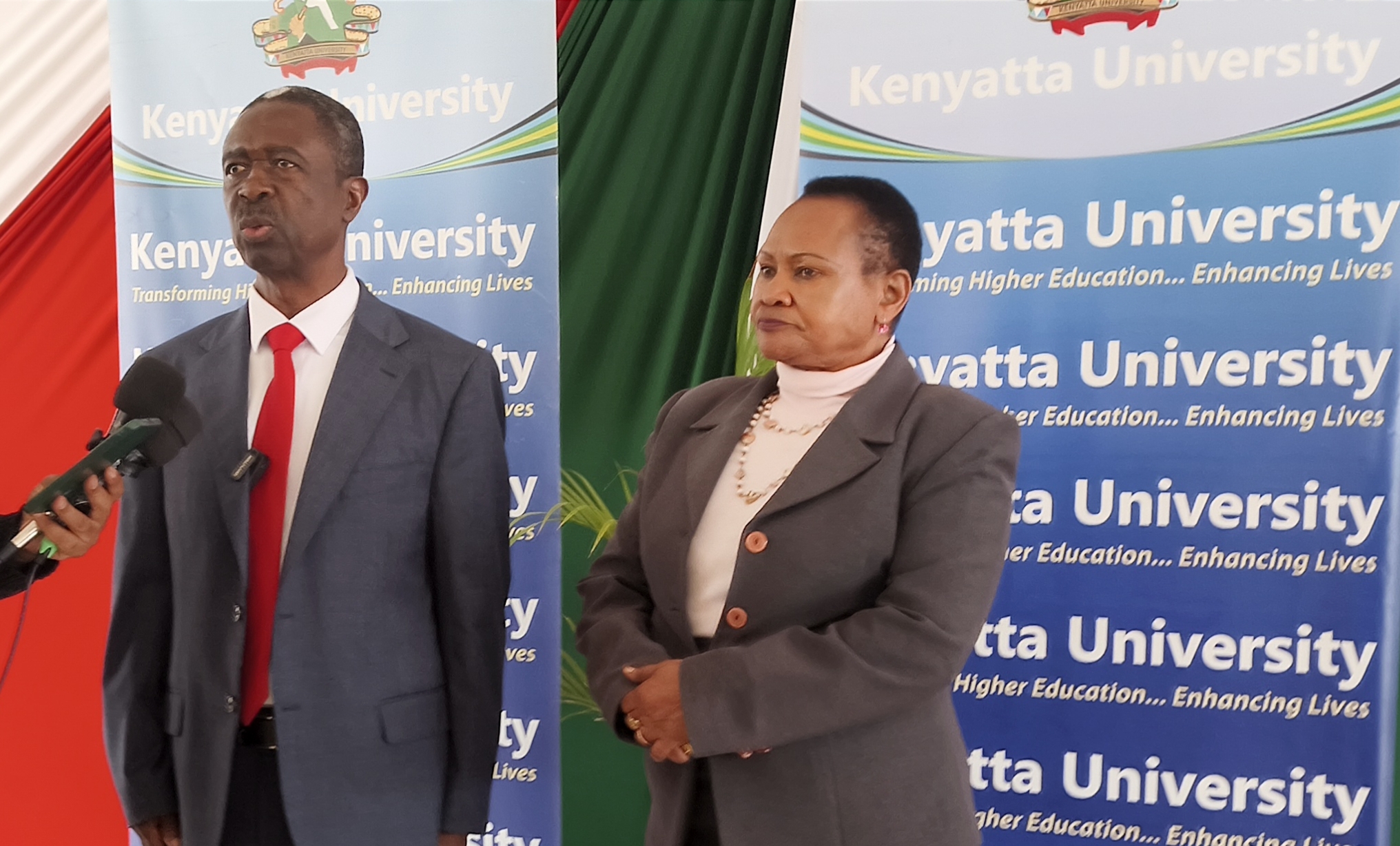
(L-R) Professor John Okumu and University Council Chairperson Professor Clara Momanyi during a media interview at the university’s main campus on July 27, 2026.
By Peace Muthoka
NAIROBI, Kenya — Kenyatta University has ushered in a new chapter after appointing Professor John Okumu as its seventh substantive Vice-Chancellor, with the seasoned academic promising to steer the institution through financial recovery while preparing it for Kenya’s evolving higher education landscape.
The appointment, which took effect on Monday, was announced by University Council Chairperson Professor Clara Momanyi during a ceremony at the university’s main campus attended by members of the Council and senior management.
Prof. Okumu, who had served as Acting Vice-Chancellor for the past six months, succeeds Prof. Paul Wainaina and assumes office at a time when public universities are grappling with financial constraints, curriculum reforms and increasing demand for quality higher education.
Speaking after receiving his appointment, Prof. Okumu thanked the University Council, the Cabinet Secretary for Education and the Kenyatta University community for the confidence they had placed in him.
“I am deeply honoured by the confidence the University Council has placed in me. I am committed to leading with humility, integrity and openness as we work together to strengthen Kenyatta University’s position as Kenya’s premier university and a globally competitive institution,” he said.
He said his administration would remain firmly focused on the university’s three core mandates—teaching, research and community service—while laying the groundwork for the transition to the Competency-Based Education (CBE) system expected to reach universities by 2029.
According to Prof. Okumu, the transition will require significant investment in infrastructure, laboratories, staff training and curriculum reforms to ensure graduates acquire practical and market-driven skills.
“We must begin preparing now because 2029 is not far away. The new system requires different teaching methods, specialised staff and adequate laboratory facilities. We must engage government and other stakeholders to ensure we have the resources needed to fulfil our mandate,” he said.
Even so, the new Vice-Chancellor acknowledged that financial challenges remain one of the university’s biggest obstacles.
He revealed that Kenyatta University has already developed a comprehensive financial turnaround strategy, which has been presented to key stakeholders, and expressed optimism that discussions with the Ministry of Education would help unlock solutions to the institution’s funding challenges.
The university’s financial difficulties, he explained, stem from historical funding gaps and a sharp decline in self-sponsored students after 2016, a revenue stream that had traditionally sustained many public universities.
“We are not sitting back. We have developed a turnaround strategy together with the University Council and management. We are seeking an opportunity to discuss it with the Ministry so that we can address pending bills and restore the university’s financial stability,” he said.
Despite the financial pressures, Prof. Okumu assured parents and students that the quality of education and student welfare would remain top priorities.
He noted that Kenyatta University had received the highest number of government-sponsored student placements this year, with more than 11,200 students expected to join the institution in September, a clear indication that public confidence in the university remains strong.
To improve student welfare, he said the university has partnered with the government to construct accommodation for about 2,500 students under the Affordable Housing Programme, while also committing to transparent student leadership elections and continuous curriculum reviews to meet changing labour market demands.
The Vice-Chancellor also pledged to strengthen collaboration with the Kenyatta University Teaching, Referral and Research Hospital (KUTRRH), saying the existing Memorandum of Understanding has already enabled fifth and sixth-year medical students to undertake clinical training at the facility.
He said the university is seeking expanded access for nursing and other medical students, adding that both institutions have established an implementation committee to oversee the partnership.
Although KUTRRH currently operates as a State corporation, Prof. Okumu noted that discussions on its future relationship with the university remain ongoing following concerns previously raised in Parliament.
Meanwhile, he said filling senior management positions currently held in an acting capacity would be among his immediate priorities.
He expressed confidence that, subject to approvals from the Public Service Commission, key positions including Deputy Vice-Chancellor for Administration and Finance would be substantively filled within the next three months.
University Council Chairperson Prof. Clara Momanyi described Prof. Okumu as a committed and hardworking leader whose performance during his six-month acting tenure convinced the Council that he was the right person to lead the institution.
“It has not been an easy transition, but we thank God that it has been peaceful. We have worked closely with Prof. Okumu over the past six months and have seen his dedication and commitment across many areas of the university. We are confident that he will successfully deliver the university’s mandate,” she said.
Prof. Momanyi acknowledged that Kenyatta University continues to face financial challenges alongside other public universities but said the Council has already intensified efforts to improve the institution’s income-generating activities.
She said the Council recently inspected several university investments and recommended value addition and renovation of underperforming facilities, including student hostels in Ruiru, to boost revenue.
The Council, she added, also remains committed to filling vacant leadership positions and strengthening governance structures to support the university’s long-term growth.