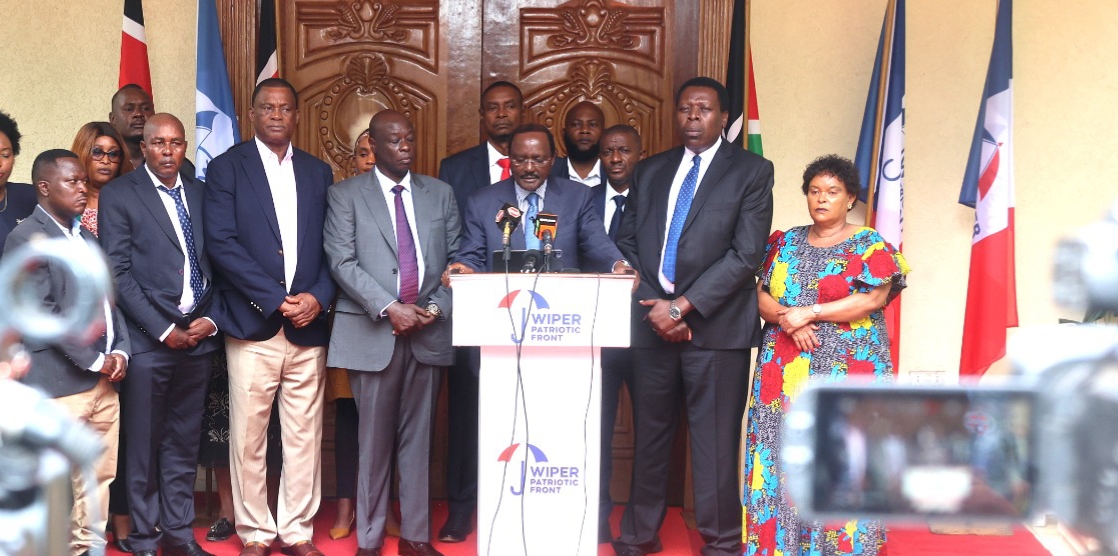
United Alternative Government Leaders Address the Media at SKM Command Center on March 5, 2026
By Peace Muthoka
Nairobi, March 5, 2026 — Leaders of the United Alternative Government have strongly opposed plans to partially divest the government’s stake in Safaricom, warning that the move could weaken national security and strip Kenya of one of its most valuable public assets.
Speaking at a press conference at the SKM Command Center in Nairobi, opposition leaders led by Kalonzo Musyoka, Rigathi Gachagua, Eugene Wamalwa and Justin Muturi criticised the government’s economic proposals contained in Sessional Paper No. 3 of 2025.
The leaders argued that selling even a portion of the state’s stake in Safaricom would amount to “selling Kenya’s crown jewels” to address short-term fiscal pressures.
They said the telecommunications giant is not just a commercial enterprise but a strategic national asset that powers the country’s digital payments ecosystem through M-PESA.
According to the opposition, Safaricom also hosts several critical government platforms, including National Integrated Identity Management System, Huduma Namba and the online services portal eCitizen.
They warned that reducing government ownership without strict controls on who acquires the shares could expose the country to national security risks.
“Safaricom’s infrastructure supports government payments, identity systems and communication channels that touch on national security,” the leaders said.
They noted that in the 2024 financial year, Safaricom declared dividends totaling KSh48.08 billion, a significant portion of which went to the government.
Selling the stake, they argued, would be similar to a family disposing of its most productive farm to cover routine household expenses.
“The income-generating asset is permanently lost, yet the budget deficit will return the following year,” they said.
The opposition further questioned the government’s preparedness to handle such a major divestiture, citing the troubled initial public offering of Kenya Pipeline Company as a cautionary example.
They said the process surrounding the KPC IPO raised serious concerns, including contested pricing, lack of transparency in advisor selection and limited participation by retail investors.
“If the government struggled to execute a pipeline company IPO with credibility, how can Kenyans trust it to manage a partial sale of Safaricom or oversee a multibillion shilling National Infrastructure Fund?” the leaders asked.
The opposition also rejected the proposed National Infrastructure Fund Bill, saying it was constitutionally flawed and unnecessary.
They argued that the fund would duplicate existing financing structures and create additional governance risks without addressing existing gaps in accountability.
As a result, the leaders called on Parliament to reject the bill entirely and commission an independent constitutional review to assess whether it complies with Article 206 of the Constitution.
They also demanded that the National Treasury account for all existing extra-budgetary public funds before introducing new financial mechanisms.
On Safaricom, the opposition urged lawmakers to reject Sessional Paper No. 3 of 2025 and push for a comprehensive independent review of the government’s strategic assets before any divestiture is considered.
They further called for full disclosure of the engagement terms for transaction advisors and an independent valuation of the government’s stake in the telecommunications company.
In addition, the leaders demanded a national security assessment on the implications of reduced state ownership and insisted that any proposal must undergo full public participation in line with Article 118 of the Constitution.
The opposition also urged Parliament to investigate the Kenya Pipeline Company IPO through the Public Investments Committee.
They said the inquiry should examine pricing methods, advisor selection processes, underwriting practices and the level of retail investor participation.
Finally, the leaders called for a suspension of all government asset monetisation plans until Parliament approves a comprehensive National Asset Management Policy.
They also urged reforms at the Privatisation Commission before it is entrusted with handling transactions involving assets of national importance.
The opposition said such safeguards are necessary to protect strategic public investments and ensure transparency in decisions affecting the country’s economic future.