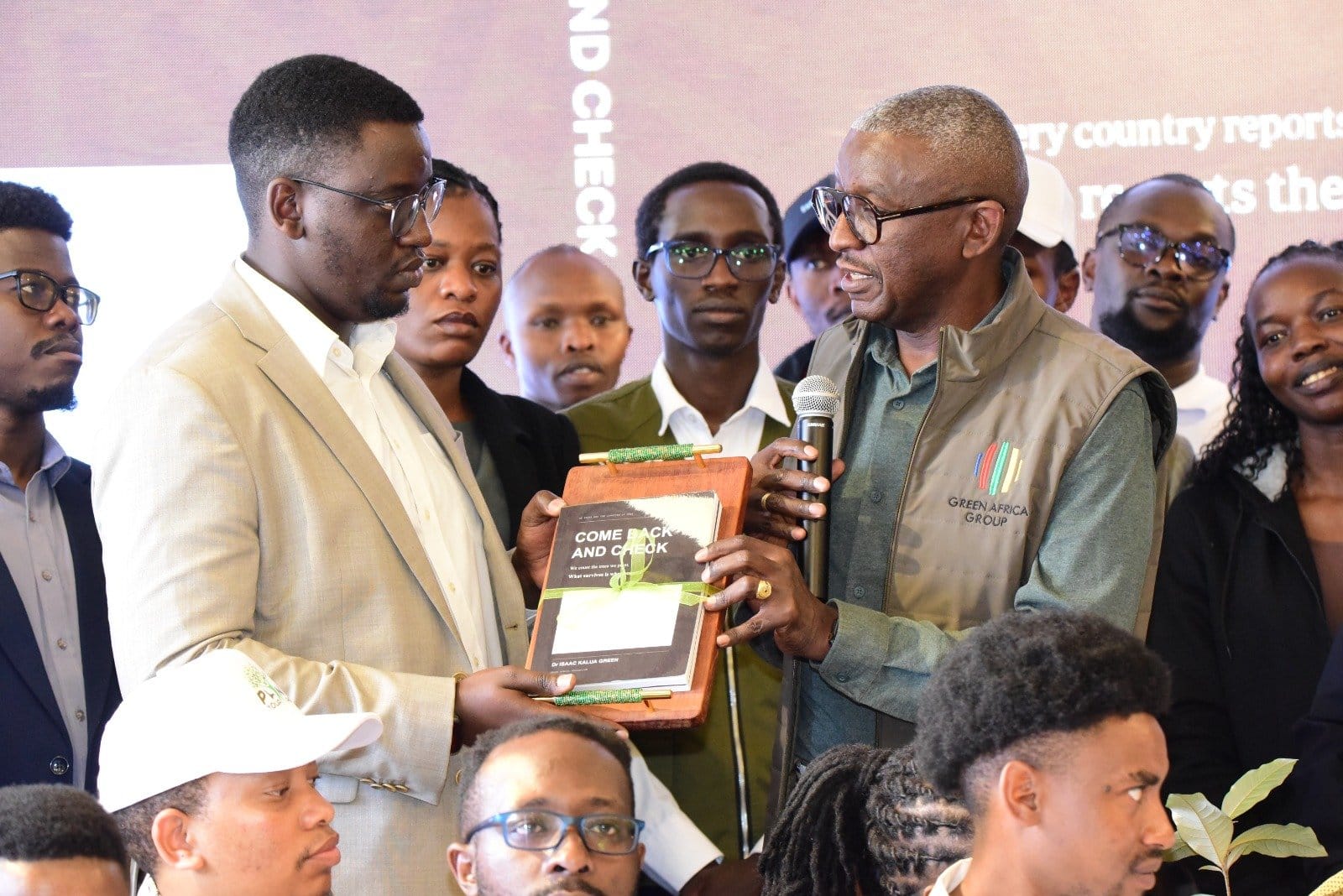
Dr Isaac Kalua Green ( Centre) : Kenya Must Count Trees That Survive, Not Just Those Planted
By Peace Muthoka
NAIROBI — Kenya must shift from counting trees planted to tracking those that survive, environmentalist Dr Isaac Kalua Green has said, warning that the country risks wasting money and resources if tree-growing campaigns end with planting ceremonies.
Kalua said the success of Kenya’s 15 billion tree-growing campaign should not be measured by the number of seedlings put into the ground, but by how many survive, who takes care of them and what benefits they eventually provide to communities and the environment.
“Do not count what you planted. Count what survived. Then come back and check,” Kalua said, explaining the central message of his book, Come Back and Check.
He said the accountability gap was not unique to environmental programmes, arguing that governments and organisations routinely report what they have started or promised without returning to establish what remains a year later.
“Every country reports the trees it plants. None reports the ones still alive,” he said.
For Kalua, the issue goes beyond environmental conservation. It is about whether individuals, institutions and governments are willing to take responsibility for what they claim to have achieved.
“Between what the world announces and what actually survives lies the largest unaudited space on earth,” he said.
Kalua, who has spent about five decades growing trees and has served in Kenya’s public institutions, said his own experiences had taught him the importance of questioning even information that one strongly believes to be true.
He recalled believing for 13 years that a tree in Kenya’s Mau Forest was exactly his age before a forester corrected him while he was working on his book. Instead of hiding the mistake, Kalua said he retained the correction as an example of the need for honesty and verification.
“The first unchecked number he confronts is his own,” he said.
He has similarly subjected the Plant Your Age movement to scrutiny, putting its reported central estimate of about 981 million tree-growing contributions since 2011 within a wider range of roughly 700 million to 1.2 billion as at June 30, 2026.
Kalua stressed that the figure represents tree-growing contributions and should not be confused with an independently verified number of living trees. He said his own Seven Questions found that only two questions could be answered, and even those only partially.
Rather than presenting the figures as unquestionable, he said he had published the limitations and invited independent institutions to examine the records.
“I want to be accountable to the world. Come back and check,” he said.
His call for scrutiny is rooted partly in his own experience in the tree nursery business, which he said once helped him buy the Mercedes-Benz he had wanted since childhood.
Although his business records could show how much money the nursery had generated, he said they could not tell him what happened to seedlings after they left his hands.
That experience informed his argument that planting alone does not guarantee survival.
“Trees endure only where people have both a reason and the means to keep them alive,” he said.
Kalua said environmental programmes must therefore connect conservation with livelihoods, responsibility and economic opportunities. He cited agriculture, food, medicine, energy, tea, coffee, avocado, macadamia and mangoes among the areas in which trees play an important role.
He also questioned the practice of providing seedlings for free without considering the people who produce them, saying such an approach could undermine young entrepreneurs operating tree nurseries.
“We are discouraging young people who are doing tree production. We are discouraging young people who would want to earn a living with that,” he said.
At the same time, Kalua criticised the allocation of funds for planting without sufficient resources for nurturing trees afterwards.
“I have seen in my own eyes where there is no budget for growing the trees but there is budget for planting the trees,” he said.
He warned that without proper planning and accountability, it would also be difficult to build credible financing models for green initiatives because investors need evidence that environmental projects are producing lasting results.
To address the accountability gap, Kalua has proposed tools including the Seven Questions, the Count What Survives Standard, an Evidence Ladder and a Living Tree Account.
The tools seek to establish what was done, where it happened, who was responsible, what survived and how confidently the results can be verified. He said losses should remain in the record, while replacement trees should be counted separately and evidence dated.
His proposed Stake Gradient, he added, is a hypothesis for researchers to test on whether a person’s stake in a tree’s future influences the care it receives.
Kalua said the principle of returning to check should also extend beyond trees to institutions, businesses, families and personal commitments.
In his book, he describes this as the “Law of the Second Visit”, arguing that starting a project is not the same as ensuring that it succeeds.
Through the Plant Your Age movement, he wants people to turn birthdays and other personal milestones into opportunities to create a living legacy by growing trees equivalent to the number of years they have lived, while also committing to their care.
That message was reinforced by Hillary Kiplagat Kibiwott, the official ambassador for Kenya’s 15 Billion Trees Campaign, who urged Kenyans to take personal ownership of the national tree-growing target.
Kibiwott, who said he holds a world record for planting the most trees individually in 24 hours, said the Plant Your Age initiative gives people an opportunity to turn personal celebrations such as birthdays, anniversaries, graduations and other achievements into environmental action.
“If I am 20 years, for example, I can grow 20 trees. If I am 30, I can grow 30 trees,” he said.
He said the strength of the initiative lies in turning individual commitments into collective action, noting that millions of Kenyans taking responsibility could make the 15 billion tree target achievable.
“Fifteen billion trees are doable,” he said, repeatedly urging Kenyans to embrace the target.
However, Kibiwott agreed with Kalua that planting should only be the beginning, saying the real measure of success must be the trees that survive and continue to provide environmental and social benefits.
“We must ask ourselves, how many survived? Who is taking care of them? Where are they located? Are they growing? And what impact are they creating?” he said.
He called for a change from tree planting to tree growing and from one-day activities to year-round environmental stewardship.
Kibiwott said the 15 billion tree-growing campaign should not be regarded as a government programme alone but as a national responsibility involving citizens, schools, communities, faith-based organisations, farms and workplaces.
“Let us change the conversation from what is government doing about the 15 billion trees to what am I doing to help Kenyans grow its 15 billion trees,” he said.
He said the campaign should ultimately restore degraded landscapes, protect forests and water catchments, strengthen climate resilience, conserve biodiversity and secure a healthier environment for future generations.
As Kenya prepares for the upcoming Mazingira Day, Kibiwott urged households, institutions and communities to prepare early by identifying planting sites and obtaining seedlings before the rains begin.
“We should not wait until Mazingira Day to start looking for the seedlings. We should not wait until the rains arrive before we identify the site,” he said.
He urged Kenyans to use the anticipated short rains to give newly planted trees the best possible chance of survival.
Kibiwott also pointed to his own environmental conservation journey, saying that through tree growing, landscape restoration and community mobilisation, he had contributed to growing more than 3.3 million trees, with a reported survival rate of up to 90 per cent.
He said the experience had shown him that significant environmental achievements are possible when communities remain committed and consistent.
“This journey has never been about numbers alone. It has been about creating a culture of environmental responsibility, particularly among young people and communities,” he said.
The message from both environmental champions was clear: Kenya’s ambition to grow 15 billion trees will require more than impressive planting figures.
It will require people to return to the sites, measure survival, provide care, keep accurate records and take responsibility for the trees long after the cameras and planting ceremonies are gone.