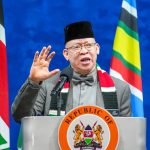

NCIC Chairperson Bishop Dr Kepha Omae
By Peace Muthoka
NAIROBI — Kenya must act early to prevent election-related tensions from escalating into violence ahead of the 2027 General Election, the National Cohesion and Integration Commission (NCIC) has said.
NCIC Chairperson Bishop Dr Kepha Omae said the country cannot afford to wait for violence to occur before responding, urging political leaders, security agencies, communities and other stakeholders to identify and address warning signs early.
Omae said the 2027 polls provide Kenya with an opportunity to demonstrate that peace and democracy can coexist, but this will require deliberate efforts to protect national unity throughout the electoral period.
“We must shift from reaction to prevention and from scattered efforts to coordinated response. Violence does not begin on election day; it is often preceded by warning signs that can be mitigated in good time,” Omae said.
He added: “Sometimes the greatest achievement is the crisis that never happens.”
Omae was speaking in Nairobi on Monday during the two-day Amani Conference, which brought together national stakeholders to assess measures for peaceful elections and strengthen cooperation ahead of the 2027 polls.
As political parties begin positioning themselves for the next election, Omae cautioned leaders and their supporters against language that could deepen divisions among communities.
He urged politicians to make policies and ideas the centre of their campaigns instead of turning political competition into a contest based on ethnic or other identities.
“Criticize policies, not communities. Challenge ideas, not identities. Let every campaign season be a contest of vision, not a contest of division,” he said.
The NCIC chairman said peace should not be treated as an election-day concern, but as a responsibility that begins well before campaigns intensify and continues after the results are announced.
His call for early intervention was reinforced by Police Deputy Inspector General Gilbert Masengeli, who said maintaining security during elections cannot be left to law enforcement agencies alone.
“Security starts with you. A peaceful election cannot be secured by security agencies alone; it requires citizens to work with security actors and take responsibility for the information they consume and share,” Masengeli said.
Masengeli’s remarks highlighted the role of citizens in preventing tensions, particularly through responsible handling and sharing of information that could inflame political or community differences.
Registrar of the Office of the Registrar of Political Parties (ORPP) John Cox similarly urged political actors and Kenyans to uphold the rule of law, warning against allowing political competition to weaken national cohesion.
“Together, we can change course from a dangerous and destructive path and choose instead the path of the rule of law, cooperation, responsibility and peace. Elections will come and go, but Kenya will remain,” Cox said.
National Parties Liaison Committee Chairman Evans Misati said the country also needs to strengthen preventive mechanisms instead of relying heavily on sanctions after tensions have already escalated.
“Sanctions only respond after damage has been done. What we need are preventive standards that build peace in our minds long before conflict arises,” Misati said.
The conference also placed young people at the centre of discussions on peaceful elections, with stakeholders warning against their exploitation during political campaigns.
World Vision East Africa Regional Leader Lilian Dodzo urged political leaders and communities to protect young people from being drawn into political conflicts, saying their future should not be sacrificed for short-term political interests.
“A country can repeat an election, but a child cannot repeat their childhood. Young people must never be reduced to instruments of political competition. Their future is bigger than any election,” Dodzo said.
She called for greater investment in peacebuilding and youth protection, stressing that preventing election-related violence requires sustained cooperation among different sectors of society.
The need for joint action was further emphasised by UNDP Kenya Resident Representative Dr Jean-Luc Stalon, who said no single institution can build and sustain peace on its own.
“Peacebuilding is not the responsibility of one institution alone. It is a shared responsibility that requires dialogue, partnership and collective action,” Stalon said.
The Amani Conference brought together stakeholders from the security, electoral, political, justice, religious and development sectors, including the Kenya Judiciary, National Police Service, ORPP, Office of the Director of Public Prosecutions, Independent Electoral and Boundaries Commission, UNDP, World Vision and the Inter-Religious Council of Kenya.
Religious leaders also called on politicians to put the interests of the country ahead of partisan politics.
Bishop Dr Geoffrey Njuguna said political leaders and parties should remember that their positions are temporary while the country remains.
“We must remind our politicians that no politician is bigger than Kenya, and no political party is bigger than Kenya. Kenya comes first, always,” Njuguna said.
The stakeholders also called for greater coordination in implementing peace initiatives, including the National Peace Charter, as part of preparations for the 2027 elections.
Omae said the focus should now shift from commitments and statements to practical action capable of preventing conflict before it takes root.
The conference ended its first day with stakeholders reaffirming their commitment to an Elections Bila Noma 2027 and calling for peace before, during and after the elections.
With political activity expected to intensify as the country moves closer to the 2027 polls, the stakeholders said Kenya’s ability to avoid election-related violence will depend largely on how early warning signs are recognised and how quickly political, security and community leaders respond.
For NCIC, the priority is clear: prevention must begin long before Kenyans walk into polling stations, because by the time violence starts, opportunities to prevent it may already have been lost.