
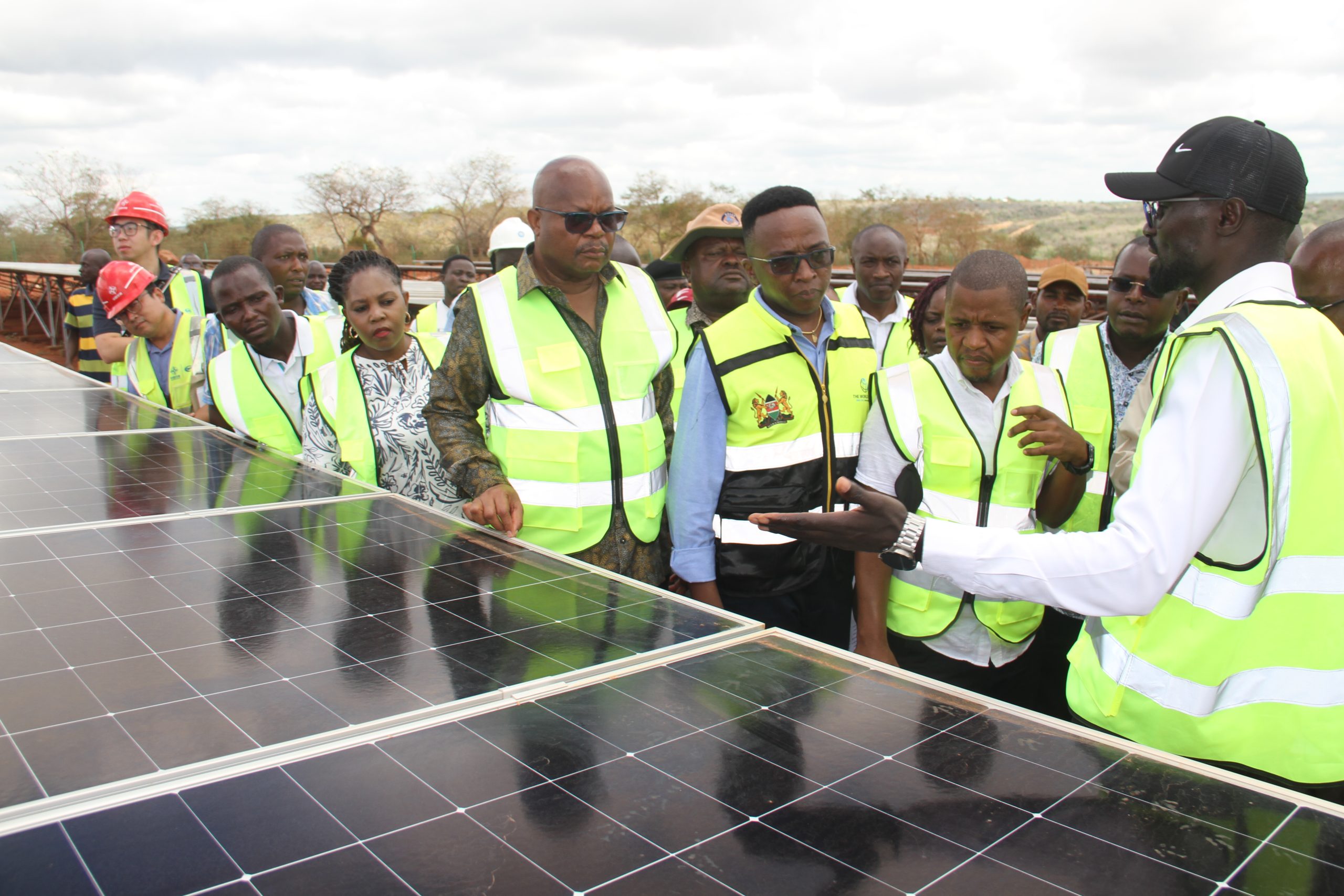
Cabinet Secretary for Water, Sanitation, and Irrigation Eric Murithi (wearing black cap) gets update of the World Bank Sponsored Water and Sanitation Development Project,
Baricho Solarization from the officials of Coast Water Works Development Agency (CWWDA) during his
tour of the project in Kwale and Kilifi Counties.
By Peace Muthoka
A major solar project at Baricho Water Works is set to transform water supply across Kenya’s Coast, offering hope for cheaper and more reliable water to millions of residents who have struggled with shortages for years.
The Baricho Solarization Project is now 90 percent complete and is expected to significantly cut the high electricity costs required to pump water across the region.
Water, Sanitation and Irrigation Cabinet Secretary Eric Murithi announced the progress during an inspection tour of the facility in Kilifi County.
For decades, electricity costs have been one of the biggest obstacles to providing consistent water supply at the Coast. The region’s geography makes the challenge even harder because most areas lie in low-lying land. As a result, water must be pumped over long distances before it reaches homes and businesses.
Murithi said the cost of powering the system has been extremely high. “We have been having problems with the electricity bill because we are in low-lying lands and water has to be pumped,” he said.
Currently, the Coast Water Works Development Agency spends between Sh60 million and Sh70 million every month on electricity to operate the Baricho system. The cost is ultimately borne by water service providers supplying Mombasa County, Kwale County and Kilifi County.
The new solar project aims to ease that financial burden while improving water supply reliability.
Across the Baricho site, thousands of solar panels now stretch across the landscape, capturing the region’s strong sunshine to power water pumping operations. Murithi said 6,716 solar panels have already been installed, with the remaining work expected to be completed within a week.
“We have set up 6,716 panels at the solar farm and some systems are already running on solar power,” he said.
Once fully operational, the solar facility will generate about 4.3 megawatts of electricity. The energy will be used to pump water from 11 boreholes in Baricho to collection points that distribute water across the coastal counties.
Engineers working on the project estimate the solar installation will reduce electricity costs by at least 20 percent. The savings could ease financial pressure on water utilities and improve service delivery for residents.
Murithi said the project is part of a broader government effort to expand access to water while reducing operational costs in the sector.
He noted that the initiative also delivers on a commitment made to coastal residents by President William Ruto.
“President William Ruto promised the residents of Kwale, Mombasa and Kilifi that one day they will have water and that the electricity costs would not be high,” Murithi said.
However, the Cabinet Secretary acknowledged that the current solar installation will only meet a fraction of the system’s total energy demand.
“It will produce 4.3 megawatts of power, but that is only about 20 percent of the total power requirement,” he said.
To fully solve the challenge, the government plans to expand the project through additional phases. Murithi said phase two and phase three of the solarization programme will increase energy production and improve efficiency.
Energy storage will also play a critical role.
“We need phase two and phase three of the solarization to address the problem well. We also need to store the power in lithium batteries,” he said.
The government is also planning to run the system through a hybrid model that combines solar power with electricity from the national grid supplied by Kenya Power.
Under the hybrid system, pumps will operate on solar energy during sunny periods while the national grid will provide backup when needed.
Murithi said the approach will make the Baricho system more efficient and protect it from fluctuating electricity costs.
For the Coast Water Works Development Agency, the project represents a crucial step toward solving one of the region’s most persistent problems.
Chief Executive Officer Hamoud Mguza said the solar initiative will strengthen water supply systems that millions of coastal residents depend on every day.
“This project will go a long way in addressing one of the most pressing problems in the region,” Mguza said.
However, he cautioned that the long-term success of the system depends on financial sustainability.
Maintaining solar infrastructure and running water treatment and pumping systems requires consistent funding. Mguza therefore urged residents to pay their water bills to support the continued operation of the system.
“The solar system also needs maintenance. We want people to pay their water bills so that we can continue to provide the commodity smoothly,” he said.
He also revealed that the agency faces significant outstanding debts from water service providers and county governments. According to Mguza, billions of shillings remain unpaid, affecting the agency’s ability to invest further in infrastructure.
Clearing those debts, he said, would strengthen the region’s water supply system and support future expansion projects.
At the county level, leaders say residents are eager to see real change. Flora Chibule said communities across Kilifi have endured years of unreliable water supply despite paying their bills.
“Residents want action,” Chibule said. She noted that the county government inherited significant electricity bills from previous administrations, which have slowed efforts to improve water services.
Many residents, she added, continue to express frustration over paying water charges while still facing dry taps. “Residents are complaining that they pay their bills, but they still do not get water,” she said.
Despite the challenges, Chibule expressed optimism that the Baricho solar project could mark a turning point for the region.
She said the county government will continue working closely with the national government to ensure the project delivers real benefits to residents.
“As a county government, we will continue to work with the national government to ensure our people get water,” she said.
For millions of coastal residents who have endured years of water shortages, the nearly completed solar farm at Baricho represents more than just a new infrastructure project. It signals a shift toward a more sustainable, affordable and reliable way of delivering one of life’s most essential services.